Rhizome Containment
Use a deep, smooth-sided container or root barrier at least 30–40 cm deep to confine the spreading rhizomes and tubers so you can manage the plant without it invading nearby beds or lawn.

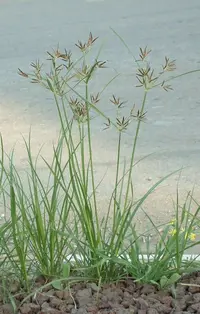
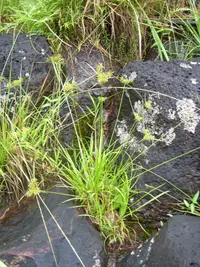
Nutgrass, Cyperus rotundus, is a perennial sedge with narrow, grass-like leaves and a spreading underground network of tubers and rhizomes. It forms dense patches rather than growing as a single clump.
This species is native to parts of Africa, Europe, and Asia but has spread widely in warm and subtropical regions, especially in disturbed soils and lawns. It is often considered a persistent weed because it spreads aggressively and is hard to remove once established.
Nutgrass tolerates poor, compacted soils and a range of moisture levels, which makes it very resilient. Understanding how to care for nutgrass is mainly useful for controlling its spread or managing it in specialized collections.

Care Difficulty
Moderate Care

Light Preference
Full Sun

Water Requirements
Regular Water

Temperature Preference
Tropical / Frost Sensitive

Hardiness Zone
8–11

Soil Texture
Sandy, Loamy, Clay

Soil pH
Acidic (5.5–6.5), Slightly acidic (6.5–7.0)

Soil Drainage
Moist but well-drained

Fertilization
Minimal (feed rarely)
Scan your plant to receive care tips personalized for your specific plant
Available on iOS and Android
Cyperus rotundus thrives in strong light but adapts to a range of outdoor sun exposures.
Cyperus rotundus prefers consistently moist soil but tolerates short dry spells once established.
This species performs best in warm conditions and declines quickly in cold or frost.
This sedge prefers moderately humid air but usually tolerates a wide range if soil moisture is kept steady.
Cyperus rotundus grows best in consistently moist, loose soil that never becomes waterlogged or fully dry.
This species can be grown in containers outdoors where its spread and moisture can be controlled more easily than in open ground.
Cyperus rotundus grows vigorously with minimal feeding but responds to light, balanced nutrition in containers or poor soils.
Pruning Cyperus rotundus focuses on tidying and limiting spread rather than shaping ornamental growth.
Transplanting or repotting Cyperus rotundus is mainly relevant where it is intentionally contained, since it spreads aggressively via tubers.
Expansion of Cyperus rotundus usually occurs through its own tuber system, so deliberate propagation is rarely necessary in gardens.
Cyperus rotundus is a warm-season species whose underground tubers survive mild winters but are vulnerable to hard freezes.

Plant Health Check
Not sure what's wrong with your plant? Check your plant's health inside the app.
This species forms hard, dark tubers linked in chains or clusters along its rhizomes, which store starch and allow the plant to resprout repeatedly after cutting or drought.
It uses C4 photosynthesis, a carbon-fixing pathway that makes it highly efficient in hot, sunny environments and helps explain its success as a weed in tropical and subtropical agriculture.
Archaeological evidence from ancient Egypt shows its tubers were sometimes eaten in times of scarcity and also used as a source of aromatic materials, although it was already recognized as a troublesome field weed.

Genetic studies across multiple continents show that many populations of this species are extremely similar at the DNA level, suggesting a relatively recent and rapid global spread strongly linked to human agriculture and soil movement.
Yellowing leaves usually come from water stress, nutrient-poor soil, or root damage from cultivation. Check for compacted or waterlogged ground, adjust irrigation, and avoid frequent tilling that slices the underground tubers and weakens new shoots.
Keep your plants happy and healthy with plant identification, disease detection, and easy care guidance.