Cool root management
Lay a 2–5 cm layer of light-colored, airy mulch such as shredded pine bark around the clump each spring to keep roots cool, conserve moisture, and protect emerging shoots from rapid temperature swings.

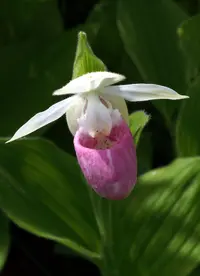
Showy lady's slipper, Cypripedium reginae, is a hardy terrestrial orchid native to cool, moist habitats in northeastern North America. It grows in wetlands, bog edges, and damp woodland openings. The plant forms clumps of upright stems with broad, ribbed green leaves and striking pouch-shaped flowers in white and pink. It has a slow growth rate and can be long-lived when given stable conditions. This species is considered challenging, mostly because it dislikes heat, root disturbance, and drying out. Gardeners who learn how to care for Showy lady's slipper focus on cool temperatures, consistently moist but well-aerated soil, and light shade.

Care Difficulty
Hard Care

Light Preference
Partial Shade

Water Requirements
Keep Soil Moist

Temperature Preference
Cold Hardy

Hardiness Zone
3–7

Soil Texture
Loamy, Silty, Organic-rich

Soil pH
Strongly acidic (4.5–5.5), Acidic (5.5–6.5)

Soil Drainage
Moist but well-drained

Fertilization
Minimal (feed rarely)
Scan your plant to receive care tips personalized for your specific plant
Available on iOS and Android
This hardy temperate orchid prefers bright, gentle light that mimics an open woodland edge.
This species needs consistently moist but not waterlogged soil throughout the growing season.
This cold-hardy orchid thrives in cool to mild conditions with distinct seasons.
This species prefers cool, moist air but usually adapts to average outdoor humidity where hardy perennials grow.
This hardy terrestrial orchid needs consistently moist, airy, organic-rich soil that never becomes waterlogged.
This species can be grown in containers outdoors, but success depends on careful moisture and temperature management.
This hardy terrestrial orchid needs modest feeding, mainly to support steady growth in nutrient-poor soils.
Pruning needs for Cypripedium reginae are minimal and focus on hygiene rather than shaping.
This species is usually grown in the ground, so attention focuses on careful transplanting rather than frequent repotting.
Division is the most practical method for increasing Cypripedium reginae, while seed propagation is highly specialized.
This orchid is naturally cold hardy in much of its native range but benefits from modest winter preparation.

Plant Health Check
Not sure what's wrong with your plant? Check your plant's health inside the app.
This orchid naturally occurs in cold, lime-rich fens and bogs of northern North America, where it grows in cool, slowly moving groundwater rather than typical garden soils.
The pouch-like labellum forms a slipper-shaped trap for visiting insects, which must exit through narrow openings that force them past the flower’s reproductive organs, improving pollination efficiency.
In many US states and Canadian provinces this species is legally protected due to habitat loss and past over-collection, and wild plants must not be dug, picked, or disturbed.

Individual plants can persist for many decades in the wild, slowly forming large clumps from their underground rhizomes, and some documented colonies are thought to be older than the surrounding forest trees.
Lack of blooms usually comes from plants being too young, planted too deep, or stressed by recent division. Inadequate winter chilling, nutrient-poor soil, or disturbance of buds in early spring can also prevent flowering for a season or two.
Keep your plants happy and healthy with plant identification, disease detection, and easy care guidance.