Mandatory plant spacing
Space plants at least 60–90 cm apart to ensure strong air circulation, which lowers the risk of fungal spots on leaves and pods.

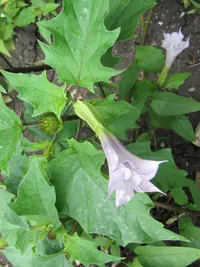
Jimsonweed (Datura stramonium) is a fast-growing annual herb that often appears as a weedy plant in disturbed soils, roadsides, and abandoned fields. It is native to parts of the Americas but is now naturalized in many temperate and subtropical regions.
The plant has coarse, toothed leaves, thick hollow stems, and large white to purple funnel-shaped flowers that open mainly at night. Spiny, egg-shaped seed pods follow the flowers and split open when mature.
Datura stramonium is hardy and can be easy to establish, but it self-seeds aggressively and is highly toxic, so it is rarely recommended for casual gardens. Those who care for jimsonweed must monitor unwanted seedlings and handle the plant with caution.
It prefers full sun, well-drained soil, and moderate moisture, and tolerates poor soil conditions once established.

Care Difficulty
Moderate Care

Light Preference
Full Sun

Water Requirements
Moderate Water

Temperature Preference
Tropical / Frost Sensitive

Hardiness Zone
5–9

Soil Texture
Sandy, Loamy, Organic-rich

Soil pH
Acidic (5.5–6.5), Slightly acidic (6.5–7.0)

Soil Drainage
Well-drained

Fertilization
Minimal (feed rarely)
Scan your plant to receive care tips personalized for your specific plant
Available on iOS and Android
This sun-loving annual thrives in strong light but benefits from some protection from extreme afternoon exposure.
This species prefers evenly moist, well-drained soil and is sensitive to prolonged saturation.
This warm-season plant grows best in stable, frost-free conditions.
This species tolerates a wide humidity range and usually does not need special humidity management outdoors.
This species grows best in light, well-drained mineral soils that do not stay waterlogged.
This species can be grown in containers if provided with adequate root space and stability outdoors.
Datura stramonium grows vigorously in average soil and only needs modest feeding in cultivation.
Pruning Datura stramonium is mainly done to manage size, remove damage, and guide branching.
This fast-growing annual or short-lived perennial is usually direct-sown or transplanted rather than long-term potted.
Datura stramonium is most commonly propagated from seed, which germinates reliably under warm conditions.
In most climates Datura stramonium behaves as a frost-sensitive annual and does not need complex winter care.

Plant Health Check
Not sure what's wrong with your plant? Check your plant's health inside the app.
This species produces high levels of tropane alkaloids such as atropine, hyoscyamine, and scopolamine, which interfere with the parasympathetic nervous system and make all plant parts highly poisonous to humans and animals.
It behaves as a fast-growing annual weed that rapidly colonizes disturbed soils such as roadsides, farm edges, and waste sites, producing many seeds that can persist in the soil seed bank for several years.
Its large, white, tubular flowers typically open in the evening and emit a strong scent that attracts nocturnal pollinators, especially moths, which can reach the nectar deep inside the floral tube.

Archaeobotanical and historical evidence indicates that this plant was introduced from the Americas to parts of Europe by the 16th century, where its striking appearance and powerful toxicity led to a long-standing association with witchcraft, poisonings, and later pharmacology research on the nervous system.
All parts of this species are highly toxic to humans and animals due to tropane alkaloids affecting the nervous system. Ingestion or inhalation of smoke from burning material can cause severe illness or death. Handle cautiously and avoid contact with children and pets.
Keep your plants happy and healthy with plant identification, disease detection, and easy care guidance.