Control Sprawl Area
Install low edging, boards, or a shallow trench around the bed to confine the mat-forming growth and keep sharp seed burrs away from walkways, pets, and lawn areas when growing puncturevine.

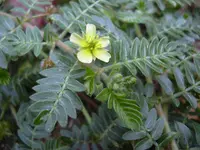
Puncturevine, Tribulus terrestris, is a low, mat-forming annual often found in dry, disturbed ground, roadsides, and sandy soils. It produces small yellow flowers and very hard, spiny seed pods that can puncture thin tires and injure bare feet. Native to parts of Europe, Asia, and Africa, it has now spread widely in many warm and semi-arid regions, especially where soil is poor and open. The plant grows vigorously in full sun and tolerates drought once established, which makes it persistent but also relatively easy to maintain where it is intentionally grown. Anyone who wants to care for puncturevine should understand its rapid self-seeding and strong spreading habit.

Care Difficulty
Easy Care

Light Preference
Full Sun

Water Requirements
Low Water

Temperature Preference
Warm Climate

Hardiness Zone
7–11

Soil Texture
Sandy, Loamy, Rocky

Soil pH
Slightly acidic (6.5–7.0), Slightly alkaline (7.0–7.5)

Soil Drainage
Well-drained

Fertilization
Minimal (feed rarely)
Scan your plant to receive care tips personalized for your specific plant
Available on iOS and Android
This sun-loving annual thrives in strong light and open, exposed sites.
This drought-tolerant species prefers infrequent, deep watering and very fast-draining soil.
This warm-season annual performs best in consistently hot, dry conditions.
Humidity is rarely a limiting factor for Tribulus terrestris, which is naturally adapted to arid, open habitats.
Tribulus terrestris grows best in lean, well-drained, mineral soils that do not stay wet for long.
This species can be grown in containers, mainly for control and observation rather than display.
Tribulus terrestris is a tough annual that needs only modest feeding in lean soils.
Pruning Tribulus terrestris is mainly done for containment and to remove declining growth.
Transplanting is more relevant than repotting for this fast-growing, ground-hugging annual.
Tribulus terrestris is most often propagated by seeds, which germinate quickly in warm, dry conditions.
Tribulus terrestris is a warm-season annual that usually dies back with frost and needs no special winter care.

Plant Health Check
Not sure what's wrong with your plant? Check your plant's health inside the app.
The fruits develop into hard, woody burs with 2–4 sharp spines that act like natural caltrops, allowing them to hook into animal fur, tires, or shoes and spread over long distances.
Seeds usually germinate only when soil is warm and moisture is available, which helps the plant time its growth to favorable summer conditions in arid and semi-arid regions.
This species shows notable tolerance to both drought and soil salinity, which helps it colonize disturbed, nutrient-poor habitats such as roadsides and overgrazed pastures.

Tribulus terrestris is considered a noxious or prohibited weed in several regions, including parts of the western United States and Australia, because its spiny burs can injure livestock, puncture bicycle tires, and contaminate wool.
This species spreads very aggressively due to its low, branching habit and prolific seed production. Each burr contains multiple seeds that stay viable in soil for years, so even small infestations can expand quickly if not controlled early.
Keep your plants happy and healthy with plant identification, disease detection, and easy care guidance.