Musky-smelling Dendrobium Care (Dendrobium moschatum)

Musky-smelling Dendrobium

About Musky-smelling Dendrobium

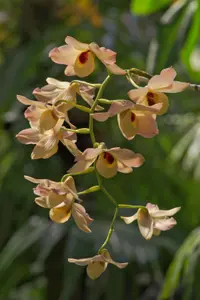
Musky-smelling Dendrobium, Dendrobium moschatum, is an epiphytic orchid that usually grows on trees or rocks in warm, humid forests. It produces long, cane-like stems with arching growth and attractive, fleshy leaves. The plant is best known for its showy yellow to orange flowers, which have a strong musky fragrance and appear in hanging clusters from older canes. This makes it a striking ornamental orchid for collections. In nature it occurs from the Himalayas through parts of Southeast Asia, where it experiences bright light, regular moisture, and a pronounced dry rest. These seasonal needs are the key point in how to care for Musky-smelling Dendrobium at home.

Main Plant Requirements

Care Difficulty

Moderate Care

Light Preference

Partial Shade

Water Requirements

Moderate Water

Temperature Preference

Tropical / Frost Sensitive

Hardiness Zone

11–12

Soil Texture

Peaty, Organic-rich

Soil pH

Acidic (5.5–6.5)

Soil Drainage

Well-drained

Fertilization

Moderate (every 2–4 weeks)

Get Personalized Care Plan

Scan your plant to receive care tips personalized for your specific plant

Available on iOS and Android

How to Care for the Musky-smelling Dendrobium

This orchid prefers bright, filtered light similar to high forest canopies.

  • Provide 4–6 hours of gentle morning sun with bright shade or dappled light the rest of the day; avoid harsh midday sun that can scorch leaves.
  • Musky-smelling Dendrobium tolerates light partial shade, but very dim conditions cause leggy growth and poor flowering.
  • In summer, use shade cloth (30–50%) outdoors; in winter, move plants to the brightest frost-free spot to compensate for shorter days.

This species prefers moist but fast-draining conditions with brief drying between waterings.

  • Water when the top 2–3 cm of the potting mix or mounting medium feels dry rather than on a fixed schedule.
  • During active growth in spring and summer, increase watering frequency but allow roots to turn silvery between soakings to avoid rot in Dendrobium moschatum.
  • Reduce watering in late autumn and winter, keeping canes slightly plump; shriveling signals underwatering, while yellowing, soft roots indicate excess moisture or poor drainage.

This orchid grows best with warm days and slightly cooler nights.

  • Aim for 70–85°F (21–29°C) by day and 60–68°F (16–20°C) by night during active growth for strong canes and flowers.
  • Protect plants from temperatures below 50°F (10°C); brief dips to 45°F (7°C) are possible but repeated cold stress slows growth and increases disease risk.
  • In hot spells above 90°F (32°C), increase shade and airflow; avoid placing plants near heat-reflective walls or in enclosed, stagnant corners.

This orchid prefers fairly moist air and reacts quickly to very dry conditions.

  • Aim for 50–70% humidity; short dips lower are tolerated if watering is consistent.
  • Dry air causes wrinkled pseudobulbs, limp leaves, and stalled buds in Musky-smelling Dendrobium.
  • Increase humidity with a pebble tray, grouped plants, or a room humidifier while keeping leaves well ventilated.

Dendrobium moschatum grows best in a loose, airy, fast-draining orchid-style medium rather than dense potting soil.

  • Use a mix of medium to coarse bark, a small amount of sphagnum moss, and chunky perlite or pumice to keep structure open.
  • Ensure rapid drainage so water runs through in seconds, leaving the mix just slightly moist around the roots.
  • Aim for slightly acidic to neutral conditions, around pH 5.5–6.5, which supports nutrient uptake and healthy root growth.
  • Avoid compact, peat-heavy, or fine garden soil that holds water around roots and eliminates vital air spaces.

This species is suitable for container growing when the pot supports its hanging, cane-forming habit.

  • Choose a heavy, stable pot or basket so tall canes and flower spikes do not tip the container in windy conditions.
  • Select a relatively narrow but deep container so roots anchor firmly while excess medium does not stay wet around the base.
  • Use slotted or mesh orchid pots to increase side airflow, helping the chunky medium dry evenly after each watering.

This orchid benefits from light, consistent feeding during active growth for balanced flowering and foliage.

  • Use a balanced orchid fertilizer (around 20-20-20) or similar NPK, diluted to 1/4–1/2 strength in low-mineral water.
  • Feed every 2 weeks in spring–summer while shoots and roots of Musky-smelling Dendrobium are actively growing.
  • Reduce to monthly or stop fertilizing in autumn–winter when growth slows and pseudobulbs mature.
  • Avoid compost-heavy mixes; use occasional weak applications of liquid feed rather than slow-release pellets in bark media.

Dendrobium moschatum needs only light, targeted pruning to maintain health and support flowering.

  • Best time is after flowering, when canes and flower spikes have finished and are clearly spent.
  • Remove dead, shriveled, or blackened canes and damaged leaves with clean, sharp scissors or pruners.
  • Leave firm, green canes, as they store water and nutrients and may rebloom or support new growth.
  • Thin only badly crowded, crossing canes to improve air flow around the plant and reduce disease risk.

Repotting is infrequent but important to keep this epiphytic orchid stable and its roots healthy.

  • Repot every 2–3 years or when roots circle tightly, medium decomposes, or growth slows despite good care.
  • Choose late winter to early spring, just before new roots emerge, to minimize transplant shock.
  • Gently remove old bark, trim dead roots, and place the plant in a slightly larger, well-drained orchid pot with fresh bark mix.
  • Water lightly for 7–10 days after repotting, keep in bright but softer light, and avoid heavy feeding until strong new roots appear.

Division is the most practical method for propagating this orchid at home.

  • Divide mature clumps in late winter–early spring when repotting and new roots are just starting.
  • Use sterile tools to separate sections with at least 3–4 healthy canes and a good root system.
  • Plant divisions in fresh, medium-grade orchid bark, keeping them firmly supported and slightly snug in the pot.
  • Maintain warm temperatures, high humidity (60–70%), bright indirect light, and gentle watering to encourage rapid establishment.

This tropical orchid is frost-sensitive and needs sheltered conditions in cool climates.

  • In regions below 50°F, grow Dendrobium moschatum in containers that can be moved indoors or into a greenhouse.
  • Keep winter temperatures around 55–65°F with bright, indirect light and good air movement.
  • Reduce watering in winter so the medium dries slightly between waterings, but do not allow complete desiccation.
  • Avoid cold drafts and keep foliage away from freezing window glass or uninsulated exterior doors.

Care Tips

Basket mounting

Grow plants in a slatted wooden or plastic basket with coarse orchid mix so the long pendent canes can hang naturally without kinking or crowding, which improves air movement and flower display.

Dry rest management

From late fall to early spring, gradually reduce watering and stop nitrogen-heavy fertilizer to trigger reliable flowering, but give a light watering if canes visibly wrinkle to prevent tissue collapse.

Cane support strategy

Use hooks or horizontal wires above the plant to drape mature canes rather than staking them upright, which avoids breakage at the base and distributes the weight of flower clusters more safely.

Targeted repot timing

Repot only when new roots just start to appear from the base of new canes, so the plant re-establishes quickly in fresh medium and disturbance does not interrupt its growth cycle.

Preventive pest checks

Inspect the undersides of leaves and cane sheaths every 1–2 weeks for scale and mites, and if found, isolate the plant and treat with a horticultural oil spray labeled for orchids to protect long-term Musky-smelling Dendrobium indoor care.

Common Pests and Diseases

Scale insects

This pest feeds on orchid canes and leaves, forming tan or brown bumps and causing yellowing and weakened growth. Symptoms include sticky honeydew on surfaces and sometimes sooty black mold on the plant.

Solution

Isolate the plant, then wipe canes and leaf bases with cotton pads dipped in 70% isopropyl alcohol, repeating weekly until no new scale appears. Improve air movement around the orchid, avoid overfertilizing with high nitrogen products, and use a labeled horticultural oil or insecticidal soap to treat sheltered areas around leaf sheaths and nodes.

Spider mites

These insects thrive on Dendrobium canes and the undersides of leaves in dry, warm conditions, causing stippled, dull foliage and fine webbing. Symptoms include leaves that lose gloss, turn yellow, and drop prematurely.

Solution

Increase humidity to around 50–60%, rinse foliage thoroughly with a firm stream of lukewarm water, and wipe leaves to remove mites and webbing. For persistent infestations, apply an orchid-safe miticide or insecticidal soap to the undersides of leaves and repeat at 5–7 day intervals while also reducing heat and dryness that favor mites.

Bacterial soft rot

This disease causes sudden, water-soaked lesions on canes or leaf bases that quickly become mushy and produce a foul odor. Symptoms include rapid tissue collapse, especially around tightly packed leaf sheaths and pseudobulb joints.

Solution

Immediately cut out all affected tissue with a sterile blade, removing some healthy margin, then dust cuts with cinnamon or a bactericidal powder labeled for orchids. Keep the plant drier around the base, water early in the day so it dries by night, increase air circulation around canes, and avoid overhead watering that leaves water trapped between sheaths.

Fusarium wilt

This disease blocks the water-conducting tissue in canes, leading to stunted new growth, shriveled pseudobulbs, and leaves that yellow from the tip backward. Symptoms include a distinctive purple or pink ring in cross-sections of affected canes and rhizomes.

Solution

Remove and discard all visibly affected canes and any potting material that stays wet too long, then repot into fresh, fast-draining orchid bark in a clean container. Sterilize cutting tools between each cut, keep watering moderate with full drying between waterings, and maintain strong air movement to reduce fungal spread; severely affected plants are often best discarded to protect nearby orchids.

Orchid viruses

This disease group can cause distorted or streaked flowers, reduced fragrance, and mottled or streaked leaves, though symptoms may be subtle in some plants. Symptoms include chronically weak growth and poor flowering despite otherwise correct Dendrobium moschatum plant care.

Solution

There is no cure; isolate and monitor any plant with suspicious mosaic, streaking, or deformities and avoid swapping tools or dividing plants without sterilizing blades in a 10% bleach or 70% alcohol solution between cuts. If virus is strongly suspected or confirmed by testing, discard the plant and its potting mix and clean benches and tools thoroughly to protect other orchids.

Interesting Facts

Musky floral chemistry

The flowers release a pronounced musky scent, produced by a complex mix of volatile organic compounds that attract specific night-active moth pollinators in its native Himalayan forests.

Pendant cane habit

In nature this orchid develops long, arching to pendulous canes that often hang down cliff faces or tree branches, allowing the large, fragrant flowers to present more visibly to flying pollinators.

Seasonal flowering trigger

Flowering is closely linked to a distinct dry rest period after the monsoon season in its native range, where reduced moisture and slightly cooler temperatures help trigger bud formation along the mature canes, a pattern important to understand in Dendrobium moschatum care.

Botan icon

Did you know?

This species naturally occurs as a lithophyte on rocky cliffs as well as an epiphyte on trees in the eastern Himalayas and surrounding regions, showing unusual flexibility in root adaptation to both bark and bare rock surfaces in high-rainfall montane habitats.

FAQs about Musky-smelling Dendrobium

This species usually blooms in late spring to summer, producing pendulous canes with many large yellow to orange flowers. The blossoms have a strong musky fragrance that is most noticeable in warm, still air.

Grow Healthy Plants with Botan Care

Keep your plants happy and healthy with plant identification, disease detection, and easy care guidance.

Botan plant care app — identify plants on mobile

Explore More Plants