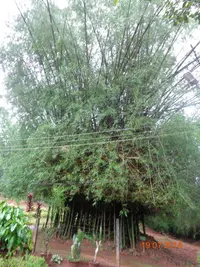
sweet bamboo Care (Dendrocalamus latiflorus)

Also known as: Ma Bamboo
sweet bamboo

About sweet bamboo

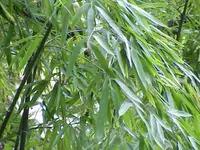
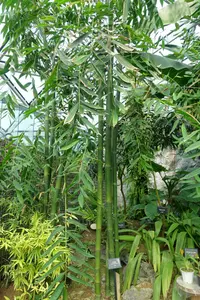
Sweet bamboo, Dendrocalamus latiflorus, is a giant clumping bamboo grown mainly for its tall, straight culms and lush, dense foliage. It is commonly used as a windbreak, privacy screen, or ornamental feature in warm climates.

This species is native to parts of Southeast Asia and Taiwan, where it forms large, stable clumps rather than spreading invasively. It grows fast and can become very large, so it suits spacious gardens more than small yards.

The plant prefers warm temperatures, consistent moisture, and fertile, well-drained soil, which influences how to care for sweet bamboo in home landscapes.

Main Plant Requirements

Care Difficulty

Moderate Care

Light Preference

Full Sun

Water Requirements

Regular Water

Temperature Preference

Tropical / Frost Sensitive

Hardiness Zone

9–11

Soil Texture

Loamy, Silty, Organic-rich

Soil pH

Acidic (5.5–6.5), Slightly acidic (6.5–7.0)

Soil Drainage

Moist but well-drained

Fertilization

Moderate (every 2–4 weeks)

Get Personalized Care Plan

Scan your plant to receive care tips personalized for your specific plant

Available on iOS and Android

How to Care for the sweet bamboo

This large clumping bamboo thrives in bright, warm conditions with plenty of indirect light.

  • Provide 4–6 hours of morning sun with light afternoon shade; strong midafternoon sun can scorch new culms and leaves.
  • Tolerates partial shade (around 3–4 hours of direct sun) but growth and culm diameter may be reduced in dense shade.
  • In hot summers, use filtered light or dappled shade; in cooler months, ensure more open exposure so sweet bamboo maintains dense foliage.

This species prefers consistently moist but not waterlogged soil to support fast culm growth.

  • Water when the top 3–5 cm of soil feel barely moist, aiming for deep soaking that reaches the full root zone in the planting area.
  • In hot, dry weather, increase frequency and watch for rolled or drooping leaves as a sign of thirst; reduce watering in cool or rainy periods.
  • Ensure free-draining soil; standing water, sour odor, or yellowing lower leaves suggest overwatering and poor aeration around Dendrocalamus latiflorus roots.

This tropical bamboo grows best in warm, frost-free climates with stable temperatures.

  • Ideal growth occurs around 70–90°F (21–32°C), supporting rapid shoot extension and leaf production.
  • Tolerates brief drops to about 28–30°F (-2 to -1°C), but repeated frost damages leaves and young culms; long exposure below 32°F (0°C) can kill shoots.
  • Handles summer heat up to about 100°F (38°C) if soil moisture is maintained; mulch roots and avoid hot, reflected sites to limit stress.

This clumping bamboo prefers moderately high, stable humidity to support vigorous shoot growth.

  • Aim for 50–70% humidity; it tolerates brief dips but prolonged very dry air slows growth and may brown leaf tips.
  • Watch for rolling leaves, crispy margins, and stalled new culms as signs of humidity stress or combined drought stress.
  • Increase humidity with nearby water features, grouped planting, and mulching the root zone rather than misting foliage of sweet bamboo.

This species performs best in deep, moist, well-drained soil with high organic content.

  • Use a loamy mix with structure: roughly 40% garden loam, 40% composted organic matter, and 20% coarse material such as pine bark or perlite.
  • Ensure rapid drainage; water should infiltrate easily without puddling for more than a few minutes after irrigation or rain.
  • Target a slightly acidic to neutral pH of 6.0–7.0 for Dendrocalamus latiflorus, adjusting with sulfur or lime only if tests show extremes.
  • Avoid compacted, heavy clay or pure sand; improve aeration and drainage by double-digging and incorporating coarse organic matter through the top 20–30 cm.

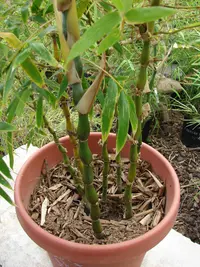
This large bamboo is only marginally suitable for containers and needs careful management to stay healthy.

  • Choose an extra-large, heavy container to reduce tipping risk from tall, wind-catching culms and dense foliage.
  • Use a deep pot that allows a wide root run, as restricted rhizome space quickly limits culm diameter and height.
  • Select thick-walled, non-porous materials like glazed ceramic to stabilize moisture and temperature around the root mass.

This large clumping bamboo benefits from consistent feeding to support strong culm and leaf production.

  • Apply a balanced slow-release fertilizer (around 10-10-10 or similar NPK) at the start of the warm growing season.
  • Supplement with well-rotted compost or aged manure around the root zone 1–2 times during active growth.
  • Use liquid balanced fertilizer at half strength every 4–6 weeks for container plants during spring and summer.
  • Reduce or stop feeding in late fall and winter when growth slows, especially for sweet bamboo grown in cooler regions.

Pruning helps maintain safe structure and access in Dendrocalamus latiflorus groves.

  • Carry out main pruning in late winter or early spring before strong new shoot growth starts.
  • Remove dead, damaged, crossing, or pest-infested culms at ground level using sharp loppers or a pruning saw.
  • Thin crowded interior culms to improve light and air movement while keeping a stable clump shape.
  • Cut side branches selectively to manage height clearance for paths or buildings without topping healthy culms.

This species is usually field-grown, so transplanting young clumps is more common than long-term container repotting.

  • Transplant or shift to a larger container in late spring when soil is warming and new shoots start to appear.
  • Look for roots circling the pot, water running off quickly, or slowed growth as signs a container plant needs more space.
  • Move up only 1–2 pot sizes, handling the dense root ball gently and keeping it intact to limit transplant shock.
  • Water thoroughly after planting, provide shade for 7–10 days, and maintain even moisture until new growth shows good recovery.

New plants are most reliably produced by division and culm cuttings rather than seed in this bamboo.

  • Divide vigorous clumps in late spring, lifting and separating sections with several healthy culms and strong rhizomes.
  • Plant divisions into moist, well-drained soil, firm carefully, and shade from intense sun until active new growth resumes.
  • Use culm cuttings with at least 2–3 nodes, laid horizontally or planted upright in warm, humid, shaded conditions.
  • Keep rooting medium evenly moist and warm (around 70–80°F) to support root and bud development over several weeks.

This tropical to subtropical bamboo is sensitive to hard freezes and needs protection in cold-winter climates.

  • In-ground plants tolerate only light frost; sustained temperatures below about 25°F can damage culms and foliage.
  • Apply a 7–10 cm layer of organic mulch over the root zone in late fall, keeping it slightly back from culm bases.
  • For exposed sites, use windbreaks or burlap wraps around young clumps to limit leaf desiccation and stem damage.
  • Move container plants indoors or into a frost-free greenhouse, keeping them cool, bright, and slightly drier until spring.

Care Tips

Wind‑firm staking

Install strong, flexible stakes and soft ties during the first 1–2 years in windy sites so new culms stay upright while roots anchor, checking and loosening ties every few months to prevent girdling.

Culm thinning strategy

Each late winter, remove the oldest, weakest, or crossing culms at ground level to maintain air flow, reduce disease pressure, and encourage thicker, straighter new shoots for timber or screening use.

Root zone protection

Maintain a permanent, 5–8 cm deep organic mulch ring over the rhizome zone and keep heavy foot traffic and machinery away from this area to protect new shoots and fine feeder roots from damage.

Controlled clump direction

Guide the clump shape by selectively cutting out new shoots that emerge in unwanted directions while they are still small and tender, which helps maintain access paths and service clearances when growing sweet bamboo.

Irrigation system planning

Use a dedicated drip or low‑flow line arranged in a wide ring around the clump, and expand the loop outward every 1–2 years as the plant grows so that water consistently reaches the active feeder roots rather than just the clump center.

Common Pests and Diseases

Bamboo aphids

This pest feeds in colonies on young culms and leaves, sucking sap and causing yellowing, curling, and sticky honeydew that can lead to sooty mold on Dendrocalamus latiflorus.

Solution

Rinse infested shoots with a strong stream of water, prune heavily infested culms, and introduce or protect natural predators such as lady beetles. If needed, use insecticidal soap or a light horticultural oil, ensuring thorough coverage of leaf undersides and new shoots.

Bamboo mites

These insects live on the underside of leaves, causing fine yellow stippling, bronzing, and reduced vigor, especially in hot, dry conditions common in sweet bamboo indoor care or under cover.

Solution

Increase humidity, hose down foliage to physically remove mites, and remove heavily damaged leaves. For persistent infestations, apply horticultural oil or a registered miticide, repeating according to label directions and focusing on leaf undersides where mites shelter.

Bamboo borers

This pest tunnels into culms and branches, leaving small round exit holes, frass (wood dust), and weakening the structural integrity of the clump.

Solution

Cut out and destroy infested culms as soon as boring damage is noticed to break the life cycle. Maintain vigorous growth through proper watering and fertilization, promptly remove dead or drying culms, and in high‑risk areas consider preventative trunk sprays with an appropriate systemic insecticide during the main shoot-flushing period.

Bamboo blight

This disease causes elongated dark lesions on culms and sometimes leaves, which can girdle shoots, lead to dieback, and reduce overall clump health in humid or poorly ventilated stands.

Solution

Prune and dispose of affected culms and foliage, cutting well below visible lesions, and avoid overhead irrigation that keeps foliage wet for long periods. Improve spacing and airflow within the clump, and in severe or recurrent cases use a suitable fungicide labeled for leaf and stem blights on ornamental grasses or bamboos.

Leaf rust

This disease produces yellow to orange-brown pustules on the underside of leaves, leading to yellowing, premature leaf drop, and a generally thinned canopy when conditions stay warm and humid.

Solution

Remove and destroy affected leaves to reduce spore load, and avoid crowding or conditions that keep foliage damp. If rust recurs seasonally, apply a preventative fungicide labeled for rust on ornamentals and rotate active ingredients to reduce resistance risk.

Interesting Facts

Massive clumping bamboo

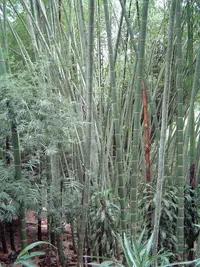
This species forms very large clumps with many thick culms that can reach around 20–25 m tall in favorable subtropical conditions, making it one of the largest bamboos cultivated in Taiwan and southern China.

Edible young shoots

Its young shoots are widely harvested and eaten as a vegetable in East and Southeast Asia, valued for their relatively mild flavor and crisp texture when properly boiled to remove bitterness.

Important windbreak species

In parts of Taiwan, it is extensively planted on slopes and farm edges as a living windbreak and erosion-control plant, because its dense culm clusters and fibrous root system help stabilize soil and reduce wind speed at ground level.

Botan icon

Did you know?

This bamboo is one of the principal raw materials for high-quality laminated bamboo boards and engineered bamboo products in Taiwan, because its large, straight culms yield broad, uniform strips that are well suited to industrial processing and structural uses.

FAQs about sweet bamboo

This species is very fast-growing, often adding 1–3 ft per year once established, and potentially more in ideal subtropical climates. Growth slows in cooler regions, poor soil, drought, or when root space is restricted.

Grow Healthy Plants with Botan Care

Keep your plants happy and healthy with plant identification, disease detection, and easy care guidance.

Botan plant care app — identify plants on mobile

Explore More Plants