Wind-aware placement
Site the plant where strong prevailing winds are filtered by a hedge or fence, since large leaves tear easily and wind damage often appears before other stress symptoms.

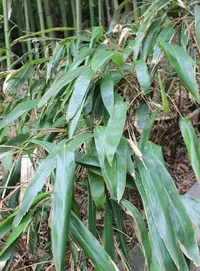
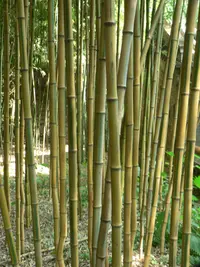
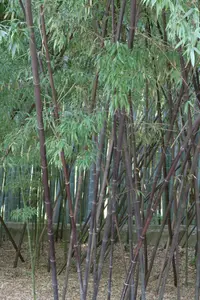
Indocalamus tessellatus, commonly called large-leaved bamboo, is a clumping evergreen bamboo grown mainly for its broad, lush foliage. It forms dense, low thickets with arching canes and striking leaves that can look almost tropical in a temperate garden.
This species is native to parts of China, where it grows in woodland and shaded mountain areas. It is valued in cultivation for its ability to create bold foliage texture without becoming aggressively invasive.
Large-leaved bamboo prefers sheltered sites with partial shade, consistent moisture, and fertile, well-drained soil. With the right conditions, it is considered relatively straightforward for gardeners learning how to care for large-leaved bamboo.

Care Difficulty
Moderate Care

Light Preference
Partial Shade

Water Requirements
Keep Soil Moist

Temperature Preference
Cold Hardy

Hardiness Zone
6–9

Soil Texture
Loamy, Clay, Organic-rich

Soil pH
Acidic (5.5–6.5), Slightly acidic (6.5–7.0)

Soil Drainage
Moist but well-drained

Fertilization
Minimal (feed rarely)
Scan your plant to receive care tips personalized for your specific plant
Available on iOS and Android
Indocalamus tessellatus prefers bright, gentle light that protects its broad leaves from scorching.
This bamboo favors consistently moist but not waterlogged soil throughout the growing season.
This species is a cool- to mild-temperate bamboo that handles some cold but grows best without extremes.
This species prefers moderate to high humidity but copes with typical indoor levels if not too dry.
Indocalamus tessellatus prefers deep, moist, well-drained, humus-rich soil that stays slightly acidic to neutral.
This bamboo is suitable for large, stable containers outdoors.
Indocalamus tessellatus responds well to light, consistent nutrition during the growing season.
Pruning Indocalamus tessellatus focuses on tidying the clump and maintaining healthy, accessible canes.
This bamboo copes well with transplanting when timed and handled carefully.
Indocalamus tessellatus is most reliably propagated by division of established clumps.
This bamboo is relatively cold hardy but benefits from basic winter preparation, especially in colder regions.

Plant Health Check
Not sure what's wrong with your plant? Check your plant's health inside the app.
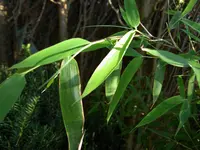
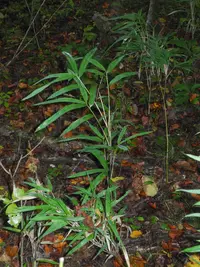
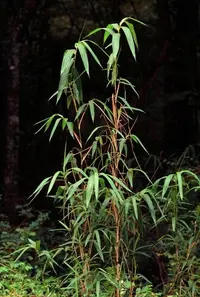
This species has some of the largest leaves of any hardy bamboo, often reaching 30–60 cm long and 5–10 cm wide, which creates a broad, almost tropical-looking canopy even in temperate climates.
Despite its lush, broad foliage, this bamboo tolerates cool temperate conditions and can survive light frosts in many parts of the US and Europe, which is unusual for such large-leaved bamboo species.
Indocalamus tessellatus grows as a tight clump through short, non-invasive rhizomes, so it tends to form compact, leafy mounds rather than spreading aggressively like many running bamboos.

In traditional East Asian gardens, this species has been used as a living screen and windbreak near ground level, since its unusually large, leathery leaves form a low, continuous barrier that rustles audibly in even light breezes and highlights the sound element in garden design.
This species has short, running rhizomes that form broad clumps rather than long-distance runners. It can slowly expand sideways over time, but is usually manageable in gardens with edging or regular division of older clumps.
Keep your plants happy and healthy with plant identification, disease detection, and easy care guidance.