Windward placement
Site plants where prevailing winds are partly blocked by buildings or taller trees to reduce culm breakage and leaf desiccation, especially in young groves.

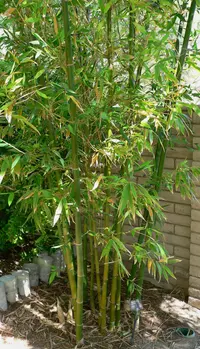
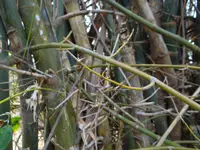
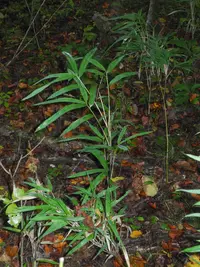
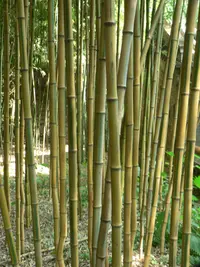
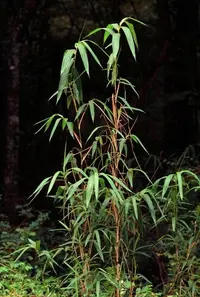
Giant timber bamboo, Bambusa oldhamii, is a large clumping bamboo valued for its tall, straight canes and dense, upright foliage. It is commonly used as a screen, windbreak, or ornamental grove in mild climates.
This species is native to subtropical East Asia and thrives outdoors in warm regions where winters are not severe. It grows fast and forms tight clumps rather than spreading aggressively, which makes it easier to control than running bamboos.
It generally prefers full sun to light shade, consistent moisture, and well-drained, fertile soil. Understanding how to care for giant timber bamboo starts with giving it enough space and stable growing conditions.

Care Difficulty
Moderate Care

Light Preference
Full Sun

Water Requirements
Regular Water

Temperature Preference
Warm Climate

Hardiness Zone
9–11

Soil Texture
Loamy, Sandy, Organic-rich

Soil pH
Acidic (5.5–6.5), Slightly acidic (6.5–7.0)

Soil Drainage
Moist but well-drained

Fertilization
Light (every 4–6 weeks)
Scan your plant to receive care tips personalized for your specific plant
Available on iOS and Android
Bambusa oldhamii needs strong, consistent light to build thick, upright culms.
Bambusa oldhamii prefers evenly moist, not soggy, soil for steady growth.
This clumping bamboo grows best in warm, mild climates with limited frost.
This species grows best in moderate humidity but adapts well to many outdoor conditions.
This bamboo prefers deep, well-drained, fertile soil that stays evenly moist without becoming waterlogged.
This species can be grown in large containers, mainly for younger plants or short-term landscape use.
Nutrient-rich soil supports strong culm and leaf growth in giant timber bamboo, especially in containers or poor ground soils.
Bambusa oldhamii benefits from light, structured pruning to keep clumps healthy and manageable.
Large clumps respond best to careful transplanting when actively growing but not under heat stress.
New plants are usually produced by division rather than by seed, which is rarely available for this species.
This bamboo is moderately cold tolerant but benefits from some winter preparation in cooler regions.

Plant Health Check
Not sure what's wrong with your plant? Check your plant's health inside the app.
This species forms very thick-walled culms relative to their diameter, which makes the canes strong enough for structural uses such as poles, fencing, and light construction in suitable climates.
Compared with many other large bamboos, the leaves and culms of this species tend to produce less rustling noise in wind, which is one reason it is often chosen as a tall privacy screen in residential areas.
Documented flowering events of this species are infrequent and unpredictable, and many cultivated plants may never be observed in bloom during a typical human lifetime.

This species is widely grown in subtropical and warm-temperate regions outside its native range, such as coastal California and parts of the southeastern United States, where it is valued as one of the most reliable large clumping bamboos for creating tall evergreen windbreaks and visual barriers.
In suitable outdoor conditions, this species is very fast-growing. New culms can extend 60–90 cm per day during peak season, and established clumps may gain several meters of height in a single growing period.
Keep your plants happy and healthy with plant identification, disease detection, and easy care guidance.