Establish clump boundaries
Install heavy-duty root barrier (60–80 mil HDPE or similar) to 60–75 cm depth in a wide ring before planting to keep the clump contained and allow safe expansion and harvesting corridors.

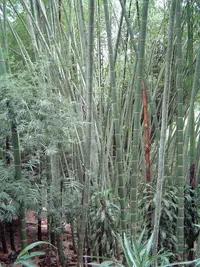
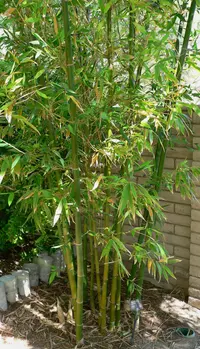
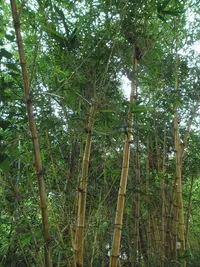
Colombian timber bamboo (Guadua angustifolia) is a large, clumping bamboo known for its thick, strong culms and fast growth. It forms dense groves that can reach tree-like proportions in suitable climates.
This species is native to tropical regions of Colombia and neighboring areas, where it is widely used as a structural and construction material. Its upright, arching canes and fine foliage create a tall, green screen.
The plant prefers warm conditions, consistent moisture, and well-drained, fertile soil, so it is less suited to cold or very dry sites. Understanding how to care for Colombian timber bamboo in a non-tropical garden mainly involves providing enough warmth, humidity, and room for its vigorous root system.

Care Difficulty
Hard Care

Light Preference
Full Sun

Water Requirements
Regular Water

Temperature Preference
Tropical / Frost Sensitive

Hardiness Zone
10–11

Soil Texture
Loamy, Silty, Organic-rich

Soil pH
Acidic (5.5–6.5), Slightly acidic (6.5–7.0)

Soil Drainage
Moist but well-drained

Fertilization
Moderate (every 2–4 weeks)
Scan your plant to receive care tips personalized for your specific plant
Available on iOS and Android
This large clumping bamboo needs strong light to fuel its fast growth while avoiding leaf scorch in extreme exposure.
This species prefers evenly moist, deep soil but suffers if kept either soggy or bone dry for long periods.
This fast-growing bamboo performs best in consistently warm, frost-free conditions.
This bamboo prefers moderately humid air but tolerates a range if soil moisture is managed well.
This clumping bamboo favors deep, moist, well-drained mineral soils with ample organic matter.
This species is only moderately suitable for containers because of its eventual size and strong root system.
Nutrient-rich soil supports strong growth of Colombian timber bamboo, especially in active warm-season conditions.
Thoughtful pruning of Guadua angustifolia maintains safe structure, access, and airflow in dense clumps.
This large clumping bamboo is usually grown in the ground, so focus on careful transplanting rather than frequent repotting.
New plants of this bamboo are most reliably produced by division of established clumps rather than from seed.
This species is frost-sensitive and benefits from targeted winter protection in regions with cold or occasional freezes.

Plant Health Check
Not sure what's wrong with your plant? Check your plant's health inside the app.
This species can produce some of the thickest bamboo culms in the Neotropics, with walls dense and strong enough to substitute for timber in structural applications when properly engineered.
In its native Andean foothills, this bamboo forms dense stands that stabilize steep slopes, reduce erosion along rivers, and create humid microclimates that shelter many understory plants and animals.
Traditional and modern builders in Colombia and neighboring countries use its culms in earthquake-resistant architecture, taking advantage of their high flexibility, low weight, and favorable strength-to-weight ratio compared with many conventional building materials.

Colombian building standards officially recognize this bamboo as a structural material, and engineers have developed detailed design codes based on its mechanical properties so it can be safely used in certified, multi-story construction in seismic regions.
Yellowing leaves often result from water stress, root disturbance, nutrient deficiency, or cold damage. Check soil moisture, drainage, and recent temperature drops, then adjust watering and provide a balanced fertilizer if growth appears weak overall.
Keep your plants happy and healthy with plant identification, disease detection, and easy care guidance.