Clump Rejuvenation
Every 3–5 years, lift and divide congested clumps at the end of flowering, replanting only the youngest, healthiest fans to maintain strong bloom performance and reduce disease build-up.

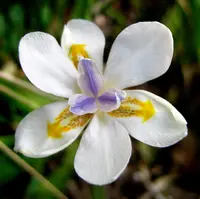
Fortnight lily, Dietes iridioides, is a clump-forming perennial often used in borders, mass plantings, and around water features. It belongs to the iris family and produces fans of flat, sword-like leaves. Flowers are white with yellow and violet markings and appear repeatedly in warm weather, usually in flushes every couple of weeks. Native to South Africa, it adapts well to many mild climates and is commonly grown in coastal and Mediterranean-style gardens. This species is generally robust and tolerant of poor soil, wind, and short dry periods, which makes it relatively easy to care for Fortnight Lily. It performs best in sun to light shade with well-drained soil and moderate moisture.

Care Difficulty
Easy Care

Light Preference
Full Sun

Water Requirements
Moderate Water

Temperature Preference
Warm Climate

Hardiness Zone
8–11

Soil Texture
Sandy, Loamy, Organic-rich

Soil pH
Slightly acidic (6.5–7.0), Neutral (7.0)

Soil Drainage
Moist but well-drained

Fertilization
Minimal (feed rarely)
Scan your plant to receive care tips personalized for your specific plant
Available on iOS and Android
Dietes iridioides thrives in bright outdoor conditions with several hours of direct sun daily.
Dietes iridioides prefers consistent moisture but does not tolerate waterlogged soil.
This species prefers mild, frost-free climates with moderate temperature fluctuations.
This species tolerates a wide humidity range and rarely needs special humidity management indoors or outdoors.
Dietes iridioides prefers well-drained, slightly moist soil that does not stay waterlogged.
This species adapts well to container growing when given enough root space and stable drainage conditions.
Dietes iridioides responds well to light, consistent feeding during the warm growing season.
Pruning Dietes iridioides is simple and mainly focuses on tidying and sustaining flowering.
Dietes iridioides is more often transplanted in the ground than repotted, but clumps still need space to stay vigorous.
Dietes iridioides is most reliably propagated by division of mature clumps.
Dietes iridioides is moderately frost tolerant but benefits from simple winter precautions in colder climates.

Plant Health Check
Not sure what's wrong with your plant? Check your plant's health inside the app.
Each flower lasts only 1 day, but the plant produces many buds that open in succession from late spring through fall, which creates the impression of continuous blooming over many weeks.
The plant forms tough, three-sided seed capsules that split open to release hard, glossy black seeds, which can be spread by gravity and water movement in its native habitats of the Eastern and Southern Cape regions of South Africa.
It grows from short rhizomes that form dense, evergreen clumps of fan-like leaves, an adaptation that helps it withstand periodic drought and allows the plant to resprout reliably after stress.

The flowers are pollinated mainly by bees in their native South African range, and the pale, patterned petals with yellow nectar guides act as visual signals that direct pollinators toward the reproductive structures, increasing the efficiency of pollination.
Yellowing leaves usually come from natural aging of older fans, nutrient deficiency, or water stress. Remove oldest yellow blades, check for soggy or compacted soil, and feed with a balanced, slow‑release fertilizer once or twice a year.
Keep your plants happy and healthy with plant identification, disease detection, and easy care guidance.