Port St Johns Creeper Care (Podranea ricasoliana)

Also known as: Zimbabwe creeper, Pink Trumpet Vine, Pondoland-Creeper, Port-St-John's Creeper, St. Johns Tecoma
Port St Johns Creeper

About Port St Johns Creeper

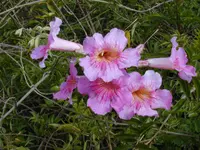
Port St Johns creeper, Podranea ricasoliana, is a fast-growing, woody climbing vine known for its clusters of soft pink, trumpet-shaped flowers. It often covers fences, pergolas, or walls with lush, glossy green foliage and an arching, somewhat sprawling habit.

This species comes from warm regions of southern Africa, where it thrives in bright, sunny conditions and mild climates. It is generally easy to grow in suitable climates but can become vigorous and needs structure and occasional pruning. Gardeners who learn how to care for Port St Johns Creeper usually find it rewarding in well-drained soil with regular moisture and protection from hard frost.


Main Plant Requirements

Care Difficulty

Moderate Care

Light Preference

Full Sun

Water Requirements

Moderate Water

Temperature Preference

Tropical / Frost Sensitive

Hardiness Zone

9–11

Soil Texture

Sandy, Loamy, Organic-rich

Soil pH

Acidic (5.5–6.5), Slightly acidic (6.5–7.0)

Soil Drainage

Well-drained

Fertilization

Light (every 4–6 weeks)

Get Personalized Care Plan

Scan your plant to receive care tips personalized for your specific plant

Available on iOS and Android

How to Care for the Port St Johns Creeper

This vigorous climber thrives in bright, warm conditions with plenty of direct sun for strong flowering.

  • Provide 6–8 hours of direct sun daily; morning and midday sun are ideal, with light afternoon shade in very hot climates to protect foliage from scorch.
  • Port St Johns Creeper tolerates light partial shade (around 3–4 hours of sun), but flowering and growth decrease as shade increases.
  • In summer, monitor for leaf yellowing or crisp edges from intense sun; in cooler seasons ensure it is not shaded by trees or structures for most of the day.

Podranea ricasoliana prefers evenly moist, well-drained soil that dries slightly between waterings.

  • Water when the top 3–5 cm of soil feel dry, then soak the root zone deeply so moisture reaches 15–20 cm down, allowing excess to drain away.
  • Reduce watering in cooler months when growth slows, but do not allow the soil to stay bone dry for long periods, especially in windy or exposed positions.
  • Watch for drooping, dry leaves and brittle stems as signs of underwatering, and yellowing leaves or soft, blackened roots as indicators of overwatering and poor drainage.

This subtropical vine grows best in warm, frost-free conditions with mild seasonal variation.

  • Ideal growth occurs around 65–80°F (18–27°C), where stems extend quickly and flowering is strongest during the warmer months.
  • Plants tolerate brief dips to about 30–32°F (-1–0°C), but repeated frosts damage young shoots and can kill top growth, especially in exposed sites.
  • In hot regions, it handles 90–95°F (32–35°C) if soil moisture is maintained and roots are mulched, but prolonged extreme heat can reduce flowering and stress foliage.

This vine accepts a fairly wide humidity range but benefits from moderately moist air.

  • Aim for 40–60% humidity, which suits Port St Johns Creeper in most heated or cooled homes.
  • Tolerates short periods of drier air, but prolonged low humidity can cause leaf edge browning and finer leaf drop.
  • Increase humidity by clustering plants, placing pots on pebble trays with water below the pot base, or running a nearby humidifier.

This species prefers loose, well-drained, nutrient-rich soil that still holds some moisture.

  • Use a loamy mix combining roughly 2 parts peat-free potting soil, 1 part compost, and 1 part perlite or coarse sand for structure and drainage.
  • Aim for slightly acidic to neutral pH around 6.0–7.0, which supports nutrient uptake for Podranea ricasoliana.
  • Ensure the soil feels springy and airy, not dense; perlite or fine bark pieces help create air pockets around the roots.
  • Avoid heavy clay, compacted ground, or mixes that stay wet longer than 2–3 days, which encourage root rot and weak growth.

This vigorous climber is suitable for container growing when given enough root space and support.

  • Choose a wide, heavy container to counterbalance the vine’s top growth and prevent tipping in wind or on balconies.
  • Provide a deep pot so roots can anchor strongly, which helps sustain fast growth and repeated flowering.
  • Position a sturdy trellis or railing attachment directly in the container so stems can be tied early, improving stability and airflow.

This vigorous climber responds well to modest, consistent feeding during the warm growing season.

  • Use a balanced NPK fertilizer (such as 10-10-10) at half strength every 4–6 weeks in spring and summer for Podranea ricasoliana.
  • Alternatively, apply a slow-release granular fertilizer at the start of spring, following label rates.
  • Supplement with a thin layer of compost over the root zone once per year to improve soil structure.
  • Stop feeding in fall and winter when growth slows, as the plant is less able to use added nutrients.

Pruning guides Port St Johns Creeper into a manageable size and encourages heavy flowering on new growth.

  • Carry out main pruning in late winter or very early spring before vigorous new shoots emerge.
  • Remove dead, damaged, or crossing stems first, using clean, sharp bypass pruners for smooth cuts.
  • Shorten long, tangling vines to shape the plant and concentrate energy into fewer, stronger flowering stems.
  • After flowering, lightly thin crowded areas to improve air movement and light penetration along the framework.

This fast-growing vine is usually planted in the ground but can be transplanted or shifted to larger containers when rootbound.

  • Plan major transplanting or up-potting for early spring, just before strong new growth begins.
  • Look for roots circling the pot, pushing through drainage holes, or for slowed top growth as signs it needs more space.
  • Move into a container 1–2 sizes larger or a garden hole with well-drained soil, keeping the root ball level with the surface.
  • Minimize root stress by handling the root ball gently, watering thoroughly after planting, and shading from harsh sun for several days.

Podranea ricasoliana is commonly propagated from cuttings to maintain desired flowering and growth traits.

  • Take semi-ripe stem cuttings in late spring or summer, using non-flowering shoots 10–15 cm long.
  • Remove lower leaves, dip the cut base in rooting hormone, and insert into a free-draining mix such as perlite and peat or coco coir.
  • Maintain high humidity and gentle bottom warmth around 70–75°F with bright, indirect light until roots form.
  • For seed propagation, sow fresh seed in a warm, sheltered spot, keeping the medium evenly moist but never waterlogged.

In mild climates this vine is semi-tender and needs thoughtful winter care where frost is common.

  • Podranea ricasoliana is damaged by hard frost and may die back to the base below about 25°F.
  • In ground, apply a 5–8 cm layer of mulch over the root zone in late fall to insulate the crown.
  • In colder regions, grow in large containers and move indoors or into a frost-free greenhouse before freezing nights.
  • Reduce watering in winter so the soil stays just barely moist, preventing root rot in cool conditions.

Care Tips

Early vine training

Install a sturdy trellis or wire system before the first main flush of growth, then loosely tie young stems with soft ties so the plant creates an organized, layered framework instead of a tangled mass that is hard to manage later.

Hardiness zone strategy

In cooler regions at or below USDA zone 9, grow plants in large, lightweight containers that can be moved to a protected spot or unheated greenhouse for winter, reducing the risk of root damage from unexpected cold snaps.

Flowering cycle cleanup

After each heavy flowering flush, remove spent flower clusters and thin out the weakest, oldest stems from the base to redirect energy into new flowering wood and maintain a strong, airy structure.

Root zone protection

In ground plantings, apply a 5–8 cm layer of organic mulch around but not touching the stems to buffer soil temperature, conserve moisture, and reduce weed competition that can stress vigorous vines.

Pest scouting routine

During active growth, check the undersides of leaves and soft shoot tips weekly for aphids, spider mites, or scale, and if detected early, use a targeted treatment such as insecticidal soap or horticultural oil rather than broad-spectrum chemicals when caring for Port St Johns Creeper.

Common Pests and Diseases

Aphids

This pest feeds on young shoots and flower buds, causing distortion, sticky honeydew, and sooty mold on the foliage and stems.

Solution

Spray vines thoroughly with a strong stream of water to dislodge colonies, then treat remaining clusters with insecticidal soap or a light horticultural oil, repeating weekly until populations collapse; encourage lady beetles and lacewings by avoiding broad-spectrum insecticides.

Spider mites

These insects thrive in hot, dry conditions and cause fine stippling, dulling of leaves, and fine webbing along stems and leaf undersides.

Solution

Increase humidity around the plant and hose down foliage, focusing on leaf undersides, then apply insecticidal soap or a horticultural oil at 5–7 day intervals; prune and discard heavily infested tips to slow reinfestation, especially in Port St Johns Creeper indoor care situations.

Caterpillars

This pest chews irregular holes in leaves and sometimes damages flower buds, leading to ragged foliage and reduced flowering.

Solution

Hand-pick visible caterpillars in the early morning or evening and prune out heavily damaged sections; for persistent infestations, apply a targeted biological product containing Bacillus thuringiensis (Bt) to young larvae, following label directions and reapplying after rain.

Powdery mildew

This disease produces white, powdery patches on leaves and young stems, which can lead to yellowing, distortion, and reduced vigor in dense, shaded growth.

Solution

Improve air circulation by thinning overcrowded stems and avoid overhead watering, then remove and discard heavily infected leaves; if needed, apply a sulfur or potassium bicarbonate fungicide labeled for ornamental vines, treating at the first sign of symptoms and repeating as directed.

Leaf spot

This disease causes small brown or purplish spots on leaves that may enlarge and coalesce, sometimes leading to premature leaf drop on stressed vines.

Solution

Collect and dispose of fallen leaves, avoid wetting foliage when watering, and reduce plant stress with consistent moisture and balanced fertilization; in severe or recurring cases, use a copper-based fungicide during warm, wet periods, focusing on new growth and following label intervals.

Interesting Facts

Flowering in mild winters

In frost-free or very mild climates, this vine can flower through winter, producing pink, trumpet-shaped blooms when many other ornamentals are dormant.

Vegetative spread potential

The plant can resprout vigorously from roots and stems, and in some warm regions it has shown invasive tendencies when it escapes cultivation and climbs over native vegetation.

Taxonomic reclassification history

This species was previously placed in the genus Tecoma and has shifted between related genera as botanists used floral and DNA characteristics to clarify its position in the Bignoniaceae family.

Botan icon

Did you know?

In some coastal Mediterranean-climate regions outside its native range in southern Africa, this vine has naturalized along railway lines and disturbed habitats, using fences and structures as support to form dense flowering screens.

FAQs about Port St Johns Creeper

Growth is vigorous in warm climates. In the ground with support, shoots can extend 1.5–3 m per year. In cooler regions or containers, growth is slower, especially if root space, nutrients, or pruning are limited.

Grow Healthy Plants with Botan Care

Keep your plants happy and healthy with plant identification, disease detection, and easy care guidance.

Botan plant care app — identify plants on mobile

Explore More Plants