Root containment strategy
In-ground plants should be given a defined root zone using deep root barriers or planting at least 8–10 m away from structures and pipes to prevent invasive surface roots and pavement lifting as the tree matures.


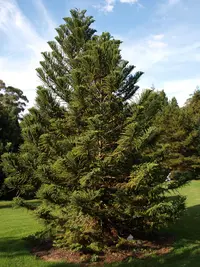
Moreton Bay fig, Ficus macrophylla, is a large evergreen fig tree native to eastern Australia, most famous for its massive trunk and buttress roots in the landscape. In nature it forms a broad, dense canopy with leathery, dark green leaves and small, rounded figs that attract wildlife.
In warm climates it is often used as a dramatic shade or specimen tree, while in cooler regions it may be grown as a container plant when young. It is generally tough once established but needs space, consistent warmth, and moderate moisture, so planning how to care for Moreton Bay fig before planting is important.

Care Difficulty
Moderate Care

Light Preference
Full Sun

Water Requirements
Moderate Water

Temperature Preference
Tropical / Frost Sensitive

Hardiness Zone
10–11

Soil Texture
Sandy, Loamy, Organic-rich

Soil pH
Acidic (5.5–6.5), Slightly acidic (6.5–7.0)

Soil Drainage
Well-drained

Fertilization
Minimal (feed rarely)
Scan your plant to receive care tips personalized for your specific plant
Available on iOS and Android
This large fig tree needs strong light to build a dense canopy and healthy growth.
This species prefers steadily moist but well-aerated soil, especially while young and establishing.
This fig prefers mild, frost-free conditions and slows sharply in prolonged cold.
This species prefers moderately humid air but usually tolerates typical indoor conditions.
Ficus macrophylla prefers deep, well-aerated, freely draining soil with moderate organic content.
This species can be grown in containers when kept pruned and root-restricted.
Ficus macrophylla in cultivation responds well to moderate, balanced feeding during its active growing season.
Pruning Ficus macrophylla helps control size, maintain structure, and remove unsafe or unhealthy wood.
Ficus macrophylla is usually grown as a landscape tree, so transplanting is more relevant than container repotting.
Propagation of Ficus macrophylla is possible but slower and more technical than many smaller ornamentals.
Ficus macrophylla is frost-sensitive and requires thoughtful winter care outside warm coastal or subtropical climates.

Plant Health Check
Not sure what's wrong with your plant? Check your plant's health inside the app.
Ficus macrophylla often begins life as a seedling high in another tree’s canopy, sending roots downward that slowly envelop and outcompete the host tree, eventually forming massive buttress roots that support a very wide trunk base.
This species relies on an almost exclusive pollination relationship with the tiny wasp Pleistodontes froggatti, which enters the enclosed fig inflorescence (syconium) to lay eggs and, in the process, transfers pollen between trees.
In cities such as Sydney, large Moreton Bay figs create complex microhabitats, supporting epiphytic plants, insects, birds, and bats, and significantly modifying local temperature and humidity under their dense canopies.

In its native range in eastern Australia, individual Moreton Bay fig trees can develop root systems and spreading crowns so extensive that a single mature specimen may cover an area comparable to a small city lot, making it one of the most spatially dominant trees in many coastal parks and headlands.
This species is considered fast-growing, often adding 60–90 cm or more per year when young in warm climates. Growth slows with age. Root space, water availability, and nutrient levels strongly influence overall growth rate and canopy spread.
Keep your plants happy and healthy with plant identification, disease detection, and easy care guidance.