Bolivian fuchsia Care (Fuchsia boliviana)

Also known as: lady's eardrops
Bolivian fuchsia

About Bolivian fuchsia

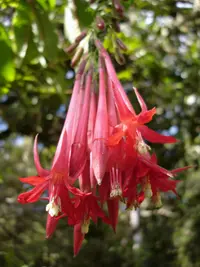
Bolivian fuchsia, Fuchsia boliviana, is a shrubby, fast-growing ornamental plant valued for its long, hanging clusters of tubular red and white flowers. It typically forms a tall, bushy plant with soft green leaves and a graceful, arching habit that suits large containers or sheltered garden spots.

This species is native to cloud forests of the Andes in Bolivia and neighboring regions, where it grows in cool, moist, partially shaded conditions. In cultivation, it is moderately easy if kept frost-free, protected from harsh sun, and given consistently moist, well-drained soil, which forms the core of how to care for Bolivian fuchsia.

Main Plant Requirements

Care Difficulty

Moderate Care

Light Preference

Partial Shade

Water Requirements

Keep Soil Moist

Temperature Preference

Tropical / Frost Sensitive

Hardiness Zone

9–11

Soil Texture

Loamy, Peaty, Organic-rich

Soil pH

Acidic (5.5–6.5), Slightly acidic (6.5–7.0)

Soil Drainage

Moist but well-drained

Fertilization

Moderate (every 2–4 weeks)

Get Personalized Care Plan

Scan your plant to receive care tips personalized for your specific plant

Available on iOS and Android

How to Care for the Bolivian fuchsia

This plant prefers bright, gentle light that mimics a cool, forest-edge environment.

  • Provide 3–5 hours of soft morning sun with bright, filtered light the rest of the day; avoid harsh afternoon sun, especially in summer.
  • Grow Bolivian fuchsia in partial shade in hotter climates, using dappled light under trees or shade cloth to reduce leaf scorch risk.
  • If stems become long and sparse or flowering declines, increase light slightly, but monitor for leaf yellowing or crisp edges from excess sun.

This species needs consistently moist but not waterlogged soil, with close attention during warm weather.

  • Water when the top 2–4 cm of soil feels dry, soaking the root zone thoroughly, then let excess drain away completely.
  • Use rich, well-drained soil; signs of overwatering include yellowing, soft leaves and blackened roots, while drooping, thin leaves and dry stems indicate underwatering.
  • Reduce watering in cooler months as growth slows, but do not allow the root ball to dry out fully, especially during windy periods.

This species favors cool to mild conditions and reacts poorly to frost or extreme heat.

  • Aim for 55–75°F (13–24°C) for active growth; flowering is usually strongest at the cooler end of this range.
  • Protect plants when temperatures drop near 32°F (0°C); light frost can damage young growth, and hard frost may kill top growth or the whole plant.
  • In hot spells above 85°F (29°C), provide shade, extra air movement, and careful watering, as prolonged heat stress reduces flowering and can cause leaf drop.

This species prefers consistently moist air and reacts quickly to dry indoor conditions.

  • Aim for 50–70% humidity, especially in heated homes or during hot, dry weather.
  • Dry tips, curled leaves, and flower bud drop indicate humidity stress and often accompany fast-drying potting mix.
  • Use daily misting, grouped plants, or a pebble tray with water below the pot to raise humidity around Bolivian fuchsia.

This species grows best in evenly moist, well-aerated, organic-rich soil that never stays waterlogged.

  • Use a loose, loamy mix of roughly 50% peat or coco coir, 30% compost, and 20% perlite or pumice for structure and air spaces.
  • Aim for slightly acidic to neutral pH around 6.0–7.0, which supports nutrient uptake and root health.
  • Improve drainage and aeration by avoiding fine, heavy garden soil and adding coarse bark chips or extra perlite to dense mixes.
  • Avoid compacted, clay-heavy, or constantly soggy conditions, which cause root rot and reduced flowering in Fuchsia boliviana.

This species adapts well to containers if the pot supports its vigorous, upright growth.

  • Choose a deep, heavy pot that resists tipping as stems elongate and foliage mass increases toward the top.
  • Select a container material that matches your climate, using terracotta for slightly faster drying or plastic to retain more moisture.
  • Ensure a wide, stable base and place the pot in a sheltered spot where wind is less likely to rock tall, top-heavy growth.

This shrub benefits from steady nutrients during the active growing season for strong shoots and flowering.

  • Use a balanced liquid fertilizer (around 10-10-10 or 20-20-20) at half strength every 2–4 weeks in spring and summer.
  • Alternatively, top-dress with compost or apply a slow-release fertilizer at the start of the growing season.
  • Always water before feeding to reduce root burn risk and avoid fertilizing drought-stressed plants.
  • In fall and winter, stop or reduce feeding to once every 6–8 weeks, especially for indoor containers.

Thoughtful pruning keeps Fuchsia boliviana compact, tidy, and flowering well.

  • Plan the main pruning in late winter or very early spring before strong new growth starts.
  • Remove dead, damaged, weak, or crossing stems first, cutting back to healthy wood with clean, sharp pruners.
  • Shorten overly long or leggy shoots to encourage branching and more flowering points along the stems.
  • In growing season, pinch soft tips lightly to maintain shape and control height in containers or small gardens.

Container-grown plants and young shrubs benefit from periodic repotting or transplanting to support ongoing growth.

  • Check for roots circling the pot, pushing through drainage holes, or for slow growth despite good care as signs to move Fuchsia boliviana.
  • Schedule repotting or transplanting for early spring, just before vigorous growth, about every 2–3 years for potted plants.
  • Step up only 1–2 pot sizes using a well-drained, moisture-retentive mix, keeping the root ball at the same soil level.
  • Water thoroughly after moving, shade from strong sun for several days, and keep soil evenly moist to limit transplant shock.

This species is most often propagated from cuttings, though seed is also possible for patient growers.

  • Take 8–12 cm semi-ripe stem cuttings in late spring or summer, removing lower leaves and any flowers or buds.
  • Insert cuttings into a free-draining mix, keep at 65–75°F, and maintain high humidity with a clear cover and gentle airflow.
  • Bottom heat and optional rooting hormone improve success and speed root formation for Fuchsia boliviana plant care.
  • Sow fresh seed on the surface of a fine mix, keep evenly moist and warm, and expect slower, less uniform germination.

This shrub is frost-sensitive and needs protection in regions with freezing winters.

  • In mild climates, apply a 5–10 cm mulch layer over the root zone in late fall, keeping it slightly away from the stems.
  • In colder areas, grow in containers and move plants indoors before temperatures drop below 40°F.
  • Overwinter indoors in a cool, bright, frost-free space, watering sparingly to keep the root ball just lightly moist.
  • In spring, gradually reintroduce outdoor plants to brighter light and cooler air to prevent shock and leaf scorch.

Care Tips

Provide structural support

Install a sturdy stake or narrow trellis when the plant is still young so the tall, upright stems can be loosely tied and supported before wind or flower weight causes bending or breakage.

Encourage bushier growth

Pinch out the soft tips of new shoots in late spring and early summer to promote side branches and a fuller flowering framework instead of a single tall, leggy stem.

Manage root competition

If planting near trees or large shrubs, add a root barrier or plant in a raised bed so the relatively shallow feeder roots are not outcompeted for moisture and nutrients.

Protect from heavy rain

In very wet climates, position the plant where eaves, a pergola, or overhead shade cloth reduce direct pounding rain on flowers and buds, which helps prevent bruising and premature drop when growing Bolivian fuchsia.

Winterizing in pots

In cold regions, move container plants into a bright, frost-free space before temperatures drop near 32°F and reduce watering so the rootball stays lightly moist but never saturated during the resting period.

Common Pests and Diseases

Fuchsia gall mite

This pest causes distorted, swollen, and reddened growth on shoot tips, leaves, and flowers, often ruining the ornamental display. Damage starts at the softest new growth and can spread rapidly in mild climates.

Solution

Prune off and dispose of all affected shoot tips and buds, sealing and discarding them in the trash, not compost. If local regulations and label directions allow, follow with repeated applications of a targeted miticide or sulfur-based spray, and maintain good spacing and airflow to reduce re‑infestation risk.

Fuchsia rust

This disease produces orange to rust-colored pustules on the undersides of leaves, with yellowing and premature leaf drop. Symptoms include reduced vigor and sparse flowering in humid, mild conditions.

Solution

Remove and discard infected leaves and any fallen debris, then improve air circulation by thinning crowded branches. Avoid overhead watering, and if needed, use a labeled fungicide for rust on a regular schedule until new growth appears clean; this forms part of sound Fuchsia boliviana care instructions in damp regions.

Whiteflies

These insects congregate on the undersides of leaves, sucking sap and causing yellowing, leaf drop, and sticky honeydew that can lead to sooty mold. Infestations build up quickly in warm, sheltered spots or indoor environments.

Solution

Regularly inspect the undersides of leaves and dislodge adults with a strong stream of water, then apply insecticidal soap or horticultural oil, ensuring full coverage. Yellow sticky traps help monitor and reduce adult numbers, and keeping plants less crowded limits spread.

Aphids

These insects feed on tender shoots and flower buds, causing curling, distortion, and sticky honeydew on leaves and stems. Heavy infestations can stunt new growth and reduce flowering.

Solution

Spray affected shoots with a firm jet of water to knock off colonies, then treat remaining insects with insecticidal soap or a light horticultural oil, repeating as needed. Removing heavily infested soft tips and encouraging natural predators such as lady beetles in outdoor plantings also helps keep populations low.

Botrytis blight

This disease leads to soft, brown, water-soaked patches on flowers, buds, and leaves, often covered by gray fuzzy mold in cool, damp conditions. Symptoms include bud drop, rotting petals, and decline of dense, poorly ventilated plants.

Solution

Promptly remove all affected flowers, buds, and leaves and discard them in the trash, then increase airflow and reduce humidity around the plant. Water at the base in the morning, avoid wetting foliage, and if outbreaks persist, use a labeled botrytis fungicide during cool, wet periods while keeping the plant pruned and uncluttered.

Interesting Facts

Hummingbird-specialized flowers

Its long, pendulous red and white flowers evolved to be pollinated mainly by hummingbirds in its native Andean range, which can access nectar deep within the tubular corolla. The flower shape, bright red coloration, and nectar production pattern closely match hummingbird feeding behavior at mid- to high-elevation cloud forests.

High-elevation cloud forest

This species is naturally found in cool, moist montane forests of Bolivia and neighboring regions, often between roughly 1,500–3,000 m where frequent mists and stable temperatures dominate. Its native habitat explains its preference for mild conditions, high humidity, and protection from intense heat.

Edible tubular fruits

After pollination, the plant produces elongated, dark red to purplish berries that are considered edible and mildly sweet by local populations in parts of the Andes. The fruits are sometimes eaten fresh or used in jams, though they are not a major commercial crop.

Botan icon

Did you know?

Some horticultural selections of this species, such as the popular cultivar Fuchsia boliviana 'Alba', produce striking white- to cream-flowered forms that contrast strongly with the typical red and white wild type, illustrating the genetic variation that breeders have been able to capture from wild Andean populations.

FAQs about Bolivian fuchsia

Lack of flowers is usually due to insufficient light, low nutrition, or heavy old wood. Ensure strong but indirect light, feed with a balanced fertilizer during active growth, and prune lightly to encourage new, flowering shoots.

Grow Healthy Plants with Botan Care

Keep your plants happy and healthy with plant identification, disease detection, and easy care guidance.

Botan plant care app — identify plants on mobile

Explore More Plants