Staking Flower Spikes
Insert a slender stake on the sheltered side of each emerging flower spike and secure it loosely with soft ties to prevent wind damage and bending once the tall inflorescences reach full height.

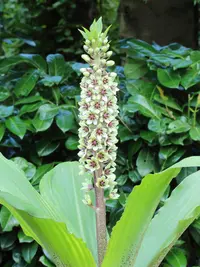
Montane pineapple lily, Eucomis montana, is a bulbous perennial grown for its upright flower spikes topped with a rosette of bracts that resemble a small pineapple. It forms a low clump of broad, often slightly wavy leaves that emerge from a swollen bulb at or just below soil level.
This species is native to higher-altitude regions of southern Africa, where it experiences cool, moist summers and drier winters. Its seasonal growth from a resting bulb makes it relatively forgiving if given a pronounced rest period.
It suits gardeners who can provide bright light, free-draining soil, and protection from hard frost. Understanding how to care for Montane Pineapple Lily mainly involves managing watering and winter dormancy rather than complex ongoing maintenance.

Care Difficulty
Moderate Care

Light Preference
Full Sun

Water Requirements
Moderate Water

Temperature Preference
Warm Climate

Hardiness Zone
7–10

Soil Texture
Sandy, Loamy, Organic-rich

Soil pH
Acidic (5.5–6.5), Slightly acidic (6.5–7.0)

Soil Drainage
Well-drained

Fertilization
Light (every 4–6 weeks)
Scan your plant to receive care tips personalized for your specific plant
Available on iOS and Android
This species prefers bright, open conditions but benefits from some protection from harsh midday sun.
Watering should respond to soil dryness and seasonal growth, not to a fixed calendar.
This bulb grows best in warm, frost-free conditions but can handle brief cool spells when dormant.
This bulb tolerates typical indoor humidity but stays healthiest with slightly moderate levels.
Eucomis montana prefers airy, sharply drained soil that still holds moderate, even moisture in the root zone.
This species is well suited to container growing outdoors in sunny, protected spots.
Eucomis montana responds well to moderate feeding during active growth but does not need heavy fertilization.
Pruning needs for Eucomis montana are minimal and focus on hygiene rather than shaping.
Eucomis montana grows from bulbs that prefer stable conditions and only occasional repotting or transplanting.
Eucomis montana is most commonly propagated by division, with seed used mainly for breeding or patience-demanding projects.
Eucomis montana has moderate frost tolerance, so winter care depends on local minimum temperatures.

Plant Health Check
Not sure what's wrong with your plant? Check your plant's health inside the app.
This species is native to montane grasslands and rocky slopes in South Africa and Lesotho, where it experiences cool nights, intense sun, and strong air movement at higher elevations, conditions that shape its compact growth and sturdy flower stems.
Its dense flower spike is topped with a tuft of leafy bracts that resemble the crown of a pineapple, an adaptation thought to help visually attract insect pollinators to the many small, star-shaped flowers on the spike.
Unlike some lowland Eucomis species, it tolerates cooler summer temperatures and benefits from a marked cool, dry winter rest, reflecting the seasonal climate pattern in its native mountain range.

Compared with many other Eucomis species, Eucomis montana produces relatively short, stout flower stalks that are notably resistant to lodging, a trait valued by horticulturists for stable ornamental displays and long-lasting cut flower use.
This species usually flowers in mid to late summer. Dense spikes can remain attractive for 3–6 weeks, first in bloom and then as ornamental seed heads, especially if protected from extreme heat, drought, and heavy rain.
Keep your plants happy and healthy with plant identification, disease detection, and easy care guidance.