Safety first setup
Place the plant where children and pets cannot reach it, and always use gloves and eye protection when handling or repotting, since the milky sap is highly irritating to skin and eyes.

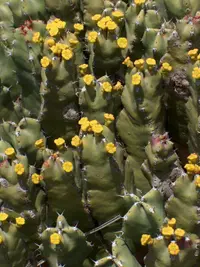
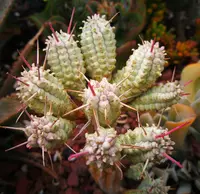
Resin spurge, Euphorbia resinifera, is a compact, clump-forming succulent shrub from arid regions of Morocco. It has upright, bluish-green, 4-angled stems that create a dense, architectural mound. Small, yellowish flowers appear near the stem tips, but the plant is usually grown for its geometric shape and color.
It stores water in its stems and tolerates heat and drought, which makes it relatively easy to grow in dry, bright conditions. Good drainage and sparse watering are key when you care for Resin spurge.

Care Difficulty
Easy Care

Light Preference
Full Sun

Water Requirements
Low Water

Temperature Preference
Warm Climate

Hardiness Zone
9–11

Soil Texture
Sandy, Loamy, Rocky

Soil pH
Slightly acidic (6.5–7.0), Slightly alkaline (7.0–7.5)

Soil Drainage
Well-drained

Fertilization
Minimal (feed rarely)
Scan your plant to receive care tips personalized for your specific plant
Available on iOS and Android
This sun-loving Moroccan succulent thrives in strong light similar to its native habitat.
This drought-adapted succulent stores water in its stems and needs infrequent, careful watering.
This species prefers warm, arid conditions and does poorly in prolonged cold or damp.
This succulent tolerates low humidity and rarely needs special humidity management indoors.
This species needs very sharply drained, mineral-based soil to prevent root and stem rot.
This species is well suited to container growing when drainage and stability are carefully managed.
This drought-adapted succulent needs only light feeding to maintain steady growth in containers.
Pruning is mainly used to keep Euphorbia resinifera compact and remove unhealthy growth.
Container-grown plants need only infrequent repotting due to their slow, compact root system.
Propagation of this species is most reliable from stem cuttings taken in warm weather.
This plant tolerates brief light frost when dry but benefits from basic winter protection in colder climates.

Plant Health Check
Not sure what's wrong with your plant? Check your plant's health inside the app.
This species produces resiniferatoxin, a natural compound in its latex that is one of the most potent TRPV1-receptor activators known and is used experimentally in pain research to selectively silence certain pain-sensing nerve fibers.
It is naturally restricted to rocky, arid slopes of the central and western High Atlas in Morocco, forming dense cushion-like colonies that help stabilize shallow soils in its native habitat.
Historical records indicate that its latex was collected and traded from North Africa into Europe for use as a caustic material, contributing to the long, complex history of euphorbia latex in early pharmacy and craft practices.

The blue-green, many-angled stems of this species form tight geometric mounds that can persist for decades in the wild, allowing a single clonal colony to slowly expand and dominate exposed rock outcrops in its native Moroccan range.
This species performs best outdoors in full sun and very well-drained, gritty soil. It can be kept in containers under bright conditions indoors, but strong light and cool, dry winters are important for reliable shape and flowering.
Keep your plants happy and healthy with plant identification, disease detection, and easy care guidance.