sheep's tongue Care (Titanopsis calcarea)

sheep's tongue

About sheep's tongue

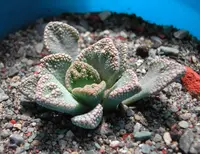
Titanopsis calcarea is a small, low-growing succulent from arid regions of South Africa and Namibia. It forms tight rosettes of thick, warty leaves that blend in with surrounding stones. The rough, knobbly leaf tips help the plant camouflage in its rocky habitat and reduce moisture loss. In good conditions it produces daisy-like yellow flowers in autumn or winter. This species stays compact, making it suitable for windowsills and small containers. It is slow-growing and sensitive to overwatering, so it suits growers who can offer bright light, very fast-draining soil, and careful watering. Understanding how to care for Titanopsis calcarea mainly involves respecting its natural dry-season rhythm.

Main Plant Requirements

Care Difficulty

Moderate Care

Light Preference

Full Sun

Water Requirements

Low Water

Temperature Preference

Cool Climate

Hardiness Zone

8–10

Soil Texture

Sandy, Rocky, Loamy

Soil pH

Slightly acidic (6.5–7.0), Neutral (7.0)

Soil Drainage

Well-drained

Fertilization

Minimal (feed rarely)

Get Personalized Care Plan

Scan your plant to receive care tips personalized for your specific plant

Available on iOS and Android

How to Care for the sheep's tongue

This small South African succulent thrives in bright, cool sun that mimics open, rocky habitats.

  • Provide 4–6 hours of direct morning sun with bright, filtered light the rest of the day; avoid intense, low-angle afternoon sun in very hot climates.
  • The plant tolerates light partial shade, but in less than 3–4 hours of sun it may elongate, lose its compact shape, and show duller leaf colors.
  • In summer, protect Titanopsis calcarea from scorching by using light shade cloth; in winter, maximize sun exposure through a south- or west-facing position.

This species stores water in its leaves and needs infrequent but careful watering to prevent rot.

  • Allow the top 3–5 cm of soil to dry completely before watering, then soak thoroughly so water drains quickly from the root zone.
  • In active growth (cooler seasons), expect to water roughly every 2–4 weeks; reduce sharply in hot dormancy or very low winter light.
  • Watch for soft, translucent leaves or a sulfur smell as signs of overwatering, and wrinkling or slight leaf shriveling as a cue to water Titanopsis calcarea.

This succulent prefers cool to moderately warm conditions with strong light and very good air movement.

  • Aim for 60–75°F (16–24°C) for steady growth; short periods up to 85°F (29°C) are tolerated if soil stays dry and shaded during peak heat.
  • Protect from frost; growth slows below 45°F (7°C), and tissue damage is likely at 32°F (0°C) or lower, especially in wet soil.
  • In hot summers, provide afternoon shade and excellent airflow; in cooler seasons, slightly lower temperatures enhance compact growth without stressing the plant.

This succulent prefers dry air and is comfortable in typical indoor humidity.

  • Aim for 30–40% humidity; avoid prolonged conditions above 60% which encourage rot.
  • Dry, shriveled leaf tips with soft bases may indicate excess humidity combined with overwatering rather than air that is too dry.
  • Improve air movement with a small fan or open window instead of using humidifiers, which are unnecessary for Titanopsis calcarea.

Soil for this species must be very fast-draining and mineral-rich to prevent root and crown rot.

  • Use a gritty mix of roughly 60–70% mineral material (pumice, coarse sand, grit) and 30–40% succulent potting mix or sieved compost.
  • Structure should be open and crumbly, with large pore spaces so water drains through in seconds rather than pooling.
  • A slightly alkaline to neutral pH around 7.0–7.5 suits Titanopsis calcarea, which naturally grows in lime-rich rocky soils.
  • Avoid fine peat, clay, or un-sieved compost that compacts; add extra pumice or grit if water does not drain freely within 1–2 minutes.

This species is well suited to container growing due to its compact, shallow root system.

  • Choose a wide, shallow pot so the thin roots spread laterally and the leaf rosettes stay above any lingering moisture layer.
  • Unglazed terracotta is useful because it allows evaporation through the pot walls, reducing the risk of a persistently wet root zone.
  • Elevate the pot slightly on feet or mesh so drainage holes stay clear and water exits quickly after each irrigation, especially outdoors.

This compact succulent needs only light feeding to stay healthy in containers.

  • Use a low-dose balanced liquid fertilizer (for example 10-10-10) diluted to 25% strength in spring and early summer.
  • Apply every 4–6 weeks during active growth if the potting mix is very mineral and low in organic matter.
  • Avoid high-nitrogen or slow-release products that keep soil moist around the roots.
  • Stop feeding Titanopsis calcarea in late summer to fall, and do not fertilize in winter dormancy.

Pruning needs for this species are minimal and focus on hygiene rather than shaping.

  • Best time to tidy the plant is late winter to early spring before active growth resumes.
  • Gently remove dead, dried, or rotting leaves at the base to reduce fungal problems.
  • Use clean fingers or fine tweezers; avoid cutting into firm, living tissue.
  • Light grooming maintains airflow between rosettes but does not significantly alter Titanopsis calcarea growth form.

This slow-growing succulent prefers infrequent repotting and tight, shallow containers.

  • Repot only every 3–4 years, or when roots circle the pot, drainage slows, or growth stalls.
  • Best timing is late spring, when conditions are warm and dry enough for quick recovery.
  • Use a shallow pot with large drainage holes and a very gritty, fast-draining mix to limit root rot risk.
  • Handle the root ball gently, remove only loose soil, and keep the plant slightly dry for 5–7 days after repotting to reduce stress.

Propagation is possible but slow, relying mainly on seed and occasional division of clumps.

  • Sow fresh seeds in late spring in a shallow tray filled with sterile, very gritty mix.
  • Provide bright light, 70–75°F warmth, and lightly moist (not wet) surface until germination.
  • Once seedlings develop several true leaves, gradually reduce watering and increase light intensity.
  • For mature clusters, divide offsets in warm weather and replant in dry mix, keeping them barely moist until new roots form.

Cold-season care focuses on keeping this succulent cool, very dry, and frost-free.

  • Outdoors, it is best in mild climates; avoid exposure below about 25°F, especially when soil is wet.
  • Move containers indoors or into a cold greenhouse before hard frost, giving bright light and good airflow.
  • Reduce watering sharply in winter, allowing the mix to stay almost completely dry to prevent root rot.
  • Do not mulch heavily around pots; excess moisture retention around the crown is more harmful than cold alone for Titanopsis calcarea.

Care Tips

Seasonal rest period

From late fall to early spring, reduce disturbance, avoid repotting, and keep the plant in a bright, cool, very dry spot to respect its natural winter-growing and summer-dormant rhythm.

Top-dressing with grit

Apply a 0.5–1 cm layer of clean mineral grit or small pumice on the soil surface to keep the leaf bases dry, reduce rot risk, and support compact, upright growth.

Targeted bottom-watering

When water is needed, place the pot in a shallow tray of water for 5–10 minutes so moisture wicks up through the drainage holes, then let it drain completely to avoid wetting the leaf rosettes.

Controlled clump division

Divide congested clumps only during active growth, keeping at least 3–4 rosettes per division, and allow cut surfaces to dry for several days before replanting into dry, sterile, mineral substrate.

Flowering energy management

After flowering, remove spent flower stalks by gently twisting them off at the base to reduce energy loss and encourage the plant to focus resources on healthy leaf and root development when growing Titanopsis calcarea.

Common Pests and Diseases

Mealybugs

This pest hides in leaf crevices and at the stem base, sucking sap and causing wrinkling, stunting, and distorted new growth. Symptoms include white, cotton-like clusters that trap dust and can lead to secondary fungal issues.

Solution

Isolate the plant, then remove visible insects with a cotton swab dipped in 70% isopropyl alcohol and gently clean the leaf surfaces. Improve light and airflow, keep the plant dry between waterings, and repeat alcohol swabs weekly until no new insects appear; for larger infestations, use a labeled systemic insecticide suitable for succulents according to directions.

Root mealybugs

This pest lives in the soil on the roots, causing slow decline, poor growth, and leaves that shrivel even when the plant is watered correctly. Symptoms include white, cottony residue on roots and around drainage holes when the plant is unpotted.

Solution

Unpot the plant, wash off all soil and infested roots with a gentle water stream, and cut away heavily affected roots with sterile tools. Soak the root zone briefly in a diluted systemic insecticide or insecticidal soap labeled for root mealybugs, let it dry for 1–2 days, then repot in fresh, very well-draining mineral mix and keep on the dry side for 7–10 days before resuming light watering.

Fungal crown rot

This disease starts at the crown where leaves meet the stem, often after overwatering or water sitting in the rosette, leading to soft, translucent tissue and collapse of the central growth. Symptoms include brown or black mushy spots at the base of leaves and a sour or musty odor.

Solution

At early stages, remove all affected tissue with a sterile blade, dust the wound lightly with a dry sulfur-based fungicide, and keep the plant completely dry in bright, airy conditions until a callus forms. If most of the crown is affected, discard the plant and disinfect the pot and tools; in future, use a fast-draining, gritty mix and water only when the mix is completely dry, avoiding water trapped in the rosette as part of general Titanopsis calcarea care.

Soft scale

These insects attach firmly to leaves and stems, appearing as small, flat or slightly domed brown or gray bumps that do not brush off easily. This pest feeds on sap, causing yellowing, reduced vigor, and sticky honeydew that can attract sooty mold.

Solution

Gently scrape off individual scales with a fingernail or soft tool, then wipe leaf surfaces with a cloth lightly moistened with 70% isopropyl alcohol to remove remaining juveniles and honeydew. Repeat inspections every 7–10 days and, for persistent infestations, apply a systemic insecticide labeled for succulents following package instructions, while maintaining good light and low humidity.

Interesting Facts

Rock-like camouflage

In its native South African habitats, the leaves mimic surrounding limestone gravel in color and texture, helping the plant avoid herbivores by visually blending into the ground surface.

Seasonally split leaves

The thick leaf pair slowly splits down the center as new leaves emerge from within, a growth pattern that protects young tissue and conserves water in an arid environment.

Micro-warty leaf surface

The rough, warty bumps on the leaf tops are composed of specialized epidermal cells that scatter intense sunlight, reducing leaf temperature and limiting UV damage.

Botan icon

Did you know?

This species often grows in shallow quartzite and limestone crevices where only a small portion of the leaf surface is exposed above the soil, an adaptation that minimizes water loss and heat stress while still allowing enough light for photosynthesis.

FAQs about sheep's tongue

Lack of flowering usually comes from insufficient light, excess summer watering, or very nutrient‑rich soil. This species often needs a cool, bright, drier rest in fall–winter to set buds and produce its daisy‑like blooms.

Grow Healthy Plants with Botan Care

Keep your plants happy and healthy with plant identification, disease detection, and easy care guidance.

Botan plant care app — identify plants on mobile

Explore More Plants