Safe handling routine
Use nitrile or latex gloves and long sleeves when repotting or taking cuttings, and keep paper towels or a damp cloth nearby to immediately wipe off any exposed sap from tools or skin.

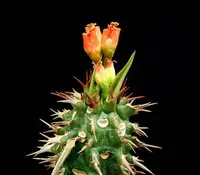
Euphorbia viguieri is a semi-succulent shrub from Madagascar, known for its thick, spiny stems and rosettes of glossy, often red-tinted leaves near the tips. It sometimes produces small, colorful bracts that frame its modest flowers, giving the plant an ornamental, almost miniature tree look.
In habitat it grows in rocky, dry areas, which explains its strong tolerance to drought and its need for excellent drainage. It is not a beginner’s plant, but patient growers who learn how to care for Euphorbia viguieri usually find it manageable in bright, warm indoor or greenhouse conditions.

Care Difficulty
Moderate Care

Light Preference
Partial Sun

Water Requirements
Low Water

Temperature Preference
Tropical / Frost Sensitive

Hardiness Zone
11–12

Soil Texture
Sandy, Loamy, Rocky

Soil pH
Slightly acidic (6.5–7.0), Neutral (7.0)

Soil Drainage
Well-drained

Fertilization
Minimal (feed rarely)
Scan your plant to receive care tips personalized for your specific plant
Available on iOS and Android
This species prefers bright, indirect light with some gentle direct sun each day.
Watering should mimic dry-season and wet-season cycles while always protecting roots from standing water.
This succulent shrub prefers warm, stable conditions and does not tolerate frost.
This succulent shrub manages well in typical indoor humidity if air stays on the dry side.
This species needs a sharply draining, mineral-rich mix that dries quickly between waterings.
This species is well suited to container growing when drainage and stability are prioritized.
This species grows on poor, rocky soils and needs only light feeding in containers.
Pruning is mainly used to remove damage and keep Euphorbia viguieri compact and safe to handle.
Container-grown plants appreciate infrequent repotting into slightly larger pots with sharp drainage.
Propagation is possible but moderately challenging, especially from cuttings that exude sticky sap.
This species is frost-sensitive and needs controlled, dry winter conditions, especially in containers.

Plant Health Check
Not sure what's wrong with your plant? Check your plant's health inside the app.
This species is endemic to the dry deciduous forests of Madagascar, where it grows on rocky slopes and well-drained substrates exposed to strong seasonal drought.
The thick, spiny trunk acts as a water-storing organ and also carries out most of the photosynthesis, while the narrow leaves are often shed in the dry season to reduce water loss.
What look like red or orange petals are actually colored bracts surrounding very small, cup-shaped cyathia, which are the characteristic inflorescences of the genus.

In its native range this species often grows as a solitary, sculptural shrub up to several meters tall, making it a striking element of the spiny thicket vegetation that has evolved a high level of endemism on Madagascar.
Yellowing leaves often result from excess moisture around the roots, sudden temperature drops, or natural aging of older foliage. Check for soggy substrate, improve drainage, and inspect roots for rot or pests before adjusting watering frequency.
Keep your plants happy and healthy with plant identification, disease detection, and easy care guidance.