Grey-leaved euryops Care (Euryops pectinatus)

Also known as: Woolly True-Eye, Golden True-Eye, Greyleaf True-Eye, Wool Harpuis
Grey-leaved euryops

About Grey-leaved euryops

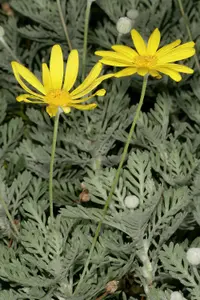
Grey-leaved euryops (Euryops pectinatus) is a compact, woody shrub known for its fine, silvery foliage and bright yellow, daisy-like flowers. It stays relatively small and rounded, which makes it useful for borders, containers, and low hedges in mild climates.

This species comes from coastal areas of South Africa, where it experiences sun, wind, and dry, rocky soils. It is valued as a long-blooming ornamental that tolerates heat, poor soils, and some drought, so many gardeners find it straightforward to care for Grey-leaved euryops.

It performs best with plenty of sun, well-drained soil, and only moderate moisture, especially once established.

Main Plant Requirements

Care Difficulty

Easy Care

Light Preference

Full Sun

Water Requirements

Low Water

Temperature Preference

Warm Climate

Hardiness Zone

9–11

Soil Texture

Sandy, Loamy, Rocky

Soil pH

Slightly acidic (6.5–7.0), Neutral (7.0)

Soil Drainage

Well-drained

Fertilization

Minimal (feed rarely)

Get Personalized Care Plan

Scan your plant to receive care tips personalized for your specific plant

Available on iOS and Android

How to Care for the Grey-leaved euryops

This sun-loving shrub needs strong light to flower well and keep compact growth.

  • Provide 6–8 hours of direct sun daily; full sun suits Grey-leaved euryops best in most coastal and temperate climates.
  • In very hot inland areas, give morning sun with light afternoon shade to reduce leaf scorch and drying winds.
  • Watch stems and blooms: lanky, weak growth and few flowers indicate too much shade, while bleached, crispy foliage points to excess intense sun.

This plant prefers moderately dry conditions and is sensitive to prolonged soggy soil.

  • Water when the top 3–5 cm of soil feels dry, allowing the root zone to dry slightly between soakings.
  • Use sharply drained soil; puddling around the base, yellowing leaves, or a sour smell indicate overwatering and poor drainage.
  • Reduce watering in cool seasons and after flowering flushes; wilting at midday that recovers by evening usually reflects heat, not a need for extra water in Euryops pectinatus.

This Mediterranean shrub thrives in mild, frost-free climates with warm, sunny conditions.

  • Aim for 60–75°F (16–24°C) for active growth, with best flowering in the cooler end of this range.
  • Euryops pectinatus tolerates brief dips to about 25°F (−4°C), but foliage damage and dieback increase below 28°F (−2°C).
  • In hot regions, it copes with 90–95°F (32–35°C) if soil is well drained and roots are mulched; prolonged frost or freezing winds can kill top growth and may require re-sprouting from the base.

This species prefers relatively dry air and rarely needs special humidity management.

  • Aim for 30–50% humidity, similar to typical indoor air, as Grey-leaved euryops tolerates dry conditions well.
  • Watch for limp, pale foliage and crisp leaf edges if air is extremely dry for long periods.
  • In very arid homes, group plants together or place the pot on a pebble tray with water below the pot base.

Euryops pectinatus grows best in light, fast-draining soil that mimics its dry, coastal origins.

  • Use a sandy or sandy-loam mix with coarse particles to keep the root zone airy and prevent compaction.
  • Combine roughly 50–60% general potting mix with 30–40% coarse sand plus 10–20% perlite for sharper drainage.
  • Target slightly acidic to neutral pH around 6.0–7.0; avoid strongly acidic or alkaline conditions that restrict nutrient uptake.
  • Avoid heavy clay, peat-heavy, or water-retentive mixes, which promote root rot and weak, lush growth.

This shrub is suitable for container growing when drainage and stability are carefully managed.

  • Choose a wide, heavy container to counter its bushy, wind-catching top growth and reduce tipping risk outdoors.
  • Select a pot slightly wider than the root ball so the free-draining mix dries between waterings rather than staying wet at the center.
  • Ensure large, unobstructed drainage holes so rain or irrigation water can exit quickly, preventing waterlogged lower roots.

This shrub responds well to light, consistent feeding during active growth.

  • Use a balanced, water-soluble fertilizer (around 10-10-10) at 1/2 strength every 4–6 weeks in spring and summer.
  • Alternatively, apply a slow-release granular fertilizer in early spring for steady nutrients.
  • Incorporate a thin layer of compost on top of the soil once a year for Grey-leaved euryops.
  • Stop feeding in fall and winter to allow natural rest and prevent weak, leggy growth.

Pruning supports compact growth and abundant flowering in Euryops pectinatus.

  • Carry out main pruning in late winter or very early spring before new growth starts.
  • Remove dead, damaged, or crossing stems with clean, sharp hand pruners.
  • Shorten overly long shoots by up to one-third to maintain a dense, rounded shape.
  • Deadhead spent flower stems through the growing season to encourage repeat blooming.

Container-grown plants benefit from periodic repotting or transplanting to maintain vigor.

  • Check for roots circling the pot, pushing through drainage holes, or noticeably slow growth as signals to move the plant.
  • Plan repotting or transplanting in early spring, about every 2–3 years for potted Euryops pectinatus.
  • Choose a slightly larger container and use a free-draining mix; gently loosen circling roots without tearing them heavily.
  • Water thoroughly after moving, then keep soil lightly moist and shelter from strong sun and wind for 7–10 days to reduce stress.

New plants are most commonly raised from semi-ripe stem cuttings.

  • Take 7–10 cm semi-ripe cuttings in late summer from healthy, non-flowering shoots of Euryops pectinatus.
  • Remove lower leaves and dip cut ends in rooting hormone to improve success.
  • Insert cuttings into a gritty, well-drained mix and keep at 65–75°F with bright, indirect light.
  • Maintain slightly moist, not wet, conditions and good air flow until roots form in 4–8 weeks.

This species is frost sensitive and needs protection in colder climates.

  • In mild coastal areas, add a 5–8 cm mulch layer around the root zone, keeping it off the stems.
  • In regions below about 25°F, grow in containers so plants can be moved indoors or into a frost-free greenhouse.
  • Place indoor plants in the brightest possible spot, water sparingly, and avoid cold drafts over winter.

Care Tips

Rotate For Balance

Turn containers 90° every 1–2 weeks so stems receive even light and develop a bushy, wind-resistant shape rather than leaning or splitting on one side.

Pinch Flower Spikes

After the main spring flush, lightly pinch back just the newest soft shoot tips with fingers or clean shears to encourage more lateral branches and a longer blooming season without heavy pruning shock.

Use Low Windbreaks

In exposed sites, place low, airy barriers such as open lattice or shrub companions on the windward side to reduce stem breakage while still allowing good air circulation around the foliage.

Refresh Surface Grit

Top-dress the soil surface annually with a thin layer of coarse grit or small gravel to keep lower stems dry, reduce soil splash on leaves, and stabilize roots in containers.

Plan For Replacement

Because plants can become woody and less floriferous after several years, take semi-ripe cuttings in late summer to root new plants so there is always a younger, more free-flowering generation available when caring for Grey-leaved euryops.

Common Pests and Diseases

Aphids

These insects feed on young shoots and flower buds, causing distortion, sticky honeydew, and sometimes sooty mold on foliage. This pest is often found on tender new growth during warm weather.

Solution

Prune off heavily infested shoot tips, then hose down remaining stems and leaves with a firm stream of water to dislodge insects. If needed, apply an insecticidal soap or a ready-to-use horticultural oil, repeating every 7–10 days until new growth stays clean; this is one of the most effective methods for caring for Grey-leaved euryops when aphids are present.

Spider mites

This pest thrives in hot, dry conditions and causes fine stippling, bronzing, and a dull, dusty look on leaves, with fine webbing between stems. Severe infestations can lead to partial defoliation and general decline.

Solution

Increase humidity around the plant and spray foliage thoroughly with water, including leaf undersides, to knock mites off. For persistent problems, use horticultural oil or insecticidal soap, applied in the evening and repeated several times, while also avoiding drought stress.

Leaf spot

This disease produces small brown to dark purplish spots on leaves that may merge and cause yellowing and premature leaf drop. Symptoms include more severe spotting in dense, poorly ventilated canopies or during prolonged wet weather.

Solution

Remove and dispose of affected leaves and any fallen debris, and thin or prune the plant lightly to improve air circulation. Water at the base rather than overhead, and in serious cases use a labeled ornamental fungicide, following product directions and treating during early symptom development.

Botrytis blight

This disease causes grey-brown, soft lesions on flowers, buds, and sometimes leaves, often covered with fuzzy grey mold in cool, damp conditions. Symptoms include browning flower heads and collapse of affected tissues.

Solution

Promptly deadhead spent or damaged flowers and remove affected plant parts to reduce spore spread, keeping the area around the plant clean. Improve airflow, avoid overhead watering late in the day, and in persistent cases consider a fungicide labeled for botrytis on ornamentals, applied at the first signs of infection.

Interesting Facts

Coastal wind specialist

This shrub naturally occurs along exposed South African coastlines and shows strong tolerance to wind and salt spray, which makes it unusually well adapted to seafront gardens compared with many other daisy relatives.

Year-round flower production

In mild Mediterranean-type climates, it can flower almost continuously, not just seasonally, because it does not require a cold dormant period to reset its blooming cycle.

Fine dissected foliage

Its grey, fern-like leaves are highly divided, increasing surface area for gas exchange while the silvery color reflects sunlight, which helps limit overheating and water loss in sunny, dry habitats.

Botan icon

Did you know?

In some Mediterranean-climate regions outside its native South Africa, this species has naturalized along disturbed roadsides and coastal areas, where its rapid growth and heavy seed production allow it to establish persistent, daisy-yellow bands of vegetation that can outcompete more delicate local wildflowers.

FAQs about Grey-leaved euryops

Poor flowering is usually linked to insufficient light, excessive nitrogen fertilizer, or old, unpruned stems. Remove spent blooms, lightly prune after flowering to renew growth, and avoid high-nitrogen feeds that favor foliage over buds.

Grow Healthy Plants with Botan Care

Keep your plants happy and healthy with plant identification, disease detection, and easy care guidance.

Botan plant care app — identify plants on mobile

Explore More Plants