Early support training
Install strong vertical supports or a trellis while the plant is still young, then loosely tie new shoots every 15–20 cm to guide the scrambling stems and prevent breakage at the base.

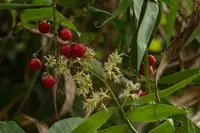
Climbing Bushcane (Flagellaria guineensis) is a perennial climbing monocot often grown as an ornamental for its long, cane-like stems and narrow, grass-like leaves. It supports itself by looping its leaf tips around nearby structures or plants, creating a loose, scrambling tangle rather than tight coils.
In the wild, it occurs in tropical Africa, usually in moist forests, thickets, and along water margins, where it benefits from warmth and steady humidity. It can be grown outdoors in frost-free climates or under protection in cooler regions.
This species is moderately easy to manage if its need for support, consistent moisture, and free-draining soil is respected. Understanding how to care for Climbing Bushcane largely comes down to providing warmth, bright light, and protection from prolonged drought or cold.

Care Difficulty
Moderate Care

Light Preference
Partial Sun

Water Requirements
Regular Water

Temperature Preference
Tropical / Frost Sensitive

Hardiness Zone
11–12

Soil Texture
Sandy, Loamy, Organic-rich

Soil pH
Acidic (5.5–6.5), Slightly acidic (6.5–7.0)

Soil Drainage
Moist but well-drained

Fertilization
Light (every 4–6 weeks)
Scan your plant to receive care tips personalized for your specific plant
Available on iOS and Android
This tropical climber needs bright, warm conditions with protection from harsh midday sun.
This species prefers consistently moist but not waterlogged soil.
This vine thrives in warm, frost‑free climates with stable temperatures.
This species prefers consistently moist air and benefits from moderately high humidity.
This climber performs best in deep, moisture-retentive but well-drained soil.
This species can adapt well to container growing when its climbing habit and high moisture needs are managed carefully.
This vigorous climber benefits from modest, consistent feeding during the warm growing season.
Pruning helps keep Flagellaria guineensis manageable, encourages fresh shoots, and maintains support-friendly growth.
This species is usually grown in the ground, but young plants or container specimens may need occasional transplanting or repotting.
New plants are typically raised from stem cuttings or layering rather than seed.
This tropical climber is frost-sensitive and needs protection in climates with cool or freezing winters.

Plant Health Check
Not sure what's wrong with your plant? Check your plant's health inside the app.
This species does not twine or produce tendrils; instead, its leaf tips extend into stiff, backward-curving hooks that mechanically latch onto neighboring vegetation to support the long, cane-like stems.
In its native West and Central African range, this plant often grows in swamp forests and at the landward margins of mangroves, tolerating periodic flooding and salt-tinged conditions better than many other forest climbers.
The tough, flexible stems are widely harvested in parts of tropical Africa for weaving baskets, fish traps, and other household items, providing an important non-timber forest product in rural communities.

Ethnobotanical studies from West and Central Africa report that this species is commonly used as a natural tying and binding material in construction and agriculture, where its strong, pliable stems substitute for rope to secure house frames, fences, and crop supports.
This species is a twining climber and performs best with sturdy support such as trellises, fences, or wires. Without something to wind around, stems flop, tangle, and are more prone to breakage and disease issues.
Keep your plants happy and healthy with plant identification, disease detection, and easy care guidance.