Post-bloom feeding
After flowers fade but leaves remain green, apply a balanced granular bulb fertilizer around the clump and water it in so the bulbs can store energy for next year’s bloom.

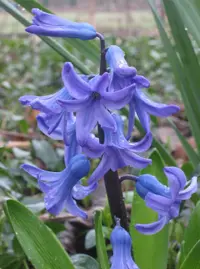
Hyacinth, Hyacinthus orientalis, is a spring-flowering bulb grown for its dense spikes of fragrant, tubular flowers. It produces upright stems from compact bulbs and narrow, strap-like leaves. Flowers come in shades of blue, purple, pink, white, and yellow, making it a common choice for seasonal displays and containers. In the wild, it originates from the eastern Mediterranean region, where it grows in sunny, well-drained sites. Modern garden forms are relatively easy to grow if the bulb is kept in free-draining soil and not exposed to standing water. Understanding how to care for Hyacinth focuses mainly on providing a cool dormant period and avoiding overwatering.

Care Difficulty
Moderate Care

Light Preference
Full Sun

Water Requirements
Moderate Water

Temperature Preference
Cool Climate

Hardiness Zone
4–8

Soil Texture
Sandy, Loamy, Organic-rich

Soil pH
Acidic (5.5–6.5), Slightly acidic (6.5–7.0)

Soil Drainage
Well-drained

Fertilization
Minimal (feed rarely)
Scan your plant to receive care tips personalized for your specific plant
Available on iOS and Android
Spring-flowering bulbs of Hyacinthus orientalis need strong light for compact growth and reliable blooming.
Hyacinthus orientalis prefers evenly moist but never waterlogged soil, especially during active spring growth.
This bulb needs a cool dormant period and mild spring temperatures to bloom well.
This bulb tolerates typical indoor humidity and does not need special humidity management.
Hyacinthus orientalis bulbs need loose, fast-draining, moderately fertile soil to avoid rot.
This species grows well in containers when drainage and bulb depth are carefully managed.
Nutrient needs for Hyacinthus orientalis are modest but targeted feeding improves flowering, especially in containers.
Pruning needs for Hyacinthus orientalis are simple and focus on flower and foliage clean-up rather than shaping.
Hyacinthus orientalis is most often grown as an outdoor bulb, with transplanting done infrequently but at defined times.
Propagation of Hyacinthus orientalis is usually done by bulb division rather than by seed in home gardens.
In many temperate climates, Hyacinthus orientalis bulbs are cold hardy and need only light winter care outdoors.

Plant Health Check
Not sure what's wrong with your plant? Check your plant's health inside the app.
This species is native to the eastern Mediterranean region, especially parts of Turkey, Syria, and Lebanon, where wild populations grow on rocky slopes and open scrub rather than in dense forests.
Its strong scent comes from a mix of volatile organic compounds such as benzyl acetate, linalool, and phenethyl alcohol, which together create the characteristic sweet fragrance that can be detected at low concentrations.
During the 17th and 18th centuries in the Netherlands, this species became a major ornamental bulb crop, and intensive breeding produced hundreds of cultivars with different flower colors and forms, making it a significant part of early European horticulture and influencing modern Hyacinthus orientalis plant care practices.

Unlike many spring bulbs that die back gradually, this species often experiences rapid post-flowering decline of its above-ground leaves in warm, dry conditions, an adaptation that helps the bulb avoid summer heat and drought in its native Mediterranean climate by remaining dormant underground.
Lack of blooms usually comes from insufficient cold period, bulbs planted too shallow, or bulbs exhausted from previous flowering. Ensure a full chilling season, plant at proper depth, and replace very small, spent bulbs for reliable flowers.
Keep your plants happy and healthy with plant identification, disease detection, and easy care guidance.