Secure Early Training
Attach new stems to the wall or support using soft ties in a loose figure-eight, guiding them horizontally during the first 2–3 years to create a dense, well-anchored framework.

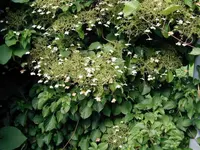
Climbing hydrangea (Hydrangea petiolaris) is a deciduous woody vine known for its strong clinging stems and showy white lacecap flowers in late spring to early summer. It climbs walls, fences, and trees using aerial roots, forming a dense, textured cover with heart-shaped, dark green leaves that turn yellow in autumn.
This species is native to wooded and rocky areas of Japan, Korea, and nearby regions, where it thrives in cool, moist, partial shade. Once established, it is generally long-lived but can be slow to get going, so patience is important when learning how to care for Climbing hydrangea. It prefers humus-rich, well-drained soil that stays evenly moist.

Care Difficulty
Moderate Care

Light Preference
Partial Shade

Water Requirements
Regular Water

Temperature Preference
Cold Hardy

Hardiness Zone
4–8

Soil Texture
Loamy, Clay, Organic-rich

Soil pH
Acidic (5.5–6.5), Slightly acidic (6.5–7.0)

Soil Drainage
Moist but well-drained

Fertilization
Light (every 4–6 weeks)
Scan your plant to receive care tips personalized for your specific plant
Available on iOS and Android
This climbing shrub prefers bright but gentle light to flower well and maintain healthy foliage.
This species prefers consistently moist, cool soil without prolonged dryness or saturation.
This hardy climber tolerates a wide temperature range but grows best in moderate conditions.
This climber prefers moderate ambient humidity and reacts if air is too dry for long periods.
Hydrangea petiolaris grows best in consistently moist, well-structured soil with reliable drainage.
This species can be grown in large containers if the pot is stable and allows extensive root development.
This woody climber benefits from modest feeding, especially when young or container grown.
Hydrangea petiolaris responds well to light, timed pruning to maintain size and encourage flowering wood.
This climber is usually grown outdoors and benefits more from careful transplanting than frequent repotting.
Hydrangea petiolaris is commonly propagated vegetatively, as seed is slow and less reliable.
This climber is quite cold hardy and usually needs minimal winter care in most temperate gardens.

Plant Health Check
Not sure what's wrong with your plant? Check your plant's health inside the app.
This species produces specialized aerial roots along its stems that secrete a sticky substance, allowing it to cling strongly to walls, rocks, and tree trunks without support structures.
Its lacecap flower clusters have a central ring of small fertile flowers surrounded by a ring of larger, sterile white florets, which act as visual signals to pollinators while the fertile flowers provide the nectar and pollen.
Native to cool, moist woodlands of Japan, Korea, and parts of eastern Russia, it has evolved strong cold tolerance and performs reliably in many temperate gardens that are too chilly for other climbing hydrangeas, which is useful to understand when planning Hydrangea petiolaris plant care.

In older specimens, the stems form a dense, woody network that can develop a trunk-like base, effectively turning the plant into a vertical, bark-covered structure that may support birds, insects, and epiphytic mosses much like a small tree in its own right.
Growth is slow in the first 2–3 years while roots develop, often only 5–15 cm per year. After establishment, it can extend 30–60 cm annually, depending on soil quality, moisture, and support.
Keep your plants happy and healthy with plant identification, disease detection, and easy care guidance.