Install sturdy support
Provide a strong trellis, wires, or tensioned mesh early on and loosely tie new vines with soft ties so stems lignify (turn woody) in the desired direction without kinking or snapping.

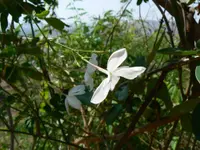
Common jasmine, Jasminum officinale, is a woody, deciduous climber valued for its fragrant, star-shaped white flowers. It often grows on trellises, fences, or pergolas, where long, flexible stems can be trained for support.
In the wild, it occurs from the Himalayas through parts of Asia and into the Middle East, thriving in warm, temperate climates. Gardeners grow it for its strong evening scent and long flowering season.
This species is moderately easy to grow if its basic needs are met. It prefers bright light, free-draining soil, and steady moisture, which are key points in how to care for Common jasmine.

Care Difficulty
Moderate Care

Light Preference
Full Sun

Water Requirements
Moderate Water

Temperature Preference
Cool Climate

Hardiness Zone
7–10

Soil Texture
Sandy, Loamy, Organic-rich

Soil pH
Acidic (5.5–6.5), Slightly acidic (6.5–7.0)

Soil Drainage
Moist but well-drained

Fertilization
Light (every 4–6 weeks)
Scan your plant to receive care tips personalized for your specific plant
Available on iOS and Android
This species prefers bright conditions and rewards stable, strong light with more flowers.
Moist but well-drained soil supports healthy roots and flowering for this jasmine.
Stable, moderate temperatures support strong growth and flowering for this vine.
This species prefers moderate humidity but usually adapts to typical home air if not extremely dry.
Jasminum officinale performs best in loose, fast-draining, moderately fertile soil.
This species is well suited to container growing when given adequate root space and support.
Jasminum officinale responds well to moderate feeding during its active growing season.
Pruning helps Jasminum officinale stay compact, manageable, and free-flowering.
Container-grown Jasminum officinale benefits from occasional repotting to maintain healthy root growth.
Jasminum officinale is commonly propagated by cuttings and layering for consistent flowering plants.
Common jasmine is fairly cold hardy but benefits from simple winter care, especially in colder regions or containers.

Plant Health Check
Not sure what's wrong with your plant? Check your plant's health inside the app.
This species releases most of its fragrance in the evening and at night, when its white, tube-shaped flowers open fully to attract nocturnal pollinators such as moths.
Although native to the Himalayan region and surrounding areas of Western China, Afghanistan, and Iran, it has naturalized widely across Europe and parts of North America, especially in mild, temperate climates.
For centuries, its intensely fragrant flowers have been harvested for high-quality jasmine absolute, a key ingredient in traditional perfumery, particularly in France and India.

In some temperate regions, this vigorous climber can produce flowering shoots up to several meters long in a single growing season, allowing it to quickly cover pergolas, fences, or walls when provided with adequate support and care, which is why many guides emphasize Jasminum officinale plant care for trained climbers.
Lack of flowers often comes from insufficient light, heavy pruning at the wrong time, or excess nitrogen fertilizer. Cool winter rest, bright conditions, and light post-bloom pruning usually restore flowering and support healthy, growing Common jasmine.
Keep your plants happy and healthy with plant identification, disease detection, and easy care guidance.