Tillandsia aeranthos Care

Tillandsia aeranthos

About Tillandsia aeranthos

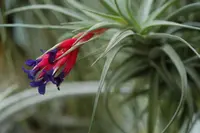
Tillandsia aeranthos is an epiphytic air plant from South America, often found clinging to tree branches or rocks instead of growing in soil. It forms tight rosettes of narrow, arching gray-green leaves that can develop pinkish tones in bright light. In season, it produces a short flower spike with purple tubular blooms and colorful bracts, giving a compact but striking display. This species is adapted to collect moisture and nutrients from the air, which makes it relatively low-maintenance indoors when humidity and airflow are adequate. Understanding how to care for Tillandsia aeranthos mainly involves providing bright, indirect light and regular watering without keeping the plant constantly wet.


Main Plant Requirements

Care Difficulty

Moderate Care

Light Preference

Bright Indirect Light

Water Requirements

Moderate Water

Temperature Preference

Tropical / Frost Sensitive

Hardiness Zone

10–12

Soil Texture

Rocky, Organic-rich

Soil pH

Acidic (5.5–6.5)

Soil Drainage

Well-drained

Fertilization

Light (every 4–6 weeks)

Get Personalized Care Plan

Scan your plant to receive care tips personalized for your specific plant

Available on iOS and Android

How to Care for the Tillandsia aeranthos

This species prefers bright, indirect light with limited direct sun exposure.

  • Provide 6–8 hours of bright, filtered light daily, such as near an east- or bright north-facing window, or under 30–50% shade cloth outdoors.
  • Allow only gentle morning sun; strong midday or afternoon sun can scorch leaves, causing bleaching or crispy tips within days.
  • If light is too low, leaves turn darker and growth slows; move Tillandsia aeranthos gradually closer to a brighter position, especially in winter.

This air plant absorbs water through its leaves and dries faster than many potted plants.

  • Thoroughly soak or mist 2–3 times per week in warm seasons, then allow leaves to dry fully within 3–4 hours in good air movement.
  • In cooler months or low light, reduce to about 1–2 thorough waterings per week, watching for slightly curling or wrinkling leaves as a sign to increase moisture.
  • Avoid overwatering signs like soft, brown bases or a musty smell by never leaving water trapped in leaf bases and ensuring fast drying after each soak.

This species prefers mild, frost-free conditions with stable temperatures.

  • Keep day temperatures around 65–80°F (18–27°C) for steady growth, with slightly cooler nights down to about 55–60°F (13–16°C).
  • Protect from frost; damage usually occurs below 32°F (0°C), so move plants to shelter whenever a freeze is forecast.
  • In hot spells above 90°F (32°C), provide shade, strong air movement, and a bit more frequent watering to prevent heat stress and leaf desiccation.

This species benefits from moderate to high humidity but tolerates typical indoor levels if watering is consistent.

  • Aim for 50–70% humidity, with slightly higher levels helpful in heated or air-conditioned rooms.
  • Dry, crispy leaf tips and slow growth indicate humidity stress and often underwatering.
  • Increase humidity by grouping air plants, using a pebble tray with water nearby, or misting lightly between soakings.

Tillandsia aeranthos is an epiphyte and should not be planted in conventional potting soil.

  • Mount plants on cork, driftwood, or open wire structures, or place them loosely in shells or baskets so air reaches all sides.
  • Avoid any dense or water-holding mix such as peat-heavy potting soil, which suffocates the roots and traps moisture around the base.
  • If decorative media are used, choose coarse bark, lava rock, or large gravel that dry quickly and do not pack tightly.
  • Ensure the plant dries fully within 3–4 hours after soaking or misting by maintaining open structure and strong air circulation.

This species can be displayed in containers as long as the design keeps it above any retained water.

  • Use shallow, wide vessels that allow the plant to sit on top of pebbles or inert media while remaining fully exposed to air.
  • Choose heavier containers or add stones for weight if the display is tall, since clumps can become top-heavy over time.
  • Select non-porous glass or ceramic only when the opening is large enough for rapid air exchange and easy removal for soaking.

This air plant benefits from light feeding during active growth but does not need heavy fertilizer inputs.

  • Use a diluted balanced epiphytic or bromeliad fertilizer (around 1/4 strength) in water, avoiding urea-based formulations.
  • Mist or soak Tillandsia aeranthos with fertilized water every 4–6 weeks in spring and summer, then rinse lightly with plain water.
  • Stop or reduce feeding to once during the whole period in fall and winter, as growth slows in cooler, lower-light conditions.
  • Avoid slow-release granules and compost, which can burn or rot foliage and trap excess moisture around the plant.

Pruning is minimal and focuses on hygiene and shaping the clump.

  • Trim dried flower spikes and completely brown leaves at any time using clean, sharp scissors to maintain a tidy appearance.
  • In late winter or early spring, remove dead or rotting foliage to improve air circulation and reduce fungal issues.
  • Separate and remove overcrowded or poorly positioned offsets to refine the shape and encourage better light exposure.
  • Disinfect tools with alcohol before use to limit disease transfer between plants.

This epiphytic species is usually mounted or placed loosely in containers rather than traditionally repotted.

  • Transplant when the clump outgrows its mount, becomes unstable, or when central plants die back and offsets dominate the display.
  • Choose late winter to early spring for remounting, as plants resume active growth and recover faster from handling stress.
  • Gently detach offsets, keeping their base intact, and tie or glue them with non-toxic adhesive to a new mount with good air flow.
  • After transplanting, provide bright, indirect light and slightly reduced watering for 7–10 days to limit stress while the plant reanchors.

Propagation relies mainly on offsets, with seed used less often for home cultivation.

  • After flowering, allow pups to reach about 1/3–1/2 the size of the parent Tillandsia aeranthos before removing them.
  • In spring or early summer, gently twist or cut pups from the base with sterile scissors, keeping their attachment point intact.
  • Mount pups on bark, cork, or wire frames in bright, indirect light with excellent air circulation to support establishment.
  • Seed propagation requires warm (70–80°F), consistently humid conditions and very bright light, and seedlings develop slowly.

This air plant is not frost hardy and benefits from controlled conditions in winter.

  • Keep plants above 45°F, with an ideal winter range around 55–65°F, as freezing temperatures can damage foliage permanently.
  • Move outdoor mounts or displays indoors before the first frost and place them in bright, indirect light.
  • Reduce watering slightly, allowing plants to dry quickly between soakings, while maintaining good air circulation to avoid rot.
  • Avoid placing plants directly above heaters or in cold drafts, as rapid temperature swings increase stress.

Care Tips

Optimized mounting surfaces

Attach plants to inert, fast-drying materials like cork bark, hardwood, or plastic-coated wire rather than moisture-holding wood, and avoid copper or treated lumber, which can leach compounds that damage air plant roots and leaf bases.

Air circulation planning

Place plants where there is gentle, consistent air movement from a ceiling or oscillating fan to speed drying after misting or soaking and reduce the risk of rot in the leaf bases.

Post-bloom pup management

After flowering, leave the mother plant in place until offsets reach about one-third to one-half its size, then gently twist or cut pups away to maintain a compact clump and encourage strong, independent growth when you grow Tillandsia aeranthos.

Drainage after soaking

After any soak, invert the plant and gently shake out trapped water from the central rosette and leaf bases, then dry it on its side or upside down on a towel for 30–60 minutes before returning it to display.

Outdoor summer placement

In mild climates, move plants outdoors in bright shade for late spring to early fall to increase light intensity and day–night temperature fluctuation, which often improves color and flowering, but protect them from direct rain and strong winds.

Common Pests and Diseases

Scale insects

This pest attaches to the leaves and bases, sucking sap and causing yellowing, stunting, and weak growth. Symptoms include small, dome-shaped brown or gray bumps that feel hard and do not rub off easily.

Solution

Isolate the plant, then manually remove insects with a cotton swab dipped in isopropyl alcohol and rinse the plant thoroughly with lukewarm water. Improve air movement, avoid overfertilizing, and repeat alcohol swabs or use an insecticidal soap spray every 7–10 days until no new scale appears.

Mealybugs

These insects hide in leaf axils and around the base, feeding on plant juices and weakening the plant. Symptoms include white, cottony clusters, sticky honeydew, and sometimes sooty mold developing on the exudate.

Solution

Physically remove visible clusters with a cotton swab dipped in isopropyl alcohol, then rinse the entire plant under a strong but gentle stream of water. Keep humidity moderate, increase airflow, and repeat alcohol spot-treatments or insecticidal soap applications weekly until the infestation is gone.

Spider mites

This pest thrives in hot, dry, stagnant air and feeds on leaf surfaces, causing a dull, speckled appearance. Symptoms include fine webbing in leaf crevices and very small moving dots when viewed closely.

Solution

Rinse the plant thoroughly under running water, focusing on the inner leaf bases and undersides, then increase humidity and air circulation. For persistent cases, use a miticidal or insecticidal soap spray labeled for spider mites, applied every 5–7 days while keeping the plant out of direct sun until dry.

Bacterial soft rot

This disease affects air plants kept too wet with poor ventilation, leading to rapid tissue collapse. Symptoms include a water-soaked, mushy base, foul odor, and leaves detaching easily from the center.

Solution

Remove and discard the affected plant, since soft rot spreads quickly and is rarely reversible. Improve care for nearby plants by limiting soaking time, ensuring they dry fully within 3–4 hours, increasing air movement, and avoiding water pooling in the central base to support healthier Tillandsia aeranthos care.

Leaf tip rot

This disease is triggered by chronic moisture on the leaves and poor drying conditions. Symptoms include dark brown or black tips that progress inward, sometimes with a thin yellow margin between healthy and dead tissue.

Solution

Trim off affected tips with sterile scissors, cutting back into firm, healthy tissue, and let the cut edges dry in good airflow. Adjust watering by shortening soak duration or switching to thorough misting, ensure the plant dries quickly after each watering, and avoid placing it in closed, stagnant containers or globes.

Interesting Facts

Southern Brazil specialist

This epiphytic species occurs naturally from southern Brazil into Uruguay and northeastern Argentina, where it grows on tree branches and sometimes on power lines in windy, open habitats near the Atlantic coast.

Twilight blooming cycle

It typically flowers once a year, often in late spring to early summer, producing blue to violet tubular flowers from pink bracts that are adapted to attract specific pollinators such as hummingbirds in its native range.

Twisted leaf adaptation

The stiff, often slightly twisted leaves are covered in dense trichomes (specialized scale-like hairs) that reflect excess light and rapidly absorb water and nutrients from rain, fog, and dust, allowing the plant to live without soil.

Botan icon

Did you know?

This species is one of the few air plants documented forming large, almost spherical clumps in the wild, as offsets stay attached to the mother plant, creating ball-like colonies that can persist on the same tree branch for many years.

FAQs about Tillandsia aeranthos

Lack of blooms usually comes from insufficient light, too little air movement, or irregular hydration. Mature plants bloom once when well lit, lightly fed, and exposed to a natural day–night temperature difference of about 10–15°F.

Grow Healthy Plants with Botan Care

Keep your plants happy and healthy with plant identification, disease detection, and easy care guidance.

Botan plant care app — identify plants on mobile

Explore More Plants