Contain Rhizome Spread
In garden beds or near ponds, install a 15–20 cm deep root barrier or plant in a wide, bottomless container sunk into the soil to prevent the rhizomes from invading nearby planting areas while still allowing normal growth.

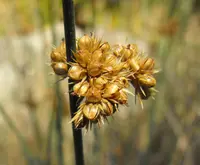
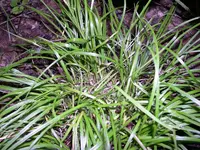
Spreading rush, Juncus patens, is a clumping, grass-like perennial rush native to wetlands and stream edges in western North America. It forms upright, narrow, blue-green stems that create a dense, architectural tuft.
This species is often used in rain gardens, water features, and naturalistic plantings because it tolerates periodic flooding and brief dry spells once established. It suits both ornamental landscapes and ecological restoration.
Spreading rush prefers sun to light shade, consistent moisture, and soil that does not stay dry for long. Its durability and tolerance of wet conditions make it relatively straightforward to care for spreading rush in suitable sites.

Care Difficulty
Moderate Care

Light Preference
Full Sun

Water Requirements
Aquatic

Temperature Preference
Cold Hardy

Hardiness Zone
6–10

Soil Texture
Sandy, Loamy, Clay

Soil pH
Slightly acidic (6.5–7.0), Neutral (7.0)

Soil Drainage
Waterlogged tolerant

Fertilization
Minimal (feed rarely)
Scan your plant to receive care tips personalized for your specific plant
Available on iOS and Android
This rush thrives in bright exposures that mimic open, damp meadows.
This wetland rush prefers consistently moist to saturated conditions rather than drying between waterings.
This species is adapted to mild climates but tolerates a broad temperature range with some seasonal adjustment.
This wetland rush prefers high humidity but adapts to typical home levels if kept evenly moist at the roots.
This species prefers consistently moist to saturated soil with a dense, organic texture that still allows some oxygen to reach the roots.
This rush is suitable for containers, especially for water features, patios, and small outdoor spaces.
Juncus patens is a low-fertility native that benefits from modest feeding in poor or soilless substrates, including spreading rush indoor care.
Pruning Juncus patens is mainly cosmetic and helps maintain a clean, upright clump.
Juncus patens is often grown in-ground, but container plants or crowded clumps benefit from periodic transplanting.
Juncus patens is most reliably propagated by division, with seed used mainly for larger restoration projects.
Juncus patens is generally cold hardy in much of the US and requires minimal winter care in the ground.

Plant Health Check
Not sure what's wrong with your plant? Check your plant's health inside the app.
This species is naturally native to coastal and lowland regions of California and Oregon, where it occupies wet meadows, seeps, stream margins, and seasonal swales that regularly fluctuate between inundated and drier conditions.
The plant forms dense, upright clumps of cylindrical, bluish-green stems that function as the main photosynthetic organs, since it has very reduced, scale-like leaves along the stems.
Its fibrous, shallow root system helps bind soil in wet areas, which can reduce erosion along stream banks and depressions while also providing structural habitat for aquatic invertebrates and small amphibians.
This species spreads slowly by short rhizomes and clump expansion rather than running widely. It can form dense patches over time but is usually manageable. Division every few years keeps size in check in small gardens.
Keep your plants happy and healthy with plant identification, disease detection, and easy care guidance.