Install sturdy staking
In windy or exposed sites, place 2–3 sturdy stakes around the clump and use soft ties or garden tape to loosely secure tall stems so heavy blooms and wet foliage do not lodge or snap.

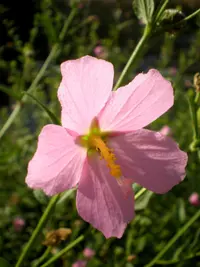
Saltmarsh mallow, Kosteletzkya pentacarpos, is a perennial flowering plant in the mallow family, related to hibiscus. It forms upright, branching stems with soft, heart-shaped leaves and showy pink, hibiscus-like blooms. Plants often reach a medium height and create a light, airy look in planting schemes.
This species is native to coastal marshes and wet meadows in eastern North America and parts of Europe and Asia, where it grows in periodically flooded, salty or brackish soils. It is generally robust if given full sun, consistent moisture, and reasonably fertile soil. Gardeners who understand how to care for Saltmarsh mallow usually find it a dependable choice for rain gardens and other damp sites.

Care Difficulty
Moderate Care

Light Preference
Full Sun

Water Requirements
Aquatic

Temperature Preference
Cold Hardy

Hardiness Zone
4–9

Soil Texture
Sandy, Loamy, Silty

Soil pH
Acidic (5.5–6.5), Slightly acidic (6.5–7.0)

Soil Drainage
Waterlogged tolerant

Fertilization
Minimal (feed rarely)
Scan your plant to receive care tips personalized for your specific plant
Available on iOS and Android
This coastal perennial thrives in full sun but tolerates some light shade in hot regions.
This wetland species prefers consistently moist conditions and does not like to dry out completely.
This hardy perennial tolerates a wide temperature range but responds best to warm, frost-free growing seasons.
This coastal perennial prefers consistently moist air but usually manages in typical outdoor humidity.
This species thrives in moist, fertile, slightly acidic to neutral soils with a soft, open structure.
This species can grow in large containers outdoors if moisture and stability are carefully managed.
This native perennial usually needs minimal feeding in fertile, moist soil, but light fertilization can support flowering in lean sites.
Pruning Kosteletzkya pentacarpos is straightforward and mainly aimed at maintaining vigor and tidy form.
This species is most often grown in the ground, so focus on transplanting young plants rather than frequent repotting.
Kosteletzkya pentacarpos is commonly propagated from seed and, less often, from softwood or semi-ripe cuttings.
This perennial is fairly cold hardy in much of its range and usually needs only simple winter care outdoors.

Plant Health Check
Not sure what's wrong with your plant? Check your plant's health inside the app.
This species is naturally found in coastal marshes, ditches, and tidal flats around the Atlantic, Mediterranean, and parts of Asia, where it tolerates periodic flooding and fluctuating water levels.
The plant is halophytic, meaning it can grow in saline soils and brackish water, and it has been studied as a potential species for phytoremediation of salt-affected lands.
Its pink hibiscus-like flowers provide nectar and pollen for bees and other pollinators, while its dense growth can offer cover and habitat structure in wetland restoration projects.

This species has been investigated as a promising crop candidate for marginal coastal lands because it combines salt tolerance with relatively high biomass production, making it of interest for both bioenergy research and ecological restoration in saline environments.
This species is highly attractive to pollinators. Bees, hoverflies, and butterflies visit the flowers for nectar and pollen through much of summer. Planting groups of several individuals increases visibility and provides a more reliable food source.
Keep your plants happy and healthy with plant identification, disease detection, and easy care guidance.