Streambank positioning
Plant near the outer edge of ponds or slow-moving streams where water is 0–5 cm above the crown to reduce winter rot and summer drought stress.

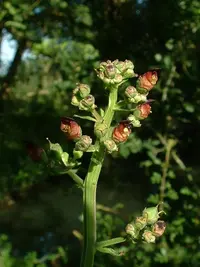
Water betony, Scrophularia auriculata, is a moisture-loving perennial herb often found along stream banks, ponds, and wet meadows. It forms upright clumps with square stems and opposite leaves.
The plant produces many small, tubular, brownish-red flowers that attract bees and other pollinators, giving it value in wildlife-friendly gardens. It is generally hardy and resilient if its need for constant moisture is met.
Gardeners who care for water betony usually grow it in sunny to lightly shaded spots with consistently damp, fertile soil. Once established in the right place, it tends to require only modest attention.

Care Difficulty
Moderate Care

Light Preference
Partial Sun

Water Requirements
Aquatic

Temperature Preference
Cool Climate

Hardiness Zone
5–8

Soil Texture
Loamy, Silty, Organic-rich

Soil pH
Slightly acidic (6.5–7.0), Neutral (7.0)

Soil Drainage
Waterlogged tolerant

Fertilization
Minimal (feed rarely)
Scan your plant to receive care tips personalized for your specific plant
Available on iOS and Android
Scrophularia auriculata prefers bright, cool conditions typical of stream banks and pond margins.
This moisture-loving species thrives in consistently damp to saturated soils.
This hardy perennial tolerates a wide temperature range typical of temperate climates.
This wetland perennial prefers consistently moist air but usually copes with typical outdoor humidity.
This species thrives in consistently wet, oxygenated soil that does not turn stagnant.
This plant can grow in containers if the pot is managed to stay very moist without becoming stagnant.
Scrophularia auriculata is a modest feeder that benefits from light, consistent nutrition in rich, moist soils.
Pruning Scrophularia auriculata is mainly done to tidy growth and support healthy flowering.
This species is usually grown in the ground, so focus more on careful transplanting than on frequent repotting.
Scrophularia auriculata is commonly propagated by seed and by division of established clumps.
This plant is generally cold hardy in much of the US and needs minimal winter care once established.

Plant Health Check
Not sure what's wrong with your plant? Check your plant's health inside the app.
The leaves have distinctive rounded lobes at the base that clasp the stem, creating an ear-like shape that gave rise to the species name auriculata, meaning eared.
Its small, dark, urn-shaped flowers have narrow openings that favor long-tongued pollinators such as certain bees, which can reach the nectar more efficiently than generalist insects.
This species commonly anchors itself along the margins of slow-flowing rivers, canals, and ditches in western Europe, where it benefits from moist soils without strong current scouring the roots.

Genetic and morphological studies show that this species is closely allied to other European figworts yet maintains a distinct niche in lowland freshwater systems, making it a useful indicator of relatively stable, unpolluted riparian habitats in parts of its native range.
This species forms clumps that gradually widen by short rhizomes and self-seeding. It can spread in consistently moist soil but is usually manageable. Deadhead spent flower stems and remove unwanted seedlings to keep patches contained.
Keep your plants happy and healthy with plant identification, disease detection, and easy care guidance.