Plan for Transplanting
Start young trees in a temporary bed with loose, stone-free soil so roots stay fibrous, then transplant to the final site when the trunk reaches about 1–2 cm diameter to reduce transplant shock and losses.

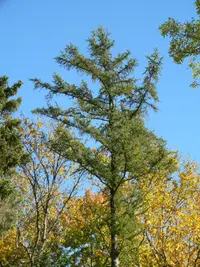
Tamarack, or Larix laricina, is a cold-hardy deciduous conifer native to northern North America, especially bogs, wetlands, and cool forest edges. It grows as a medium-sized tree with soft, bright green needles that emerge in clusters and turn golden yellow before dropping in fall.
The tree has a straight, narrow trunk with fine, flexible branches, giving a light, open crown. It tolerates harsh winters and wet, acidic soils but dislikes hot, dry conditions.
Because of its need for cold winters, ample moisture, and specific soil conditions, it is easier to grow in northern climates than in warmer regions. Understanding how to care for Tamarack starts with matching its natural habitat as closely as possible.

Care Difficulty
Moderate Care

Light Preference
Full Sun

Water Requirements
Regular Water

Temperature Preference
Cold Hardy

Hardiness Zone
2–5

Soil Texture
Loamy, Silty, Peaty

Soil pH
Strongly acidic (4.5–5.5), Acidic (5.5–6.5)

Soil Drainage
Waterlogged tolerant

Fertilization
Minimal (feed rarely)
Scan your plant to receive care tips personalized for your specific plant
Available on iOS and Android
This cold-hardy conifer needs abundant direct light to develop dense, healthy foliage.
This species prefers consistently moist but not stagnant soil, especially during its active growing season.
This boreal conifer is very cold-tolerant and prefers cool to cold winters with moderate summer heat.
Larix laricina tolerates a wide humidity range and rarely needs special humidity management outdoors.
Larix laricina prefers cool, moist, and aerated soil that does not dry out completely.
This species can be grown in containers only for the short to medium term, mainly for young specimens or bonsai.
Larix laricina usually grows well in average soil and needs only modest fertilization in cultivation.
Larix laricina benefits from light, targeted pruning to maintain structure and tree health.
Larix laricina is usually grown in the ground, so focus on careful transplanting rather than frequent repotting.
Larix laricina is most reliably propagated from seed, with success depending on correct dormancy-breaking conditions.
Larix laricina is a cold-hardy, deciduous conifer that usually needs minimal winter care in the ground.

Plant Health Check
Not sure what's wrong with your plant? Check your plant's health inside the app.
This conifer is unusual because it is fully deciduous, dropping all its needles each autumn after they turn a clear yellow, then leafing out again in spring.
It is strongly associated with cold peatlands and sphagnum bogs, where it tolerates waterlogged, oxygen-poor soils that exclude many other tree species.
Its soft, short needles are produced in dense clusters on short shoots, a structure that improves light capture during the short northern growing season while still tolerating frost and wind.

In parts of northern North America, tamarack often forms the natural treeline, marking the transition zone where continuous forest ends and open tundra begins, which makes its presence an indicator of climate and permafrost conditions.
This conifer is deciduous, not evergreen. It keeps soft needles through the growing season, then they turn golden-yellow and drop in fall. Bare branches in winter are normal and not a sign of poor health.
Keep your plants happy and healthy with plant identification, disease detection, and easy care guidance.