Install firm supports
Provide a sturdy mesh, wire fence, or netting at sowing time so young vines can climb early, which reduces stem breakage and maximizes airflow around foliage.

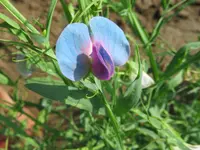
White pea, Lathyrus sativus, is an annual legume grown for its edible seeds and as a hardy cover crop. It has slender, climbing stems, paired leaflets, and tendrils that help it scramble over supports or nearby plants.
Flowers are typically white to pale blue, followed by angular pods containing small, square seeds. The plant is native to parts of the Mediterranean and Asia but is now cultivated in many dry, marginal farming areas.
It is valued for its tolerance to poor soils and drought, which can make it easier to maintain than many other legumes. Those who want to learn how to care for white pea should note that it prefers full sun, moderate moisture, and well-drained soil.

Care Difficulty
Easy Care

Light Preference
Full Sun

Water Requirements
Moderate Water

Temperature Preference
Cool Climate

Hardiness Zone
6–9

Soil Texture
Sandy, Loamy, Silty

Soil pH
Slightly acidic (6.5–7.0), Neutral (7.0)

Soil Drainage
Well-drained

Fertilization
Minimal (feed rarely)
Scan your plant to receive care tips personalized for your specific plant
Available on iOS and Android
Lathyrus sativus prefers full sun but tolerates some light shade in hot climates.
Lathyrus sativus prefers steadily moist, well‑drained soil without long dry spells or standing water.
This cool‑season annual thrives in mild temperatures and struggles with frost or intense summer heat.
Humidity is rarely a concern for Lathyrus sativus, which suits typical outdoor conditions in most regions.
Lathyrus sativus prefers moderately fertile, well-drained mineral soil that stays evenly moist but not saturated.
This species can be grown in containers if the pot is deep, stable, and drains very efficiently.
Lathyrus sativus benefits from modest feeding on poor soils but often manages without fertilizer in reasonably rich ground.
Lathyrus sativus responds well to light structural pruning that maintains airflow and encourages flowering.
This species is usually grown as a field or garden crop, so transplanting young plants matters more than long-term repotting.
Lathyrus sativus is most commonly propagated from seed, which allows straightforward increase of planting stock.
In many temperate regions this species is handled as a cool-season annual, so extensive winter care is usually unnecessary.

Plant Health Check
Not sure what's wrong with your plant? Check your plant's health inside the app.
The seeds contain a compound called beta-N-oxalyl-L-alpha,beta-diaminopropionic acid (beta-ODAP), a neurotoxic amino acid that can cause a paralysis syndrome known as neurolathyrism after heavy, long-term consumption as a staple food.
This species is highly drought-tolerant and can produce a harvest on poor, dry soils where many other food crops fail, which is why it has historically been used as a famine or emergency crop in parts of Asia and Africa.
The seeds are rich in protein and have been widely used as an inexpensive source of dietary protein for humans and livestock, especially during food shortages, despite the risk associated with chronic overconsumption.

Historical reports link recurrent neurolathyrism outbreaks to prolonged drought and famine conditions, where communities in regions such as the Indian subcontinent relied on this single legume as their main staple for months, highlighting how environmental stress and food insecurity can turn an otherwise valuable crop into a serious public health risk.
Poor flowering usually comes from high temperatures, excessive nitrogen fertilizer, or too much shade. Allow cooler conditions, use a balanced low-nitrogen fertilizer, and ensure enough light so buds can set and open normally.
Keep your plants happy and healthy with plant identification, disease detection, and easy care guidance.