Moss mulch layer
Apply a thin layer of live or dried sphagnum moss around the root zone to keep the shallow roots evenly cool and moist while preventing fine stems from drying out at the soil surface.

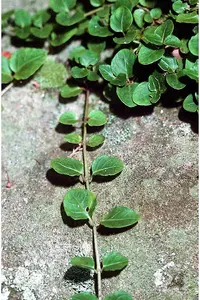
Partridgeberry (Mitchella repens) is a low, creeping evergreen groundcover native to woodlands of eastern North America. It forms dense mats of small, rounded leaves and fine trailing stems.
The plant bears tiny white, fragrant flowers that develop into paired red berries that can persist into winter. Its compact growth makes it suitable for shaded rock gardens, terrariums, and naturalistic woodland plantings.
Partridgeberry prefers part to full shade, evenly moist but well-drained, acidic soil, and cool conditions. These traits mean it can be slow to establish, so understanding how to care for partridgeberry helps keep it healthy over time.

Care Difficulty
Moderate Care

Light Preference
Partial Shade

Water Requirements
Keep Soil Moist

Temperature Preference
Cold Hardy

Hardiness Zone
3–8

Soil Texture
Loamy, Peaty, Organic-rich

Soil pH
Strongly acidic (4.5–5.5), Acidic (5.5–6.5)

Soil Drainage
Moist but well-drained

Fertilization
Minimal (feed rarely)
Scan your plant to receive care tips personalized for your specific plant
Available on iOS and Android
Mitchella repens prefers cool, shaded woodland conditions with soft, filtered light.
This species prefers consistently moist, never soggy, soil that mimics a cool forest floor.
This creeping evergreen thrives in cool to moderate climates with stable, non-extreme temperatures.
This species prefers moderately moist air but usually adapts to typical home humidity.
Mitchella repens grows best in loose, humus-rich soil that mimics a cool forest floor.
This creeping species is suitable for shallow containers and troughs.
Mitchella repens is a low-feeding woodland groundcover that benefits from light, occasional nutrition in poor soils.
Mitchella repens needs minimal pruning, mainly to keep its low mat tidy and healthy.
This species is usually grown as a groundcover, so transplanting in the garden is more common than container repotting.
Mitchella repens is most often propagated vegetatively to maintain its compact, mat-forming habit.
This evergreen groundcover is cold hardy in much of its native range and usually needs little winter attention.

Plant Health Check
Not sure what's wrong with your plant? Check your plant's health inside the app.
This low, creeping shrub forms dense evergreen mats in acidic forests, and its distinctive twin bright red berries usually develop from paired white fragrant flowers on each stem node.
Its small tubular flowers are pollinated mainly by small native bees and flies that can navigate the narrow corolla, which helps maintain fruit set in the shaded forest understory where larger pollinators are less active.
The berries are relatively dry and mild-tasting for humans but are eaten by wild turkeys, grouse, small mammals, and some songbirds during late fall and winter, providing a modest but reliable food source on the forest floor.

This species frequently reproduces vegetatively by rooting at stem nodes as it spreads, so a large carpet in the woods is often a single genetic individual that has slowly expanded across the forest floor over many years.
This species spreads slowly as a low, creeping ground cover, rooting where stems touch the soil. It rarely becomes aggressive. Edges are easy to manage by lifting or trimming runners that move beyond the desired area.
Keep your plants happy and healthy with plant identification, disease detection, and easy care guidance.