


Swiss Cheese Vine (Monstera adansonii) Light Needs

Swiss Cheese Plant grows best in bright, indirect light with only brief, gentle direct sun.

Light Preference

Partial Shade

Monstera adansonii Light Requirements

Monstera adansonii is native to tropical Central and South America, where it grows in humid forests as a climbing understory plant. Its leaves are adapted to dappled light beneath taller vegetation, not exposed open sun. It may receive brief sunflecks or softer seasonal light, but most light is filtered through the canopy. In cultivation, it prefers bright, indirect or filtered light.

  • Ideal exposure:

    Swiss Cheese Plant needs about 6–8 hours of bright, indirect or filtered light daily, including up to 1–2 hours of gentle morning sun.

  • Direct sun:

    Brief early sun is usually tolerated, but full sun and hot afternoon rays can scorch the thin leaves.

  • Lower light:

    Shade is tolerated, yet growth often becomes slower, leggier, and less full when light stays weak.

  • Seasonal light:

    In winter, a brighter position may be helpful because indoor daylight is weaker and shorter.

Indoors, place it where daylight is bright but direct sun is limited and gentle.

NConditional
North-facing window:

A north-facing window can work if it is large and unobstructed, but growth may slow in dim rooms.

EBest
East-facing window:

An east-facing window is often ideal because it gives soft morning sun and bright indirect light later in the day.

SConditional
South-facing window:

A south-facing window works best with a sheer curtain or a position 3–6 ft back from the glass.

WConditional
West-facing window:

A west-facing window can be too intense unless filtered or set back from direct afternoon rays.

Choose the brightest position that avoids long, hot direct sun on the leaves.

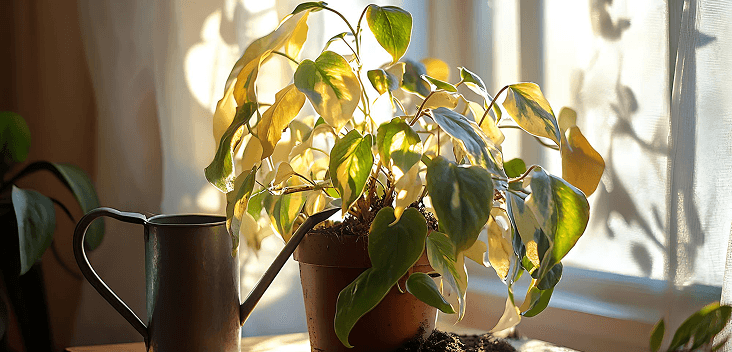
Strong direct sun can mark the thin leaves quickly.

Pale patches:

Leaves may develop washed-out tan or yellowish areas on the side facing the glass or sun.

Papery scorch:

Sun-exposed sections can turn dry, thin, and papery after strong direct rays.

Curled leaves:

Leaves may curl or angle away from the light during the brightest part of the day.

Faded surface:

Monstera adansonii may look dull or bleached where direct sun repeatedly hits the same leaves.

Move the plant out of the direct sun path or filter the light with a sheer curtain. Damaged areas will not turn green again, so judge recovery by new growth.

Low light usually shows up in the growth pattern before it causes major leaf problems.

  • Long spacing:

    Vines may stretch with wider gaps between leaves as the plant reaches toward available light.

  • Smaller leaves:

    New leaves may be smaller and may develop fewer natural openings than expected.

  • Leaning growth:

    Stems may angle strongly toward the nearest window or brighter side of the room.

  • Slow active growth:

    During spring and summer, new growth may be sparse even when the plant is otherwise stable.

Move it gradually to a brighter spot with indirect light. Avoid a sudden shift into strong direct sun, which can create a new stress problem.

Choose the brightest room that avoids hot afternoon rays, and keep the leaves outside direct sun patches. If ideal light is not available, a slightly lower-light spot is safer than a harsh, exposed one.

Move the plant a few inches at a time if growth stretches, and rotate the pot every 1–2 weeks for more even vines. Avoid dim corners far from daylight because new leaves usually stay small there.

Get Personalized Care Plan

Scan your plant to receive care tips personalized for your specific plant

FAQ

The best light for Swiss Cheese Plant is bright, indirect light for most of the day. Gentle morning sun is usually fine, but harsh direct sun can scorch the leaves.

Everything About Swiss Cheese Vine

More Plant Light Guides

Get the Botan App

Discover how to care for your plants with Botan.

Botan app identifying a plant with a phone camera
Best Fertilizer for Vegetable Gardens – What to Use for Each Plant

11 min read · 20 Jul 2026

Best Fertilizer for Vegetable Gardens – What to Use for Each Plant

Here, you’ll find the right fertilizer formula for vegetables in your garden. Learn how to adjust feeding correctly throughout the growing cycle, spot nutrient deficiencies by their symptoms, and keep your plants healthy and prolific.

Plant Recommendations
Best Fertilizer for Vegetable Gardens – What to Use for Each Plant
How to Mist Plants – Proper Technique and Common Mistakes

7 min read · 30 Jul 2026

How to Mist Plants – Proper Technique and Common Mistakes

Find out when misting works well and when to avoid it. Here, you’ll find detailed information about compatible and incompatible species, tips on how often to mist plants and do it correctly, and some great alternatives for raising humidity.

Beginner Guides
How to Mist Plants – Proper Technique and Common Mistakes
Plant Pot Sizes: How to Choose the Right Plant Container

7 min read · 20 Aug 2026

Plant Pot Sizes: How to Choose the Right Plant Container

Plant pot sizes can be confusing because the number on the label only tells you part of the required information. A container may look spacious but actually be too shallow. So, how to choose pot size for plant species?

Beginner Guides
Plant Pot Sizes: How to Choose the Right Plant Container