Stabilize tall spikes
Use thin, smooth orchid stakes and soft clips placed loosely along the inflorescence as it elongates to keep the tall flower spikes upright without bruising the stem or leaves.

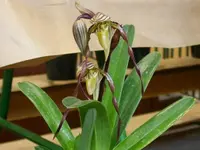
Paphiopedilum philippinense, often called the Philippine paphiopedilum, is a tropical slipper orchid known for its striking, long-petaled flowers and mottled foliage. It grows as a compact, clump-forming plant without pseudobulbs, storing moisture mainly in its leaves and roots.
This species is native to limestone-rich forests in the Philippines, where it grows on rocky slopes and among leaf litter in warm, humid conditions. Its need for stable warmth, good humidity, and pure water makes it moderately challenging, so learning how to care for Philippine paphiopedilum is important for long-term success.
In cultivation, Paphiopedilum philippinense prefers bright, filtered light, evenly moist but well-drained media, and good air movement around the roots and foliage.

Care Difficulty
Moderate Care

Light Preference
Bright Indirect Light

Water Requirements
Keep Soil Moist

Temperature Preference
Tropical / Frost Sensitive

Hardiness Zone
Unknown

Soil Texture
Peaty, Organic-rich

Soil pH
Acidic (5.5–6.5)

Soil Drainage
Moist but well-drained

Fertilization
Light (every 4–6 weeks)
Scan your plant to receive care tips personalized for your specific plant
Available on iOS and Android
This species prefers bright, filtered light similar to bright shade under taller plants.
This orchid prefers evenly moist but never soggy roots throughout the growing season.
This warm‑to‑intermediate orchid grows best with stable, mild temperatures year‑round.
This orchid prefers moderate to high, steady humidity to keep foliage and roots healthy.
This species needs an airy, fast-draining, organic-rich orchid medium rather than regular potting soil.
This species is well suited to container growing when stability and moisture control are managed carefully.
This species benefits from light, consistent feeding rather than heavy doses.
Paphiopedilum philippinense needs minimal pruning focused on hygiene rather than shaping.
This orchid grows best in a fresh, free-draining medium and benefits from periodic repotting.
Propagation of this species is done almost exclusively by careful division of mature plants.
This tropical orchid is frost-sensitive and must be kept above freezing in winter.

Plant Health Check
Not sure what's wrong with your plant? Check your plant's health inside the app.
The flower lip forms a deep, slipper-like pouch that functions as an insect trap, forcing visiting pollinators to exit past the reproductive structures and improving pollen transfer efficiency.
Its lateral petals can grow very long and naturally twist into corkscrew-like spirals, a trait that helps distinguish it from many other Asian lady’s slipper orchids.
In the wild, this species is typically found on or near limestone outcrops and ridges in the Philippines, where it often grows in leaf litter and debris accumulated in rock crevices.

This species was among the first Philippine lady’s slipper orchids to become prominent in 19th-century European orchid collections, and its striking long-petalled form played a notable role in early hybridization efforts to grow Paphiopedilum philippinense and related slipper orchids.
This species usually blooms once a year, often in late winter to spring under stable conditions. Mature, well-grown plants can produce multiple sequential flowers on the same spike, sometimes extending the display for several weeks.
Keep your plants happy and healthy with plant identification, disease detection, and easy care guidance.