



Virginia creeper Identification (Parthenocissus quinquefolia)

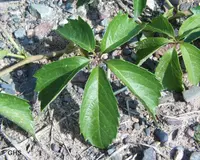
To recognize Virginia creeper, look first for palmately compound leaves with five leaflets radiating from one point, usually on long leaf stalks. The vine climbs by slender tendrils that end in small adhesive pads.

Stems are woody with age, and leaves are arranged alternately along the vine rather than in opposite pairs.

Parthenocissus quinquefolia Identification

Identify a Plant by Photo

Take or upload a photo to confirm your plant ID with Botan.

Clear images work best. Avoid photos taken too close or too far away

Use these visible traits to check for Virginia creeper.

  • Leaves are palmately compound, with 5 leaflets joined at one point.
  • Each leaflet is oval to lance-shaped, with coarse teeth along the edges.
  • Leaflets are often 2-6 inches (5-15 cm) long, with the middle one usually largest.
  • The plant climbs as a woody vine, with branching tendrils opposite the leaves.
  • Small round berries hang in clusters and ripen to dark blue-black.

Look closely at both the five-part leaves and the tendrils to confirm the match.

Parthenocissus quinquefolia shows useful visual shifts from seedling leaves to fruiting clusters.

  • Seedling: First leaves are simple or shallowly lobed, not yet divided into five leaflets, on a thin upright stem before climbing becomes obvious.
  • Young plant: Leaves become palmately compound, usually with 5 leaflets, and stems start trailing or climbing with branched tendrils that grip supports.
  • Mature plant: Older vines turn woody and heavily branched, often spreading 20 to 50 feet (6 to 15 m), with dense layered foliage covering fences or trunks.
  • Fruiting stage: Virginia creeper carries small dark blue to black berries in branched clusters, hanging beyond the leaves and making the vine easier to recognize.

In spring, Virginia creeper leafs out with reddish to bronze new growth that soon turns green. By early summer, small greenish flower clusters may be visible, followed later by blue-black berries on red stalks. Fall is the clearest seasonal clue. The five-part leaves often turn bright red before dropping, which exposes the vine’s woody stems and branching pattern through winter.

These are the main look-alikes for Virginia creeper.

Boston ivy(Parthenocissus tricuspidata)

Often confused because both are climbing vines with red fall color. Boston ivy usually has single, simple leaves with 3 shallow lobes, not 5 separate leaflets. Its leaves also attach one per node rather than as a palmately compound leaf.

Poison ivy(Toxicodendron radicans)

Confusion happens when young shoots or small leaves are seen at a distance. Poison ivy has 3 leaflets per leaf, while Virginia creeper usually has 5. Poison ivy also lacks the neat palmate leaflet arrangement typical of this vine.

Native to eastern and central North America, Parthenocissus quinquefolia occurs from southeastern Canada through the eastern and central United States and into eastern Mexico. It is most often found in woodland edges, floodplains, thickets, fencerows, and rocky slopes. Seeing it in disturbed woods or climbing trees and walls in this native range can help separate it from planted look-alikes.

  • Berries: The berries are poisonous if eaten and are a concern for humans and pets. Ingestion can cause stomach upset.
  • Sap and leaves: The sap and leaves contain calcium oxalate crystals. Skin contact can irritate some people, and chewing or swallowing plant parts can irritate the mouth and digestive tract in humans and pets.

Check Your Plant ID

Use Botan to compare a photo and confirm the plant, which helps avoid mix-ups with similar species.

FAQ

The clearest mark is its palmately compound leaf with five leaflets radiating from one point. For how to identify Virginia creeper, also check for branched tendrils with small adhesive pads that let it cling to surfaces.

More Plant Identification Guides

Identify Your Plant with Botan

Snap a photo to identify it, then see plant details, care information, and common problems for that species.

Botan app identifying a plant from a photo
10 Easy Garden Flowers to Grow

8 min read · 10 Sept 2026

10 Easy Garden Flowers to Grow

Discover 10 garden flowers that require minimal care. Learn which characteristics make plants easy to grow and follow tips on how to create a beautiful corner from beginner-friendly blooms on your property.

Beginner Guides
10 Easy Garden Flowers to Grow
How to Plant Pumpkin Seeds for a Fall Harvest and Grow Your Own Patch

7 min read · 4 Nov 2026

How to Plant Pumpkin Seeds for a Fall Harvest and Grow Your Own Patch

A backyard pumpkin patch starts months before the first leaves turn: the harvest that ends up on the porch in October is decided by what a gardener does in late spring.

Beginner Guides
How to Plant Pumpkin Seeds for a Fall Harvest and Grow Your Own Patch
Best Time to Water Grass in Summer – Lawn Watering Tips

5 min read · 21 Jul 2026

Best Time to Water Grass in Summer – Lawn Watering Tips

Summer watering is easy to get wrong. This guide explains when to turn on your sprinkler, how much liquid your grass needs each week, and how to tell if you're overwatering or underwatering.

Plant Care
Best Time to Water Grass in Summer – Lawn Watering Tips