

winter squash Identification (Cucurbita maxima)

To recognize Cucurbita maxima, look for a trailing vine with long, round, soft stems rather than sharply angled ones, and very large, broad leaves with shallow lobes and a heart-shaped base.

The flowers are large, yellow, and funnel-shaped, usually several inches wide, and the thick leaf stalks hold the leaves singly along the vine.

Cucurbita maxima Identification

Is This winter squash?

Not sure about your plant ID? Upload a photo and check it with Botan.

Clear images work best. Avoid photos taken too close or too far away

Check the vine, leaves, flowers, and fruit for a quick Cucurbita maxima ID.

  • Long, trailing vines sprawl along the ground rather than forming an upright plant.
  • Leaves are large, simple, and broadly heart-shaped to round, often 8-16 inches (20-40 cm) wide, with shallow lobes.
  • Flowers are large, open, and yellow-orange, with 5 fused petals forming a broad funnel.
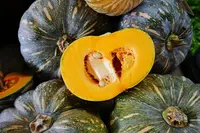
  • Fruits are usually large and rounded to flattened, with a smooth to lightly ribbed surface and a thick, corky stem.

Match several traits together, especially the broad leaves and large fruit.

Cucurbita maxima shows clear visual shifts from seedling leaves to sprawling vines and fruits.

  • Seedling: Seedlings show two large, fleshy cotyledons, then rounded first true leaves with shallow lobing and a softer surface than later foliage.
  • Young plant: Early plants form a compact crown before vining, with broader, more evidently lobed leaves and thickening, angled stems starting to trail outward.
  • Flowering stage: Long vines spread several feet (1-2 m), bearing large yellow funnel-shaped flowers; the plant looks more open as blossoms sit beyond the leaf mass.
  • Fruiting stage: After flowering, swollen ovaries enlarge into heavy, ribbed or smooth fruits on thick stalks, making the vine appear weighted and more irregularly spaced.

Several Cucurbita maxima cultivars are easy to separate by fruit shape and rind color.

  • 'Blue Hubbard': Large fruits are teardrop-shaped with a pointed neck and a blue-gray rind, unlike the rounder, orange typical form.
  • 'Turban': Fruits show a distinct cap-like swollen blossom end, creating a two-tiered turban shape rather than a simple globe.
  • 'Banana': Fruits are long and cylindrical, often 2 to 3 feet (60 to 90 cm) long, with pink to orange skin instead of squat fruits.
  • 'Buttercup': Dark green fruits are squat and nearly round, usually with a pale circular button on the blossom end.

In spring to early summer, Cucurbita maxima quickly shifts from seedlings to long, trailing vines with large, broad leaves. By summer, the plant is easier to recognize when its large yellow-orange flowers become visible along the stems. From late summer into fall, mature winter squash fruit becomes the clearest seasonal clue. As the season ends, vines decline, leaves yellow and collapse, and the plant loses its fresh green, vigorous look.

Several other squash and pumpkin species are often mistaken for Cucurbita maxima.

field pumpkin(Cucurbita pepo)

Often confused because both are sprawling vines with large lobed leaves and round to flattened fruits. A fast check is the fruit stem: C. pepo has a hard, sharply angled, ridged stem, while C. maxima has a softer, corky, rounded stem.

moschata squash(Cucurbita moschata)

Confusion is common when fruits are tan, green, or flattened. C. moschata usually has a hard, deeply ridged stem that flares wider where it meets the fruit, unlike the rounder, less angular stem of C. maxima.

Does Your Plant Match?

Use Botan to compare a photo and help confirm the plant, which can reduce mix-ups with similar-looking species.

FAQ

The fruit stem is usually the best clue. In this species it is rounded, soft, and corky rather than sharply angled. That trait is central to Cucurbita maxima identification, especially when fruits are mature.

More Plant Identification Guides

Know What Plant You Have

Identify a plant from a photo with Botan, then review plant details, care information, and common problems.

Botan app identifying a plant from a photo
Best Time to Mow Lawn – A Complete Guide

5 min read · 10 Aug 2026

Best Time to Mow Lawn – A Complete Guide

Explore when to mow your lawn for its health and a pleasant green color. Find out the best time for this task during the summer heat, and follow practical tips for correctly cutting the grass, and learn common mistakes to avoid.

Plant Care
Best Time to Mow Lawn – A Complete Guide
Frozen vs Fresh Vegetable Nutrients: Which Option Is Healthier?

6 min read · 8 Sept 2026

Frozen vs Fresh Vegetable Nutrients: Which Option Is Healthier?

Frozen and fresh vegetables are nutritionally comparable: frozen produce often retains vitamins just as well as fresh and may sometimes contain more. Here’s how blanching and storage affect nutrients—and when to choose each.

Plant Recommendations
Frozen vs Fresh Vegetable Nutrients: Which Option Is Healthier?
How to Winterize Your Garden in 6 Steps

5 min read · 28 Sept 2026

How to Winterize Your Garden in 6 Steps

Learn how to prepare your garden for winter with a practical six-step checklist covering cleanup, tender plant care, watering, mulching, winter protection, and winterizing equipment and containers.

Plant Care
How to Winterize Your Garden in 6 Steps