


cherry plum Identification (Prunus cerasifera)

Recognize cherry plum by its small tree form, often 15 to 25 feet tall (4.6 to 7.6 m), with smooth gray-brown bark and simple, alternate leaves that are oval to elliptic with finely serrated edges.

Its flowers appear singly or in pairs on short stalks, each with five rounded petals and many stamens.

Prunus cerasifera Identification

Identify Your Plant with Botan

Check your plant ID by uploading a clear photo to Botan.

Clear images work best. Avoid photos taken too close or too far away

Check the flowers, leaves, and small plum-like fruit on Prunus cerasifera.

  • Usually a small tree with a rounded crown and many slender twigs.
  • Leaves are simple, alternate, oval to elliptic, with fine toothed edges, often about 1.5-3 inches (4-8 cm) long.
  • Flowers are single or paired along the twigs, white to pale pink, with 5 petals and many stamens.
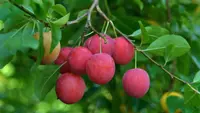
  • Fruit is smooth, round, and plum-like, about 1 inch (2.5 cm) wide, hanging singly or in pairs.

Use several traits together, since leaf and fruit color can vary.

Prunus cerasifera shows clear visual shifts from sapling structure to flowering and fruiting features.

  • Young plant: Young plants are often upright and twiggy, with smooth reddish shoots and simple alternate leaves that look relatively narrow compared with later crown growth.
  • Flowering stage: Before full leaf expansion, branches carry many single white to pale pink five-petaled flowers, each about 1 inch (2.5 cm) across, crowding short spur shoots.
  • Fruiting stage: After flowering, the same short spurs bear rounded drupes that change the silhouette by dotting branches with small plumlike fruits, unlike the bare-flower display.

Cherry plum has several named forms that are easy to separate by leaf color, flower color, or crown shape.

  • 'Nigra': Leaves emerge deep purple and usually stay dark maroon through summer; pale pink flowers open before the leaves.
  • 'Pissardii': Foliage is purple to reddish purple rather than green, and the single flowers are light pink.
  • 'Thundercloud': Leaves are a darker, more uniform purple than many purple-leaf forms, with soft pink flowers in early spring.
  • 'Krauter Vesuvius': This form keeps very dark purple leaves and often has a narrower, more upright crown than the typical broad-rounded form.

In early spring, cherry plum often flowers before the leaves open. Branches can look covered in pale pink to white blossoms, which makes the tree easy to notice from a distance. After flowering, leaves emerge and may be green, purple, or red-purple, depending on the form. Small round fruits become visible by summer, then leaves drop in fall and reveal the twiggy branching.

These trees are most often confused when flowering or carrying purple leaves.

purpleleaf plum(Prunus × blireiana)

Often mistaken for cherry plum because both are small Prunus trees with pink spring flowers and purple foliage. Prunus × blireiana is usually grown as an ornamental and rarely sets noticeable fruit; cherry plum commonly develops round plum fruits.

purpleleaf sand cherry(Prunus × cistena)

Confusion comes from the same reddish-purple leaves and pale pink spring bloom. The clearest difference is size and form: Prunus × cistena is usually a multi-stem shrub about 6 to 10 feet (1.8 to 3 m) tall, not a single-trunk small tree.

Prunus cerasifera is native from the Balkans and southeastern Europe through western and central Asia to the Caucasus. It is often found on woodland edges, thickets, hedgerows, scrub, and rocky slopes. This habitat context helps because wild or naturalized trees are more likely in open, disturbed places than in deep forest. In those settings, dense thorny growth can support the identification.

  • Seed and wilted leaf toxicity: Like other Prunus, seeds and wilted leaves contain cyanogenic compounds. The risk is from ingestion, affecting humans and pets.
  • Fruit pit hazard: The hard pit is the main concern in the fruit. Besides the compounds in the seed inside, swallowed pits can pose a choking or blockage risk, especially for dogs.

Not Sure About the ID?

Use Botan to identify or confirm it from a photo, helping avoid mix-ups before you label, buy, or plant it.

FAQ

Yes. The species bears smooth, round drupes, meaning stone fruits, about 1 inch (2.5 cm) across. They ripen yellow, red, or purple, often with a slight waxy bloom, which supports cherry plum identification.

More Plant Identification Guides

Identify the Plant and Get Its Profile

Upload a photo to identify it, then see plant details, care information, and common problems matched to the species.

Botan app identifying a plant from a photo
12 Best Plants That Repel Spiders For Your Home and Garden

8 min read · 24 Jul 2026

12 Best Plants That Repel Spiders For Your Home and Garden

Spiders constantly appear in places you don't want them. A few common plants can help repel them using scent alone. Here are 12 options suitable for both indoors and outdoors, plus care tips for each.

Plant Recommendations
12 Best Plants That Repel Spiders For Your Home and Garden
How Often to Water Fruit Trees

7 min read · 11 Aug 2026

How Often to Water Fruit Trees

Irrigation needs change as roots establish and weather shifts. This guide gives practical starting intervals, explains how soil and tree type change them, and shows how to recognize both excess moisture and drought stress.

Plant Care
How Often to Water Fruit Trees
Plants That Repel Mosquitoes – 10 Effective Choices

8 min read · 6 Jul 2026

Plants That Repel Mosquitoes – 10 Effective Choices

Plants that repel mosquitoes can help mask human scent naturally and make outdoor spaces more comfortable. Explore the most effective options, their benefits and drawbacks, and choose the right plant for your space.

Plant Recommendations
Plants That Repel Mosquitoes – 10 Effective Choices