

watermelon Identification (Citrullus lanatus)

Recognize watermelon by its trailing, rough-hairy vines, alternate leaves cut into 3 to 5 deep lobes, and coiled tendrils at the nodes where leaves attach.

Plants sprawl along the ground rather than forming an upright stem. The yellow flowers are separate male and female blooms on the same vine.

Citrullus lanatus Identification

Identify a Plant by Photo

Not sure about your plant ID? Upload a photo and check it with Botan.

Clear images work best. Avoid photos taken too close or too far away

Check the vine, leaves, flowers, and fruit for a fast Citrullus lanatus ID.

  • Trailing vine with long, slender stems that sprawl across the ground and climb weakly with branched tendrils at the nodes.
  • Leaves are alternate, rough, and deeply lobed, usually with 3-5 main lobes; blades are about 2-8 inches (5-20 cm) long.
  • Flowers are single, yellow, and 5-petaled, borne where the leaf stalk meets the stem.
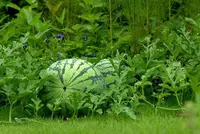
  • Fruit is a large, round to oblong pepo, often smooth-skinned with mottled or striped green patterns.

A sprawling vine with deeply lobed leaves and large striped fruit is a strong visual match.

Citrullus lanatus shows clear visual shifts from seedling to flowering and fruiting vine.

  • Seedling: Seedlings show two thick, smooth cotyledons, then early true leaves that are rounder and only shallowly lobed, unlike the deeply cut leaves later.
  • Young plant: The plant becomes a trailing vine with rough, hairy stems, coiling tendrils, and alternate leaves that are more divided into narrow lobes.
  • Flowering stage: Small yellow five-petaled flowers appear singly in leaf axils, standing out against the vine before any swelling ovary or fruit is visible.
  • Fruiting stage: Watermelon is easiest to confirm when round to oblong fruits form behind female flowers, enlarging to 6-24 inches (15-61 cm) with a thick rind.

A few watermelon cultivars are easy to tell apart by rind pattern, fruit shape, or flesh color.

  • 'Moon and Stars': Dark green fruits and leaves carry many small yellow spots plus one or more larger yellow blotches, unlike the plain or striped typical form.
  • 'Sugar Baby': Fruits are small and nearly round, usually about 8-10 inches (20-25 cm) across, with a very dark green rind that lacks strong striping.
  • 'Charleston Gray': Fruits are long and oblong with a smooth pale gray-green rind, rather than rounded with darker green striping.
  • 'Yellow Crimson': The main visible difference is bright yellow flesh instead of the usual red flesh; the rind remains striped green.

In late spring to summer, Citrullus lanatus is easiest to recognize when the sprawling vine carries yellow, five-petaled flowers above its lobed, rough-textured leaves. By summer into early fall, the most obvious seasonal clue is the developing fruit, which becomes large, round to oblong, and smooth-skinned on the ground among the vines.

A few cucurbits can be mistaken for watermelon at a glance.

citron melon(Citrullus amarus)

Often confused because both are trailing vines with deeply lobed leaves and round to oblong striped fruits. Citron melon usually has firmer, pale flesh rather than the red or pink flesh typical of ripe watermelon, and its fruit is commonly hard and less sweet.

colocynth(Citrullus colocynthis)

This species can resemble it through its low vine and similarly lobed leaves. The clearest visible differences are much smaller fruits, often only a few inches wide, and yellowish flesh; the fruit is notably not the large edible melon form most people expect.

Citrullus lanatus is native to parts of Africa and is associated with dry tropical to subtropical open ground, including sandy plains and semi-arid scrub. Wild or naturalized plants are most likely in disturbed, sun-exposed sites rather than shaded woodland or wet habitats. That setting helps with identification because a sprawling cucurbit found on dry, open ground fits Citrullus better than similar vines from forest margins or wetter places. Habitat alone is not enough, but it can narrow the field.

Confirm the Species with Botan

Upload a photo to compare key features and get help identifying the plant or confirming that your current ID is correct.

FAQ

Fruits appear after the yellow flowers are pollinated, usually in summer on outdoor plants. Early fruit is fuzzy and green, then enlarges on trailing vines with deeply lobed leaves, a useful stage for identifying watermelon.

More Plant Identification Guides

Identify First. Learn What Comes Next.

Use a photo to identify the plant, then get species-specific care information, safety notes, and common problems.

Botan app identifying a plant from a photo
What Do Plants Need to Grow – 5 Things Every Greenery Can't Live Without

8 min read · 31 Jul 2026

What Do Plants Need to Grow – 5 Things Every Greenery Can't Live Without

To keep plants healthy and thriving, provide the right balance of light, humidity, nutrients, airflow, and quality soil. This guide covers the essentials of year-round plant care.

Beginner Guides

What Do Plants Need to Grow – 5 Things Every Greenery Can't Live Without
How to Winterize Your Garden in 6 Steps

5 min read · 28 Sept 2026

How to Winterize Your Garden in 6 Steps

Learn how to prepare your garden for winter with a practical six-step checklist covering cleanup, tender plant care, watering, mulching, winter protection, and winterizing equipment and containers.

Plant Care
How to Winterize Your Garden in 6 Steps
Top 15 Fast-Growing Trees For Your Garden

13 min read · 28 Jul 2026

Top 15 Fast-Growing Trees For Your Garden

Learn which of the 15 fastest-growing trees will suit your area. We’ll share detailed information on each: growth rate, mature spread, key tree demands, and main vulnerabilities. Read on and make the best choice possible.

Plant Recommendations
Top 15 Fast-Growing Trees For Your Garden