Contain Running Rhizomes
Install a solid rhizome barrier 60–75 cm deep around the planting area and angle it slightly outward so underground stems are deflected upward and can be cut off as they hit the barrier edge.

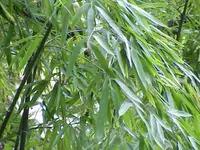
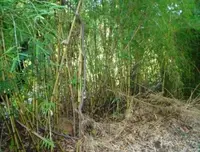
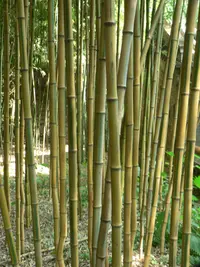
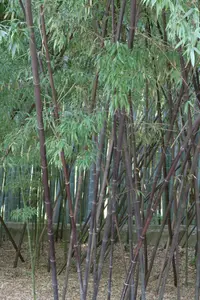
Golden bamboo, Phyllostachys aurea, is a fast-growing, evergreen bamboo commonly used for hedging, privacy screens, and ornamental groves. It forms tall, upright canes with dense, fine-textured foliage.
This species is native to China and has naturalized in many warm-temperate regions, where it can spread vigorously by underground rhizomes. Its rapid growth makes it useful where a quick visual barrier is needed, but it can become invasive without root containment.
Phyllostachys aurea is generally considered easy to grow in mild climates, provided it has enough space to spread. It prefers bright light, regular moisture, and well-drained soil, and understanding these conditions is key to how to care for golden bamboo.

Care Difficulty
Moderate Care

Light Preference
Full Sun

Water Requirements
Regular Water

Temperature Preference
Cold Hardy

Hardiness Zone
6–10

Soil Texture
Sandy, Loamy, Clay

Soil pH
Acidic (5.5–6.5), Slightly acidic (6.5–7.0)

Soil Drainage
Moist but well-drained

Fertilization
Minimal (feed rarely)
Scan your plant to receive care tips personalized for your specific plant
Available on iOS and Android
This bamboo thrives in full sun but tolerates some shade if light levels stay fairly high.
This species prefers consistently moist, well-drained soil, especially while establishing dense clumps.
This bamboo grows best in mild to warm climates with moderate seasonal variation.
This species handles a wide humidity range but grows best with moderate ambient moisture.
Phyllostachys aurea prefers moist, well-structured soil that drains freely yet retains some consistent moisture.
This bamboo can be grown in containers if the pot is large, stable, and managed to control its spreading roots.
Phyllostachys aurea responds well to moderate feeding during the active growing season.
Phyllostachys aurea benefits from selective pruning to maintain structure, density, and access paths.
Container or clump management of golden bamboo focuses on timely transplanting and root control.
Phyllostachys aurea is most reliably propagated by division of established clumps rather than by seed.
Phyllostachys aurea is generally cold hardy in much of the US and needs only modest winter care once established.

Plant Health Check
Not sure what's wrong with your plant? Check your plant's health inside the app.
Golden bamboo often develops shortened, irregular internodes near the base of older culms, creating a “kinked” or congested appearance that helps distinguish it from many other running bamboo species.
Young culms start green and can develop a warm yellow to golden coloration with sun exposure and age, especially on the side facing strong light, which is a key identification feature used in Phyllostachys aurea care.
Despite its subtropical origin in China, this species tolerates moderate frost and can survive in many temperate climates, which has contributed to its wide cultivation and, in some regions, its tendency to naturalize and spread aggressively through rhizomes.

Golden bamboo has been widely used as a living screen and sound barrier along roads, railways, and property boundaries because its dense, tall culms can form a thick hedge that intercepts wind and diffuses noise when planted in a continuous line.
This species is a running bamboo with long underground rhizomes, so it spreads vigorously and can become invasive. Use deep root barriers, regular rhizome pruning, or container planting to prevent unwanted spread and protect nearby plantings.
Keep your plants happy and healthy with plant identification, disease detection, and easy care guidance.