





annual bluegrass Identification (Poa annua)

Recognize annual bluegrass by its low, tufted clumps, soft light-green leaves with blunt, boat-shaped tips, and open, airy flower heads held above the foliage on short stems.

Plants usually stay under 12 inches (30 cm) tall, and the leaves arise in dense basal clusters rather than along a creeping stem.

Poa annua Identification

Check Your Plant with Botan

Take a photo and use Botan to confirm your plant identification.

Clear images work best. Avoid photos taken too close or too far away

Check annual bluegrass for a low, tufted grass form and pale green leaves.

  • Plants usually grow in loose clumps, often 4-12 inches (10-30 cm) tall, without thick creeping stems.
  • Leaf tips are blunt and slightly boat-shaped, a useful close-up shape clue.
  • Leaves are soft, narrow, and light green, often about 1-4 inches (2.5-10 cm) long.
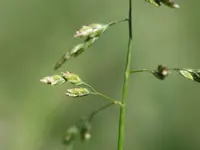
  • Flower heads are open, airy panicles with many fine branches held above the leaves.
  • Small spikelets sit along the branchlets, giving the seedhead a delicate, lightly clouded look.

Use the boat-shaped leaf tip and open seedhead together for a faster visual check.

Poa annua shows clear visual shifts from tiny tufted seedlings to open seed-bearing plants.

  • Seedling: Seedlings appear as a very small tuft of soft, bright green blades, with broad-tipped leaves and no obvious branched flowering stems.
  • Young plant: The plant forms a low, tufted clump with several folded leaves. Leaf tips stay boat-shaped, while stems remain short and mostly hidden.
  • Mature plant: Mature annual bluegrass forms dense to loose tufts about 4-12 inches (10-30 cm) tall, with slender upright stems rising above the leaf cluster.
  • Flowering stage: Open, airy panicles emerge above the leaves. The seedheads branch finely and carry many small pale green spikelets, changing the plant from tufted to feathery.

Poa annua is often easiest to spot from late winter through spring, when small, pale green seedheads rise just above the foliage and can appear even in closely mowed turf. Those open, airy flower clusters are a strong seasonal clue. In hot summer weather, many plants thin out, fade, or die back, leaving patchy gaps. In cooler fall conditions, fresh light green tufts often reappear.

A few turf grasses are often mistaken for annual bluegrass.

rough bluegrass(Poa trivialis)

Confusion happens because both are light green and tufted. Poa trivialis is usually perennial and spreads by stolons, aboveground runners. Its leaf tips are less distinctly boat-shaped than Poa annua.

Kentucky bluegrass(Poa pratensis)

Both have boat-shaped leaf tips and loose panicles. Kentucky bluegrass forms dense sod with rhizomes, underground stems, while Poa annua usually grows in small clumps and often flowers when very short.

perennial ryegrass(Lolium perenne)

Short mown plants can look similar in lawns. Perennial ryegrass has shiny leaf undersides and narrow, spike-like seedheads, not the open branched panicles of Poa annua.

Poa annua is native to Europe and temperate parts of Asia, though it is now widespread far beyond that range. Its original habitat context still helps with identification because it commonly appears in cool, disturbed places rather than intact native grassland. Look for it in lawns, paths, garden beds, field edges, pavement cracks, and moist compacted ground from lowlands into montane areas. Finding it in repeatedly disturbed urban or agricultural sites strongly supports an identification of Poa annua.

Confirm It from a Photo

Use Botan to identify or verify the plant in your photo, helping avoid mix-ups with similar-looking species.

FAQ

The clearest clue is the open, airy seedhead that appears very low to the ground, often on short plants. Leaves are soft, light green, and usually have a blunt, boat-shaped tip, which supports annual bluegrass identification.

More Plant Identification Guides

One Photo. More About Your Plant.

Identify a plant from a photo with Botan, then get species-specific care information, safety notes, and common problems.

Botan app identifying a plant from a photo
How Fast Does Bamboo Grow Per Day, Month, and Year

10 min read · 7 Jul 2026

How Fast Does Bamboo Grow Per Day, Month, and Year

Bamboo grows extremely fast: some species can reach 5-6 m in just 3-4 months under the right conditions. This guide explains how much bamboo can grow per day, week, and year, and what affects its growth rate.

Plant Recommendations

How Fast Does Bamboo Grow Per Day, Month, and Year
Best Water for Plants – How to Choose the Right Type

7 min read · 13 Aug 2026

Best Water for Plants – How to Choose the Right Type

Rainwater, filtered, distilled, and tap water affect plants differently. Learn which types support healthy growth and which cause slow damage. Match each to your plants and discover how to easily improve tap water quality.

Plant Care
Best Water for Plants – How to Choose the Right Type
How to Water Houseplants: Watering Guide

7 min read · 24 Aug 2026

How to Water Houseplants: Watering Guide

Learn how often to water indoor plants, key factors for proper watering, and how to adjust the care routine by plant type, season, pot size, light, and indoor conditions.

Plant Care
How to Water Houseplants: Watering Guide