


reed canarygrass Identification (Phalaris arundinacea)

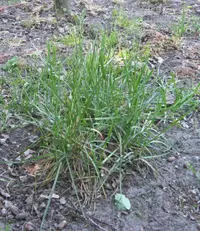
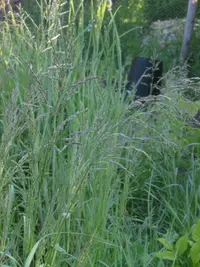
Recognize reed canarygrass by its tall, upright grass stems, flat leaf blades about 1/4 to 3/4 inch (0.6 to 2 cm) wide, and dense clumps connected by creeping rhizomes.

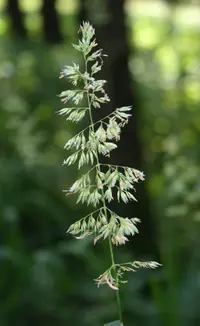
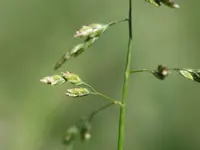
The flowering head is a compact, many-branched panicle at the stem tip, usually 3 to 8 inches (8 to 20 cm) long.

Phalaris arundinacea Identification

Check Your Plant with Botan

Not sure about your plant ID? Upload a photo and check it with Botan.

Clear images work best. Avoid photos taken too close or too far away

Check the overall form and flower head of Phalaris arundinacea first.

  • Tall, upright grass forming dense patches, often 3 to 6 feet (0.9 to 1.8 m) high.
  • Leaves are flat, long, and narrow, usually about 1/4 to 3/4 inch (0.6 to 2 cm) wide, attached alternately along the stem.
  • Stems are smooth, hollow, and jointed, with visible nodes spaced up the culm.
  • Flower heads are dense, upright panicles, narrow and somewhat tapered rather than open or feathery.

A broad, clasping leaf base and compact panicle help confirm the ID.

Reed canarygrass shows useful visual shifts from small shoots to flowering, seed-bearing stems.

  • Seedling: Begins as a few narrow, flat blades emerging in a small tuft, without the tall, jointed stems and broad clumping form seen later.
  • Young plant: Forms leafy shoots from spreading rhizomes, with upright stems and longer blades, but the stand is still open rather than a dense colony.
  • Flowering stage: Stems rise to about 3-6 feet (0.9-1.8 m) and carry narrow, upright panicles that make the plant look taller and more structured than vegetative shoots.
  • Fruiting stage: The panicles shift from tight and erect to more expanded and straw-colored, with small packed spikelets replacing the fresher flowering appearance.

Several named forms of reed canarygrass are easy to separate by leaf variegation and overall stature.

  • 'Picta': Leaves are striped green and creamy white, often with broad longitudinal bands; plants usually stand about 2-4 feet (0.6-1.2 m) tall.
  • 'Feesey': New leaves emerge pink to rosy cream, then age to green and white variegation, giving a distinctly flushed spring look unlike the typical solid green form.
  • Phalaris arundinacea f. variegata: Foliage shows narrow white to pale cream striping along the blades rather than the plain green leaves of the species.

In spring, Phalaris arundinacea sends up fresh green blades from dense clumps and spreading rhizomes, giving wet sites a noticeably grassy, upright look. By late spring into early summer, the flower heads become visible as narrow, branched panicles, often pale green to purplish at first and later straw-colored. After frost, the top growth turns tan and dies back, leaving dry stems and flattened leaves.

Several wetland grasses can be mistaken for reed canarygrass at a glance.

common reed(Phragmites australis)

Both are tall, broad-leaved grasses in dense stands. Common reed is usually much taller, often 6-12 feet (1.8-3.7 m), and its flower plume is large, feathery, and often purplish to tan. Phalaris arundinacea has a narrower, more compact panicle.

manna grass(Glyceria maxima)

This species shares wet habitats and wide, arching leaves. It differs by its drooping, open panicle with hanging branches, while Phalaris arundinacea has a firmer, more upright flower cluster. Manna grass leaves also tend to look softer and more lax.

Phalaris arundinacea is native across much of temperate Eurasia and North America. It occurs naturally in marshes, wet meadows, pond edges, streambanks, ditches, and other freshwater wetlands. Habitat is a strong identification clue. Finding it in saturated ground or shallow water, often in dense stands along lowland waterways, helps separate it from many drier-site grasses. Wetland settings are especially useful when narrowing down similar tall grasses.

Confirm the Species with Botan

Upload a photo to compare key details and get help identifying the plant or confirming your identification.

FAQ

The quickest field mark is the broad, flat blade paired with a prominent membranous ligule at the leaf base. For reed canarygrass identification, also note its tall, dense stands in wet ground and upright stems.

More Plant Identification Guides

Identify First. Learn What Comes Next.

Use a photo to identify the plant, then see species details, care information, and common problems in Botan.

Botan app identifying a plant from a photo
How Fast Does Bamboo Grow Per Day, Month, and Year

10 min read · 7 Jul 2026

How Fast Does Bamboo Grow Per Day, Month, and Year

Bamboo grows extremely fast: some species can reach 5-6 m in just 3-4 months under the right conditions. This guide explains how much bamboo can grow per day, week, and year, and what affects its growth rate.

Plant Recommendations
How Fast Does Bamboo Grow Per Day, Month, and Year
Thorny Plants: A Comprehensive Guide

10 min read · 25 Aug 2026

Thorny Plants: A Comprehensive Guide

Many plants defend themselves with sharp thorns. This guide explores over 20 examples among flowers, shrubs, trees, and vines. You'll learn what each plant looks like, why it grows thorns, and how to quickly identify them.

Plant Recommendations
Thorny Plants: A Comprehensive Guide
Is Sugar Water Good for Plants?

4 min read · 14 Sept 2026

Is Sugar Water Good for Plants?

Sugar water may sound like an easy boost, but most rooted plants do not need extra sucrose. This guide explains how green tissues produce carbohydrates, when a sweetened solution can be useful, and why too much can cause problems.

Plant Care
Is Sugar Water Good for Plants?