

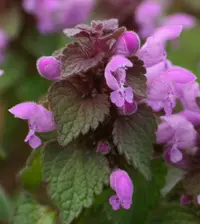


common blue violet Identification (Viola sororia)

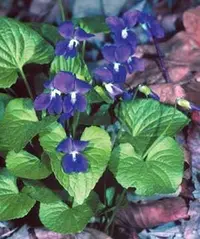
Recognize common blue violet by its basal clump of heart-shaped leaves on long stalks, with no obvious aboveground stem. Leaves and flowers rise separately from the crown, and the plant stays low, usually under 8 inches (20 cm) tall.

Flowers have five petals, with the lower three often marked by darker nectar-guide lines.

Viola sororia Identification

Check Your Plant with Botan

Check your plant ID by uploading a clear photo to Botan.

Clear images work best. Avoid photos taken too close or too far away

  • 1 free identification
  • No sign-up
  • 30,000+ plants in database

Check the leaf shape, flower form, and low clumping habit of Viola sororia.

  • Leaves rise from the base on long stalks, forming a low clump rather than leafy upright stems.
  • Leaf blades are heart-shaped to kidney-shaped, usually 2-5 inches (5-13 cm) wide, with rounded toothed edges.
  • Flowers have 5 petals and are about 3/4-1 inch (2-2.5 cm) across, usually blue-violet with a white throat.
  • The lower petal shows darker nectar guides, and a short backward spur is visible behind the flower.

Seed capsules are small, green, and three-parted when present.

Viola sororia shows clear visual shifts from small leaf rosettes to flowers and capsules.

  • Juvenile plant: Begins as a low basal rosette with few leaves. Blades are small, rounded to heart-shaped, and sit close to the ground on slender stalks.
  • Mature plant: Forms a broader clump about 4-8 inches (10-20 cm) tall. Leaves become wider and distinctly heart-shaped, with longer petioles rising from the crown.
  • Flowering stage: Leafless stalks stand above or beside the foliage, each carrying a single five-petaled violet-blue flower with a pale throat and short backward spur.
  • Fruiting stage: After flowering, upright green capsules replace the blooms. They are small, three-parted, and held above the leaves before splitting to release seeds.

Several named forms of Viola sororia are recognizable mainly by flower color or petal pattern.

  • f. albiflora: Flowers are white instead of the usual blue-violet, often with only faint purple guide lines in the throat.
  • f. priceana: Petals are white with clear violet to purple edging, giving a distinctly bicolored flower.
  • 'Freckles': White flowers are densely spotted and flecked with violet-purple across much of the petal surface.

In spring, Viola sororia is easiest to spot when low clumps of heart-shaped leaves are topped by violet, blue-violet, or white flowers. After flowering, small green seed capsules replace the blooms. In winter, the plant usually dies back, so the spring leaves and flowers are the main seasonal clues.

A few violets are regularly mistaken for Viola sororia.

downy yellow violet(Viola pubescens)

Both make low clumps of heart-shaped leaves. Viola pubescens has yellow flowers, not blue-violet, and its leaves and flower stalks are softly hairy.

marsh blue violet(Viola cucullata)

This one shares blue-purple flowers and similar leaves. It usually has narrower, more hooded leaves with a more elongated tip, while common blue violet has broader heart-shaped blades.

confederate violet(Viola × primulifolia)

This hybrid can overlap in flower color and size. Its leaves are more lance-shaped to narrowly heart-shaped, rather than the broader rounded leaves typical of V. sororia.

Native to eastern and central North America, Viola sororia occurs from southeastern Canada through much of the eastern United States and west into the central plains. It is most often found in deciduous woods, woodland edges, floodplains, stream banks, and shaded lawns. Seeing it in moist, partly shaded lowland sites helps separate it from violets more typical of dry, sandy, or strongly upland habitats.

Check Your Plant ID

Use Botan to identify or confirm it from a photo, which helps avoid mix-ups before you label, buy, or share the plant.

FAQ

The best clue is the basal rosette of heart-shaped leaves with rounded teeth and long stalks, paired with five-petaled violet flowers. For common blue violet identification, note that leaves rise directly from the crown, not along upright stems.

More Plant Identification Guides

Identify Your Plant with Botan

Identify it from a photo, then get species-specific care information, plant details, and common problems.

Botan app identifying a plant from a photo
When to Harvest Carrots: Timing, Signs, and How to Pick Them

6 min read · 23 Oct 2026

When to Harvest Carrots: Timing, Signs, and How to Pick Them

Carrots are usually ready 60-80 days after sowing them in the soil, depending on the variety. Learn how to recognize maturity signs, choose the right harvest season, pull carrots without damaging them, and store roots after picking.

Plant Care

When to Harvest Carrots: Timing, Signs, and How to Pick Them
Frozen vs Fresh Vegetable Nutrients: Which Option Is Healthier?

6 min read · 8 Sept 2026

Frozen vs Fresh Vegetable Nutrients: Which Option Is Healthier?

Frozen and fresh vegetables are nutritionally comparable: frozen produce often retains vitamins just as well as fresh and may sometimes contain more. Here’s how blanching and storage affect nutrients—and when to choose each.

Plant Recommendations
Frozen vs Fresh Vegetable Nutrients: Which Option Is Healthier?
How to Water Houseplants: Watering Guide

7 min read · 24 Aug 2026

How to Water Houseplants: Watering Guide

Learn how often to water indoor plants, key factors for proper watering, and how to adjust the care routine by plant type, season, pot size, light, and indoor conditions.

Plant Care
How to Water Houseplants: Watering Guide