
wild oat Identification (Avena fatua)

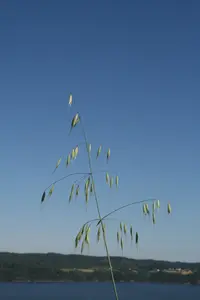
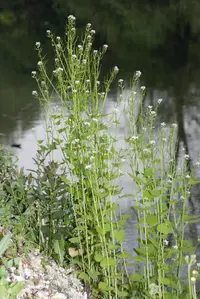
To recognize wild oat, look for an upright annual grass with narrow flat leaves and open, drooping flower heads on slender branches. Plants commonly reach 2 to 4 feet (0.6 to 1.2 m) tall.

Each dangling spikelet is relatively large and usually bears 2 to 3 florets with long, bent awns.

Avena fatua Identification

Identify a Plant by Photo

Upload a clear image to check whether your plant ID is correct.

Clear images work best. Avoid photos taken too close or too far away

  • 1 free identification
  • No sign-up
  • 30,000+ plants in database

Check the plant’s loose, nodding seed heads and grasslike form first.

  • Plants usually stand 2-4 feet (0.6-1.2 m) tall, with upright, slender stems.
  • Leaves are flat and narrow, about 4-12 inches (10-30 cm) long, and sheath the stem.
  • The flowering head is an open, airy panicle with long, spreading branches.
  • Each hanging spikelet is relatively large and carries 2-3 florets.
  • Mature grains stay enclosed in husks and often show a long, bent, twisted awn.

Use several features together, especially the drooping panicle and awned spikelets.

Avena fatua shows clear visual shifts from seedling leaves to open, drooping seed heads.

  • Seedling: The first leaves are narrow, flat, and soft-looking, arising upright from the base without a branched stem or visible flowering head.
  • Young plant: By the young stage, wild oat forms a tuft of longer linear leaves and upright culms, with the plant reaching about 1-3 feet (30-90 cm) before heading.
  • Flowering stage: The top opens into a loose, spreading panicle, with many slender branchlets carrying dangling spikelets that give the inflorescence a light, airy outline.
  • Fruiting stage: As fruits develop, the panicle stays open but looks heavier, and each spikelet shows long bent awns on maturing grains, often around 1 inch (2.5 cm) long.

In spring, wild oat appears as a fresh green grass with narrow leaves and upright stems. By late spring to early summer, loose, drooping flower clusters become obvious. As seeds mature, the heads turn straw colored and stay visible briefly before the annual plant dries down and dies.

These grasses can be mistaken for Avena fatua at a glance.

slender oat(Avena barbata)

Both are loose, nodding annual oats with dangling spikelets. Slender oat is usually smaller and often has two long awns per spikelet; wild oat typically shows a larger spikelet with one strong bent awn and a dense ring of hairs at the grain base.

sterile oat(Avena sterilis)

It shares the open panicle and drooping spikelets. Sterile oat is generally coarser, with larger spikelets and very long awns, often over 2 inches (5 cm); Avena fatua is usually less robust, with shorter awns and smaller spikelets.

Avena fatua is native across parts of Europe, North Africa, and temperate Asia. It is most often found in disturbed ground, grain fields, field margins, roadsides, and open grassland rather than intact native plant communities. That setting is useful for identification. A grass that appears as a common weed in cereal crops or other recently disturbed, sunny sites is more consistent with Avena fatua than with many less weedy wild grasses.

Not Sure About the ID?

Use Botan to identify or confirm it from a photo, which helps avoid mix-ups before you act on the result.

FAQ

The loose, nodding seed head is the clearest marker. Each floret usually carries a long, bent, twisted awn arising from the back, a key point in wild oat identification once the plant has flowered.

More Plant Identification Guides

Know Your Plant Better

Identify it from a photo with Botan, then review plant details, care information, and common problems for the matched species.

Botan app identifying a plant from a photo
20 Most Popular Fruits Around the World

7 min read · 22 Jul 2026

20 Most Popular Fruits Around the World

Curious which fruits the world actually eats the most? Here's the top-20 by production volume, an overview of what people choose in each region, and a few figures that defy common assumptions.

Plant Recommendations
20 Most Popular Fruits Around the World
Rice Water for Plants – Which Plants Love It and How to Make It

8 min read · 14 Jul 2026

Rice Water for Plants – Which Plants Love It and How to Make It

Rice water can be an ideal DIY solution for orchids, roses, or fruiting plants. It supports growth, leaf count, and height. We’ll share how to make and apply it correctly for your plant.

Plant Care
Rice Water for Plants – Which Plants Love It and How to Make It
How Often to Water Fruit Trees

7 min read · 11 Aug 2026

How Often to Water Fruit Trees

Irrigation needs change as roots establish and weather shifts. This guide gives practical starting intervals, explains how soil and tree type change them, and shows how to recognize both excess moisture and drought stress.

Plant Care
How Often to Water Fruit Trees