Self‑seeding control
Leave a few spent flower stalks to set seed if you want a groundcover, but deadhead most of the rest before seed capsules mature to keep plants from spreading aggressively into lawns and beds.

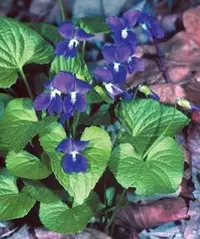
The common blue violet, Viola sororia, is a low-growing perennial wildflower often found in lawns, woodland edges, and moist meadows. It forms small clumps or loose carpets from short rhizomes, with heart-shaped leaves and violet-blue spring flowers. In many regions it behaves as a self-seeding groundcover, filling gaps in garden beds and naturalized areas. Flowers and leaves are modest in size but appear in good numbers, giving a soft, natural look. This species adapts well to partial shade, consistent moisture, and humus-rich soil, which makes it relatively simple to care for common blue violet in informal gardens.

Care Difficulty
Easy Care

Light Preference
Partial Shade

Water Requirements
Moderate Water

Temperature Preference
Cold Hardy

Hardiness Zone
3–8

Soil Texture
Loamy, Clay, Organic-rich

Soil pH
Acidic (5.5–6.5), Slightly acidic (6.5–7.0)

Soil Drainage
Moist but well-drained

Fertilization
Minimal (feed rarely)
Scan your plant to receive care tips personalized for your specific plant
Available on iOS and Android
Viola sororia thrives in cool, bright conditions with protection from intense midday sun.
Viola sororia prefers evenly moist, cool soil that never stays waterlogged.
This species is a hardy woodland violet adapted to cool to mild outdoor temperatures.
This species handles a wide humidity range but grows best with slightly moist air.
This species prefers consistently moist, loose soil that mimics a woodland edge.
This species adapts well to container growing when moisture and space are managed carefully.
Viola sororia, including the common blue violet, needs only light fertilization in typical garden soil.
Pruning Viola sororia is simple and mainly supports tidiness and healthy regrowth.
Transplanting suits Viola sororia better than frequent repotting, since it is most often grown in the ground.
Propagation of Viola sororia is straightforward through both clump division and seed.
Winter care for Viola sororia is minimal because the plant is naturally cold hardy in most temperate regions.

Plant Health Check
Not sure what's wrong with your plant? Check your plant's health inside the app.
The seeds of this species have a fleshy oil-rich appendage called an elaiosome that attracts ants, which carry the seeds away and help disperse the plant across the forest floor and lawns.
This violet is native to eastern North America and has adapted so well to mowed turf that it often becomes a dominant broadleaf plant in untreated lawns, especially in moist, partly shaded yards.
In addition to the showy spring flowers, this violet also produces small closed, self-pollinating flowers later in the season, a strategy called cleistogamy that ensures regular seed production even when insect pollinators are scarce.

In several U.S. states, including Rhode Island, Illinois, New Jersey, and Wisconsin, this species or closely related native violets have been formally adopted as the official state flower, reflecting its cultural and ecological prominence in eastern North America.
This species spreads steadily by short rhizomes and self-seeding. In lawns and loose beds it can form dense patches over several seasons. Regular edging, deadheading seed pods, or using defined borders helps keep it within desired areas.
Keep your plants happy and healthy with plant identification, disease detection, and easy care guidance.