Airflow management
Place a small fan on a low setting nearby to keep gentle air movement around the foliage and pseudobases, which helps prevent fungal spotting and bacterial rot in the dense leaf cluster.

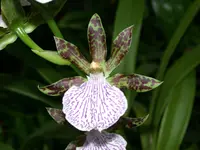
Zygopetalum maculatum is an epiphytic orchid, often found growing on trees in humid forests of South America, especially Brazil. It forms clumps of upright pseudobulbs with arching, strap-like leaves and striking, patterned flowers in shades of green, brown, and purple. The flowers are usually fragrant and last well, which makes the plant popular among orchid collectors. It is considered moderately challenging, mainly because it dislikes extremes in temperature and dryness around the roots. Those learning how to care for Zygopetalum maculatum should know it prefers bright, filtered light, steady moisture, and an airy orchid substrate rather than regular potting soil.

Care Difficulty
Moderate Care

Light Preference
Bright Indirect Light

Water Requirements
Keep Soil Moist

Temperature Preference
Warm Climate

Hardiness Zone
Unknown

Soil Texture
Loamy, Peaty, Organic-rich

Soil pH
Acidic (5.5–6.5)

Soil Drainage
Moist but well-drained

Fertilization
Moderate (every 2–4 weeks)
Scan your plant to receive care tips personalized for your specific plant
Available on iOS and Android
This orchid prefers bright, gentle light that mimics dappled forest conditions.
This species prefers evenly moist but not soggy roots throughout the active growing season.
This orchid grows best in cool to intermediate conditions with mild temperature swings.
This orchid prefers fairly moist air to maintain healthy foliage and blooms.
This epiphytic orchid needs a very airy, fast-draining mix rather than dense mineral soil.
This species is well suited to container growing for easier moisture control and inspection of roots.
Balanced feeding supports steady growth and flowering for Zygopetalum maculatum in containers.
Pruning needs for Zygopetalum maculatum are light and focus on hygiene rather than shaping.
Repotting keeps this orchid healthy by preventing sour, compacted medium and root crowding.
Propagation of Zygopetalum maculatum is typically done by division rather than from seed at home.
This orchid needs cool to intermediate indoor winter conditions, since it is not frost hardy outdoors in most regions.

Plant Health Check
Not sure what's wrong with your plant? Check your plant's health inside the app.
This species produces fragrant, thick-textured flowers with olive‑green petals heavily overlaid with irregular purple-brown spots and a broad white lip marked with purple veining, a pattern that helps guide pollinators toward the nectar source.
In nature it often grows as an epiphyte on trees or occasionally on rocks in cooler, moist forests of southeastern Brazil, experiencing distinct day–night temperature drops that influence its flowering cycle.
Its swollen pseudobulbs store water and nutrients and also reflect the plant’s past growing conditions, so shriveled or marked pseudobulbs often indicate earlier periods of stress rather than current problems in Zygopetalum maculatum care instructions.
Lack of blooms usually comes from insufficient seasonal temperature drop, too little light, or exhaustion after previous flowering. Provide bright but indirect light, cooler nights around 55–60°F in fall, and balanced fertilization during active growth to restore flowering.
Keep your plants happy and healthy with plant identification, disease detection, and easy care guidance.