peach Care (Prunus persica)

Also known as: Peaches and nectarines, Nectarine
peach

About peach

Peach, Prunus persica, is a small deciduous fruit tree grown for its sweet, juicy drupes and attractive spring blossoms. It usually forms a rounded crown with slender branches and simple, narrow leaves.

The species originates from China but is now widely cultivated in temperate regions, especially in orchards and home gardens. Many modern selections are bred for fruit quality, disease resistance, and cold tolerance, which strongly affects how easy they are to grow.

Peach trees prefer full sun, moderate moisture, and well-drained, fertile soil. Understanding local climate, chilling requirements, and basic pest management is key to successful care for peach.

Main Plant Requirements

Care Difficulty

Moderate Care

Light Preference

Full Sun

Water Requirements

Moderate Water

Temperature Preference

Cold Hardy

Hardiness Zone

5–9

Soil Texture

Sandy, Loamy, Clay

Soil pH

Acidic (5.5–6.5), Slightly acidic (6.5–7.0)

Soil Drainage

Well-drained

Fertilization

Minimal (feed rarely)

Get Personalized Care Plan

Scan your plant to receive care tips personalized for your specific plant

Available on iOS and Android

How to Care for the peach

This species needs strong, direct light to flower and fruit well.

  • Provide 6–8 hours of full sun daily, with morning sun and light afternoon shade preferred in very hot climates to limit leaf scorch.
  • Trees tolerate light partial shade (around 4–5 hours direct sun), but peach yield and sweetness drop noticeably with less exposure.
  • Avoid dense shade from buildings or large trees, and prune canopy lightly so inner branches receive enough sunlight during spring and summer growth.

Prunus persica performs best in evenly moist but never waterlogged soil.

  • Allow the top 3–5 cm of soil to dry before deep watering, ensuring moisture reaches 20–30 cm down to support the main root zone.
  • Increase watering during flowering, fruit swell, and prolonged hot, dry periods; reduce frequency in cool or rainy weather and in late autumn.
  • Watch for yellowing, soft leaves or soggy soil as signs of overwatering, and wilting, curling leaves, or small fruit drop as signs of underwatering; soil must drain freely.

This tree prefers warm growing seasons with cool winters for proper dormancy.

  • Active growth is strongest around 65–85°F (18–29°C), with fruit quality best where summers are warm but not extremely hot for long periods.
  • Mature trees usually tolerate short dips to about 10–15°F (-12 to -9°C), but young shoots and blossoms are easily damaged by late spring frosts.
  • During heat waves above 95°F (35°C), fruit and leaves can sunburn; use mulch and adequate irrigation to reduce heat stress in midsummer.

Humidity is rarely a limiting factor for peach, which adapts well to typical outdoor humidity in most temperate regions.

Prunus persica grows best in deep, well‑structured mineral soil that drains freely yet holds moderate moisture.

  • Aim for a loamy or sandy loam texture with 2–4 in of incorporated compost to improve structure and nutrient holding.
  • Maintain pH around 6.0–7.0; avoid strongly acidic or alkaline conditions that limit nutrient availability and root activity.
  • Ensure rapid drainage by avoiding compacted clay; create raised beds or mounded rows where natural drainage is poor.
  • Improve aeration by mixing in coarse sand or fine gravel, but do not exceed about 20% to prevent excessive drying.

Prunus persica can be grown in containers if dwarf or patio forms are used and moisture is managed carefully.

  • Choose a heavy, wide container to counterbalance the tree’s canopy and reduce tipping in strong winds.
  • Use a deep pot (at least 40–50 cm) so structural roots can anchor and resist rocking that damages fine roots.
  • Select a slightly porous material such as unglazed clay if overwatering is a risk, as it allows gradual moisture loss from the root zone.

Prunus persica responds well to moderate, targeted feeding during the active growing season.

  • Use a balanced granular or liquid fertilizer, such as 10-10-10, or well-rotted compost spread in a broad ring under the canopy.
  • Feed established trees every 4–6 weeks from early spring to mid-summer, then stop to allow wood to harden before winter.
  • Apply fertilizers at half to three-quarter label strength for young trees to reduce salt stress and root burn risk.
  • Water thoroughly after feeding to move nutrients into the root zone and avoid fertilizer accumulation at the soil surface.

Prunus persica benefits from structured pruning to maintain health, light penetration, and fruit quality.

  • Prune in late winter to very early spring before bud break, avoiding heavy cuts during active sap flow or hard frost periods.
  • Remove dead, diseased, and crossing branches first, then thin crowded shoots to open the canopy for light and air movement.
  • Shape the tree to an open-center or vase form, which supports strong fruiting wood and reduces branch breakage under crop weight.
  • Use sharp, clean bypass pruners and a pruning saw, making smooth cuts just outside the branch collar to promote proper healing.

Young Prunus persica plants are often moved from containers to the ground, and timing strongly affects success.

  • Transplant or up-pot in late winter to early spring while the tree is dormant and soil is workable, reducing transplant shock.
  • Look for roots circling the pot, water running off quickly, or stalled growth as signs a container-grown tree needs more space.
  • Shift to a container 5–8 cm wider, or into a prepared ground site with well-drained soil and a broad, loosened planting hole.
  • Gently tease out circling roots, set the tree at the same soil level, backfill firmly, water deeply, and keep soil evenly moist for several weeks.

Sexual and vegetative propagation of Prunus persica is possible, but maintaining fruit quality usually requires grafting skills.

  • Grow Prunus persica from seed in late fall by sowing stratified seeds in a free-draining medium kept cool and slightly moist.
  • Use semi-hardwood cuttings in mid to late summer, placed in a humid, warm environment with bottom heat for better rooting.
  • Commercially, named cultivars are grafted or budded onto compatible rootstocks in late winter or late summer to preserve traits.
  • Home seed-grown trees may show variable fruit quality, so they are best used for rootstocks or ornamental purposes.

Prunus persica is moderately cold hardy but benefits from thoughtful winter preparation, especially in colder regions.

  • Most cultivars tolerate light to moderate frost, yet flower buds are more sensitive than dormant wood to very low temperatures.
  • Apply 5–8 cm of organic mulch around the root zone, keeping it clear of the trunk, to moderate soil temperature and moisture swings.
  • For young trunks, use breathable tree wraps or guards in winter to limit sunscald and rodent damage at the base.
  • Container-grown peach trees in cold climates should be moved into an unheated but frost-sheltered space, such as a garage or shed.

Care Tips

Early fruit thinning

When fruits reach marble size, remove excess so that only 1 fruit remains every 10–15 cm along the branch to reduce limb breakage and improve fruit size and quality.


Support heavy branches

Before fruit swell in late spring, add sturdy props or tie branches to a horizontal support to prevent splitting and allow safer access for harvest.

Manage root suckers

Inspect the base of the trunk and surrounding soil several times a season and promptly cut off any root suckers at ground level to prevent weak, unproductive growth from draining energy.

Sanitation after harvest

After harvest, collect and dispose of all fallen leaves, mummified fruits, and pruned diseased wood in household trash to reduce overwintering pests and fungal spores around the tree.

Blossom frost protection

On predicted frost nights during bloom, irrigate the soil thoroughly the afternoon before and cover small trees with a breathable fabric supported by stakes to buffer temperature drops and protect flower buds.

Common Pests and Diseases

Peach leaf curl

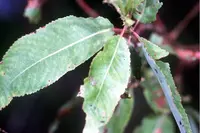
This disease causes young leaves to thicken, pucker, and turn red or yellow, often leading to early leaf drop and reduced vigor.

Solution

Remove and discard affected leaves, then apply a copper-based fungicide or other labeled fungicide as a preventative spray during late winter or very early spring before buds swell; avoid overhead watering and keep the tree well fed to support recovery.

Brown rot

This disease attacks blossoms and fruit, causing flowers to wilt and fruit to develop tan spots that enlarge into soft, brown, fuzzy rot, often mummifying on the tree.

Solution

Prune out and discard infected twigs and all mummified fruit, thin fruit so they do not touch, and apply a labeled fungicide during bloom and again as fruit ripen; maintain good airflow by pruning for an open canopy and avoiding wetting the flowers and fruit when watering.

Peach tree borer

This pest is a clearwing moth whose larvae tunnel into the lower trunk and crown, causing oozing gum mixed with sawdust at the base and gradual decline or sudden collapse of young trees.

Solution

Probe and destroy larvae in their tunnels if visible, apply trunk wraps or protective paints to reduce egg-laying, and use labeled trunk-applied insecticides or beneficial nematodes targeted to the lower trunk and soil zone in late spring to summer when larvae are active.

Peach twig borer

This pest has larvae that bore into shoot tips and fruit, leading to wilting terminal shoots (flagging) and wormy, damaged peaches.

Solution

Prune out and destroy flagged shoots and infested fruit, encourage natural predators by avoiding broad-spectrum insecticides, and use timing-based sprays such as Bacillus thuringiensis (Bt) or other labeled products at early shoot growth and pre-bloom stages guided by local extension recommendations for Prunus persica plant care.

Aphids

These insects cluster on tender shoots and leaf undersides, sucking sap and causing curled, sticky, honeydew-covered foliage that may attract ants and sooty mold.

Solution

Spray colonies off with a strong stream of water, prune heavily infested shoot tips, and use insecticidal soap or horticultural oil thoroughly on leaf undersides; control ants and encourage beneficial insects like lady beetles to keep aphid numbers low over time.

Interesting Facts

Origin in northern China

Genetic and archaeological evidence points to northern China as the domestication center of Prunus persica, with peach remains found in human sites dating back several thousand years. From there, it spread along ancient trade routes through Persia and into Europe.

Self-fertile blossom biology

Most cultivated peach trees are self-fertile, meaning a single tree can set fruit because its flowers contain both functional male and female organs. This reproductive strategy allows reliable fruiting even when pollinators or compatible trees are limited.

Fuzzy skin function

The characteristic fuzz on peach skin reduces water loss and can help protect the fruit from some insects and fungal spores. This contrasts with its smooth-skinned relative, the nectarine, which is a genetic variant of the same species with a recessive trait for lack of fuzz.

Botan icon

Did you know?

Prunus persica has one of the smallest known genomes among tree crops, which has made it a model species for genetic research in the rose family and helped scientists study traits like fruit flavor, ripening, and stress tolerance across related fruit trees.

FAQs about peach

Yellowing leaves often result from water stress, nutrient deficiency, or root problems. Check drainage, avoid waterlogged soil, and test for nitrogen or iron deficiency. Pests like aphids and spider mites can also cause gradual yellowing and leaf drop.

Grow Healthy Plants with Botan Care

Keep your plants happy and healthy with plant identification, disease detection, and easy care guidance.

Botan plant care app — identify plants on mobile

Explore More Plants

How to Care for peach (Prunus persica)