Provide sturdy staking
Install tall, rigid stakes or a peony-style support ring early in the season so the long stems can grow through them and stay upright in wind and rain.

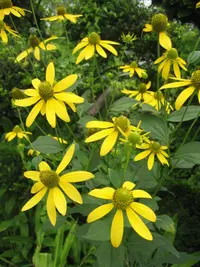
Cutleaf coneflower (Rudbeckia laciniata) is a tall, long-lived herbaceous perennial in the aster family, grown mainly for its bright summer flowers. It has deeply divided, “cut” leaves and produces drooping yellow ray petals around a raised green to brown central cone.
In the wild, it occurs in moist meadows, stream banks, and open woodlands across much of North America. It spreads by rhizomes and self-seeding, forming large clumps that can naturalize in suitable conditions.
This species is generally easy to grow, provided it has sun to light shade, evenly moist soil, and enough space. Understanding how to care for cutleaf coneflower helps keep plants vigorous and prevents them from becoming overcrowded or floppy.

Care Difficulty
Easy Care

Light Preference
Full Sun

Water Requirements
Regular Water

Temperature Preference
Cold Hardy

Hardiness Zone
3–9

Soil Texture
Loamy, Clay, Organic-rich

Soil pH
Acidic (5.5–6.5), Slightly acidic (6.5–7.0)

Soil Drainage
Moist but well-drained

Fertilization
Minimal (feed rarely)
Scan your plant to receive care tips personalized for your specific plant
Available on iOS and Android
This tall perennial prefers consistent sun exposure to flower strongly and stay sturdy.
This species prefers evenly moist, not soggy, soil, especially during active growth and flowering.
This hardy perennial tolerates a wide temperature range but grows best in moderate, temperate conditions.
Humidity is rarely a concern for Rudbeckia laciniata grown outdoors.
Rudbeckia laciniata prefers moderately moist, fertile ground with balanced texture and reliable drainage.
This species can be grown in containers, though tall growth makes management more demanding than in-ground planting.
This vigorous perennial needs only light feeding in average garden soil when growing cutleaf coneflower in home landscapes.
Pruning Rudbeckia laciniata focuses on maintaining sturdy growth and continuous flowering.
Most plants are grown in the ground, so transplanting Rudbeckia laciniata clumps is more common than repotting.
Rudbeckia laciniata is commonly propagated by division and seeds for maintaining or expanding plantings.
This species is cold hardy in most temperate climates and usually needs minimal winter care.

Plant Health Check
Not sure what's wrong with your plant? Check your plant's health inside the app.
This species can reach 6–9 ft in ideal conditions, making it one of the tallest commonly grown Rudbeckia species in North America.
Several specialist solitary bees, including species in the genus Andrena, preferentially visit its flowers, relying on its late-summer pollen as a key resource.
Unlike many garden coneflowers, it is naturally adapted to moist floodplains, stream banks, and wet meadows, tolerating periodic flooding better than most ornamental daisies.

In parts of eastern North America, this species forms extensive natural colonies through spreading rhizomes, creating near-monoculture stands that can dominate tall wetland meadow vegetation for many years.
This species spreads by both seed and underground rhizomes. In rich, moist soil it can form large colonies. Use edging, regular division, or deadheading to control spread, especially near smaller or less vigorous perennials.
Keep your plants happy and healthy with plant identification, disease detection, and easy care guidance.