


Mounting strategy
Use a hardwood slab or cork bark with a thin pad of long-fiber sphagnum only around the roots, leaving the leaf bases exposed so air can circulate and prevent rot at the crown.

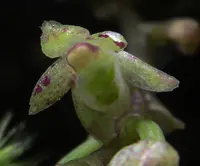
Drymoanthus adversus, commonly called the green fleshy tree orchid, is a small epiphytic orchid that grows attached to tree trunks and branches. It forms compact clumps of short, fleshy leaves and fine roots that cling tightly to bark.
This species is native to New Zealand forests, where it enjoys cool, moist, and shaded habitats. Its growth habit is relatively slow but stable when conditions are consistent.
For those learning how to care for Green Fleshy Tree Orchid, the main challenges are maintaining steady humidity, gentle air movement, and avoiding direct harsh sun. It generally adapts well in controlled indoor or greenhouse environments when mounted or grown in a very open orchid mix.

Care Difficulty
Hard Care

Light Preference
Partial Shade

Water Requirements
Regular Water

Temperature Preference
Tropical / Frost Sensitive

Hardiness Zone
Unknown

Soil Texture
Organic-rich, Peaty, Sandy

Soil pH
Acidic (5.5–6.5)

Soil Drainage
Moist but well-drained

Fertilization
Light (every 4–6 weeks)
Scan your plant to receive care tips personalized for your specific plant
Available on iOS and Android
This small epiphytic orchid prefers bright, gentle light that mimics dappled forest conditions.
This orchid prefers consistent moisture around its roots without prolonged saturation.
This species does best in mild, frost-free conditions with only moderate temperature swings.
This epiphytic orchid prefers moderate humidity but tolerates typical indoor levels if not too dry.
This species grows best mounted or in a very loose, airy orchid substrate rather than conventional potting soil.
This orchid can be grown in containers, though mounting on bark or cork is often closer to its natural habit.
This epiphytic orchid grows slowly and needs only light, targeted feeding under cultivation.
Drymoanthus adversus needs minimal pruning, mainly to keep plants healthy and tidy.
This species is usually grown mounted or in small orchid pots and dislikes frequent disturbance.
Propagation of this orchid is moderate in difficulty and is usually done vegetatively rather than from seed at home.
This orchid prefers mild, frost-free conditions and needs protection in colder climates.

Plant Health Check
Not sure what's wrong with your plant? Check your plant's health inside the app.
This species naturally grows as a small epiphyte on tree trunks and branches in cool, moist New Zealand forests, relying on host trees only for physical support, not for nutrients.
The small, greenish-white flowers are reported to release a stronger scent in the evening and at night, an adaptation linked to attracting nocturnal pollinators in its native habitat.
It is native to New Zealand and occurs in relatively specific forest habitats, so changes in forest structure and humidity can strongly affect its local populations.
This species usually performs better outdoors in mild, frost-free climates where humidity and air movement are high. Indoors, it can grow if provided bright filtered light, consistent moisture, high humidity, and very good air circulation.
Keep your plants happy and healthy with plant identification, disease detection, and easy care guidance.
