Encourage Dense Clumps
Plant several divisions 15–20 cm apart and lightly top-dress with compost every 1–2 years to help stems knit into a dense, weed-suppressing thicket.

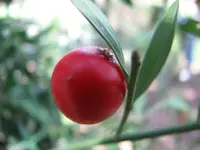
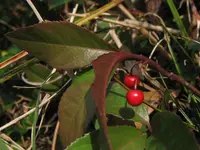
Butcher's-broom, Ruscus aculeatus, is a compact evergreen shrub with stiff, upright stems and sharp, leaf-like cladodes that give it a tough, architectural look. It often carries small greenish flowers followed by bright red berries that can persist into winter.
This species is native to shaded woodlands and scrub in southern and western Europe, thriving in dry, rocky or woodland soils. It grows slowly, forming dense clumps, and is long-lived with minimal pruning needs.
Ruscus aculeatus tolerates shade, drought, and poor soil once established, which makes it relatively easy to maintain in suitable conditions. Understanding how to care for butcher's-broom mainly involves providing stable shade and avoiding consistently waterlogged sites.

Care Difficulty
Easy Care

Light Preference
Partial Shade

Water Requirements
Moderate Water

Temperature Preference
Cold Hardy

Hardiness Zone
6–9

Soil Texture
Sandy, Loamy, Organic-rich

Soil pH
Acidic (5.5–6.5), Slightly acidic (6.5–7.0)

Soil Drainage
Moist but well-drained

Fertilization
Minimal (feed rarely)
Scan your plant to receive care tips personalized for your specific plant
Available on iOS and Android
This shade-tolerant evergreen thrives with low to moderate light rather than strong direct sun.
This species prefers evenly moist but not saturated soil and copes better with slight drought than with excess water.
This hardy shrub tolerates a wide temperature range but grows best in mild conditions.
Ruscus aculeatus tolerates a wide humidity range and usually does not need special humidity management indoors.
Ruscus aculeatus prefers loose, free-draining soil that still holds some moisture and organic matter.
This species is well suited to container growing outdoors on patios, balconies, and shaded entries.
This slow-growing evergreen shrub needs only light feeding to stay healthy in containers or poor soils.
Ruscus aculeatus needs minimal pruning, mainly to keep the clump tidy and healthy.
This shrub develops a dense, fibrous root system and prefers infrequent disturbance.
Ruscus aculeatus is most reliably propagated by division, with seed used less often and germinating slowly.
This species is generally cold hardy and usually needs little winter attention in the ground.

Plant Health Check
Not sure what's wrong with your plant? Check your plant's health inside the app.
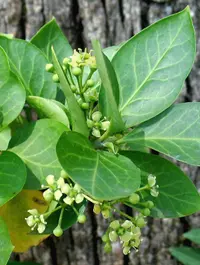
What look like thick, oval leaves are actually flattened stem structures called cladodes, while the true leaves are tiny scales at their base. This adaptation reduces water loss and allows efficient photosynthesis in the dry, shaded understory of Mediterranean woodlands.
The small whitish flowers emerge directly from the center of the cladodes, an unusual feature among flowering plants. Later, bright red berries develop from the same spot, often appearing to sit on the surface of a single, fake leaf.
The plant often carries its glossy red berries through winter when many other understory species are bare or dormant. These long-lasting fruits provide a visual food cue for birds, which disperse the seeds in shaded forest habitats.

Genetic and morphological studies have shown that this species is part of an evolutionary line of monocots that independently evolved a woody, shrub-like growth form, a trait more typical of dicot shrubs, making it a notable example of convergent evolution in plant structure.
This species spreads slowly by rhizomes and seed, usually forming small clumps rather than large colonies. In typical garden conditions it is not aggressive, but in mild, shaded sites it can gradually expand over many years.
Keep your plants happy and healthy with plant identification, disease detection, and easy care guidance.