Use wide trays
Grow this species in a wide, shallow pot or tray so creeping stems can spread horizontally, which encourages denser growth and reduces the risk of tall, floppy sections that dry out at the tips.

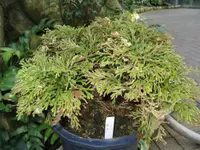
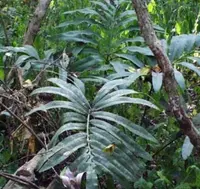
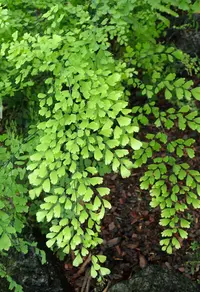
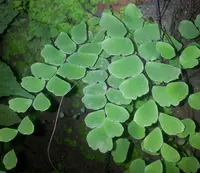
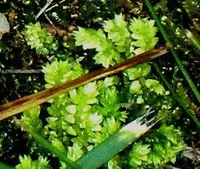
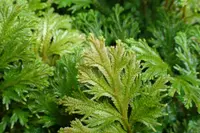
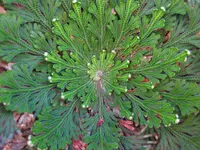
Selaginella tamariscina is a small, fern-like spikemoss, often grown as a novelty foliage plant. It forms low, dense clumps of finely divided, scale-like leaves that can curl and appear dry, then green up again when rehydrated.
This species is native to East Asia, where it grows in rocky, well-drained but seasonally moist habitats. Its ability to tolerate drying makes it more forgiving than many other Selaginella, but stable moisture and humidity still improve its appearance.
Because it dislikes waterlogged conditions yet resents prolonged drought, it can be moderately challenging for beginners. Bright, indirect light, a loose, airy substrate, and steady moisture form the basis of how to care for Selaginella tamariscina.

Care Difficulty
Hard Care

Light Preference
Partial Shade

Water Requirements
Keep Soil Moist

Temperature Preference
Cool Climate

Hardiness Zone
6–9

Soil Texture
Loamy, Peaty, Organic-rich

Soil pH
Strongly acidic (4.5–5.5), Acidic (5.5–6.5)

Soil Drainage
Moist but well-drained

Fertilization
Minimal (feed rarely)
Scan your plant to receive care tips personalized for your specific plant
Available on iOS and Android
This shade-loving spikemoss prefers soft, filtered light that mimics a forest floor.
This species needs consistently moist conditions but not stagnant, waterlogged soil.
This plant prefers cool to mildly warm, stable temperatures without extremes.
This species needs consistently high humidity to maintain healthy foliage and avoid desiccation.
This plant prefers a loose, moist, organic-rich substrate that never fully dries out.
This species is well suited to container growing, especially in shallow, moisture-retentive setups.
This species grows slowly and needs only light feeding in containers under active Selaginella tamariscina care.
Pruning Selaginella tamariscina is minimal and mainly for tidiness rather than shaping.
This plant has a fine, shallow root system that dislikes disturbance, so repot Selaginella tamariscina only when clearly needed.
New plants of Selaginella tamariscina are most often produced by division or stem cuttings.
In many regions Selaginella tamariscina is cold-tolerant outdoors and needs only modest winter attention.

Plant Health Check
Not sure what's wrong with your plant? Check your plant's health inside the app.
Selaginella tamariscina can survive almost complete drying by curling into a tight ball and dramatically reducing its metabolism, then resume normal growth within hours after rehydration, a process known as poikilohydry.
This species belongs to Selaginellaceae, a very old lineage of vascular plants that diverged early in land-plant evolution, so its reproduction with spores rather than seeds reflects a more ancient strategy than that of flowering plants.
It produces two distinct types of spores, large female megaspores and small male microspores, an advanced form of spore dimorphism (heterospory) that represents an evolutionary step toward the seed habit in later plant groups.
In East Asia, dried Selaginella tamariscina plants have been used for centuries in religious and cultural contexts as symbols of resilience and renewal, because a seemingly dead, brown cluster can open and turn green again after soaking in water.
This species adapts to both, but performs best in cool, humid, shaded outdoor spots or in controlled indoor terrariums. Stable humidity and protection from direct sun and drying air matter more than the exact location when caring for Selaginella tamariscina.
Keep your plants happy and healthy with plant identification, disease detection, and easy care guidance.