Encourage Dense Clumps
After flowering, lightly shear back spent flower stalks to stimulate compact new growth and more flowering shoots the following season.

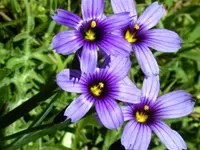
Western blue-eyed grass (Sisyrinchium bellum) is a small, clump-forming perennial often grown as a meadow or border plant. Despite its name, it belongs to the iris family, not the grasses.
It typically forms narrow, grass-like leaves and short stems topped with star-shaped blue to violet flowers with yellow centers. Plants usually appear delicate but are fairly resilient once established.
Western blue-eyed grass is native to western North America, especially California and nearby regions, where it grows in open meadows, coastal grasslands, and light woodlands. It prefers sun to light shade, modest moisture, and well-drained soil, so learning how to care for western blue-eyed grass is straightforward for most gardeners.

Care Difficulty
Easy Care

Light Preference
Full Sun

Water Requirements
Moderate Water

Temperature Preference
Cold Hardy

Hardiness Zone
4–9

Soil Texture
Sandy, Loamy, Clay

Soil pH
Slightly acidic (6.5–7.0), Neutral (7.0)

Soil Drainage
Moist but well-drained

Fertilization
Minimal (feed rarely)
Scan your plant to receive care tips personalized for your specific plant
Available on iOS and Android
This species prefers open, bright conditions similar to a sunny meadow edge.
This plant prefers evenly moist but not saturated soil, especially during active growth and flowering.
This species is adapted to mild, Mediterranean-type climates with cool, wet winters and warm, dry summers.
Humidity is not a major factor for Sisyrinchium bellum, which adapts well to typical outdoor conditions in its range.
Sisyrinchium bellum grows best in light, well-drained mineral soils that do not stay wet for long.
This species can be grown in containers if the potting setup prevents waterlogging and overheating of the roots.
This low-maintenance native needs only light feeding in typical garden soil.
Pruning needs for Sisyrinchium bellum are minimal and mainly focused on tidiness and flowering quality.
This species is more often transplanted in the garden than grown long term in containers.
Sisyrinchium bellum is commonly propagated by both division and seed.
This species is generally cold hardy in its range and needs only modest winter attention.

Plant Health Check
Not sure what's wrong with your plant? Check your plant's health inside the app.
Despite its grass-like leaves, this species is a true member of the iris family (Iridaceae), with flattened leaf fans and star-shaped flowers that reveal its iris relatives on close inspection.
Individual flowers often open a rich violet-blue in the morning and fade toward paler blue or nearly white by afternoon, a daily color shift driven by pigment breakdown under light and temperature.
In its native California range, this plant typically grows and flowers in the cool, moist months, then often goes dormant or dies back in summer drought, an adaptation to Mediterranean-type climates.

The flowers of this species usually remain open for only a single day, but the plant produces many buds over several weeks, so a healthy clump can appear to bloom continuously through much of spring.
Poor flowering often comes from plants being too shaded, overcrowded, or stressed by drought or nutrient-poor soil. Divide congested clumps, maintain moderate moisture, and provide a light spring feeding to support reliable bloom production.
Keep your plants happy and healthy with plant identification, disease detection, and easy care guidance.