Secure Site Selection
Choose a long-term, undisturbed planting site on a steep, well-drained slope or raised mound, since this monocarpic species can take decades to flower and cannot be safely transplanted once established.

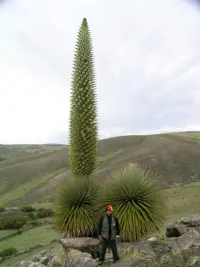
Queen of the Andes (Puya raimondii) is a giant terrestrial bromeliad, famous for producing one of the tallest flower spikes in the plant world. It forms a large, spiny rosette of stiff, grey-green leaves that can take decades to mature before flowering once and then dying.
This species is native to high-altitude slopes in the Andes of Peru and Bolivia, where it experiences intense sun, cool temperatures, and very dry, rocky soils. These extreme adaptations make it challenging to grow in typical gardens, and how to care for Queen of the Andes often involves replicating high light, excellent drainage, and low, carefully managed moisture.
Puya raimondii is best suited to experienced growers or botanical collections with space, patience, and a suitable climate.

Care Difficulty
Hard Care

Light Preference
Full Sun

Water Requirements
Low Water

Temperature Preference
Cool Climate

Hardiness Zone
8–10

Soil Texture
Sandy, Rocky, Loamy

Soil pH
Slightly acidic (6.5–7.0), Neutral (7.0)

Soil Drainage
Well-drained

Fertilization
Minimal (feed rarely)
Scan your plant to receive care tips personalized for your specific plant
Available on iOS and Android
This high-altitude bromeliad needs intense, direct sun to develop strong rosettes and eventual flowering.
This species is adapted to dry, rocky slopes and is highly sensitive to excess moisture around the roots.
This plant evolved in cold, high Andean climates and handles cool nights better than prolonged heat.
This high-Andean species prefers very dry air and does not need added humidity.
Puya raimondii needs extremely fast-draining, mineral-rich soil that dries quickly after watering.
This species is technically growable in containers when young, but it is challenging and size-limited.
Puya raimondii evolved in nutrient-poor Andean soils and usually needs little or no fertilization in cultivation.
Pruning Puya raimondii is mainly limited to hygiene and safety, not shaping the plant.
Transplanting this large terrestrial bromeliad is rare and should be done only when clearly necessary.
Propagation of Puya raimondii is technically possible but challenging and slow, mostly done from seed.
Winter care focuses on avoiding prolonged hard freezes and waterlogged soil around Puya raimondii.

Plant Health Check
Not sure what's wrong with your plant? Check your plant's health inside the app.
This species produces one of the tallest known flower stalks of any bromeliad, often exceeding 6–10 m and carrying thousands of individual flowers on a single massive inflorescence.
It is a classic example of a monocarpic plant, living for many decades at high altitude and then flowering only once before dying, with some wild individuals estimated to take around a century to reach flowering.
The species is naturally restricted to dry, rocky slopes of the central Andes in Peru and Bolivia, typically between about 3,200–4,800 m elevation, where it endures intense sunlight, strong winds, and frequent cold nights.

The enormous flowering columns of this species provide a major nectar source for high-Andean wildlife, including hummingbirds and certain bats, which travel long distances to feed on its massed flowers during the relatively brief blooming period.
Growth is very slow. Seedlings may take many years to form a noticeable rosette, and the full life cycle can span decades. Limited water, poor soil, and cool temperatures further slow development compared with other ornamental species.
Keep your plants happy and healthy with plant identification, disease detection, and easy care guidance.