Butterfly orchid Care (Anacamptis papilionacea)

Also known as: Pink-butterfly Orchid
Butterfly orchid

About Butterfly orchid

The butterfly orchid, Anacamptis papilionacea, is a terrestrial orchid from the Mediterranean region, often found in sunny meadows and light scrub. It grows from underground tubers and produces a short stem with a loose cluster of showy, pink to purple flowers that resemble small butterflies.

This species is more often grown by orchid enthusiasts than by beginners, as it has a marked seasonal rest period and dislikes constant moisture. It prefers bright light, moderate temperatures, and sharply draining, mineral-rich soil. Understanding how to care for Butterfly orchid starts with respecting its cool, moist winters and dry summer dormancy in cultivation.

Main Plant Requirements

Care Difficulty

Hard Care

Light Preference

Partial Sun

Water Requirements

Moderate Water

Temperature Preference

Warm Climate

Hardiness Zone

8–10

Soil Texture

Sandy, Loamy, Organic-rich

Soil pH

Acidic (5.5–6.5), Slightly acidic (6.5–7.0)

Soil Drainage

Well-drained

Fertilization

Minimal (feed rarely)

Get Personalized Care Plan

Scan your plant to receive care tips personalized for your specific plant

Available on iOS and Android

How to Care for the Butterfly orchid

This Mediterranean terrestrial orchid prefers bright, gentle light that mimics open scrub or light woodland edges.

  • Provide 3–5 hours of soft morning sun with light dappled or filtered light for the rest of the day, especially in spring growth.
  • Allow partial shade at midday and afternoon; strong sun in summer can scorch leaves and flower spikes of Butterfly orchid.
  • In autumn–winter growth, place where low-angle sun reaches the plant, but avoid dense shade that leads to weak, elongated leaves.

This bulb-like orchid needs a marked wet–dry cycle that follows its Mediterranean seasonal rhythm.

  • From autumn sprouting to late spring, water when the top 2–3 cm of soil are dry, then soak thoroughly and let excess drain away.
  • Use sharply draining, gritty soil so water runs through quickly; soggy conditions around the tubers indicate a high risk of rot in Anacamptis papilionacea.
  • In summer dormancy, keep soil almost dry, giving only a light splash if tubers are at risk of shriveling, and avoid any standing water.

This species is adapted to mild, Mediterranean-like climates with cool, moist winters and warm, dry summers.

  • Aim for active growth temperatures of 50–68°F (10–20°C); short cool spells down to about 41°F (5°C) are tolerated during winter growth.
  • Protect from hard frost; brief dips to 32°F (0°C) are survivable if soil is well-drained, but prolonged freezing can damage tubers and buds.
  • During summer dormancy, tolerate 75–90°F (24–32°C) as long as the soil stays dry; prolonged heat with moisture raises rot risk.

This Mediterranean terrestrial orchid prefers moderate humidity but generally adapts to typical indoor levels.

  • Aim for 40–60% relative humidity, avoiding prolonged levels above 70% that can promote fungal issues.
  • It tolerates short periods of drier air; slight leaf edge browning and wrinkling indicate humidity stress.
  • Increase humidity with a nearby open tray of water and stones or grouping plants, rather than misting Butterfly orchid foliage.

This species needs a sharply draining, airy substrate that mimics light, rocky, calcareous ground.

  • Use a mix of roughly 40% fine orchid bark, 30% coarse sand or grit, and 30% loamy compost to provide both anchorage and aeration.
  • Maintain slightly alkaline conditions around pH 7.5–8.0 by adding a small amount of crushed limestone or horticultural lime.
  • Ensure very fast drainage; water must run through freely and never leave Anacamptis papilionacea standing in a saucer of water.
  • Avoid compacted, peat-heavy, or clay-based mixes that hold water around the tubers and increase the risk of rot.

This orchid can be grown in containers if the pot setup strongly prioritizes drainage and root aeration.

  • Select a deep, narrow pot to accommodate the tubers with at least 8–10 cm of well-drained medium below them for seasonal root growth.
  • Choose unglazed terracotta to allow evaporative drying through the pot walls, reducing moisture accumulation around dormant tubers.
  • Raise the pot on feet or mesh so drainage holes remain clear and excess water cannot pool under the container after rain or watering.

Anacamptis papilionacea is adapted to low‑nutrient soils, so fertilizer use must stay light and infrequent.

  • Use a very dilute balanced NPK liquid fertilizer (around 1/4 strength) only for potted Butterfly orchid plants in active spring growth.
  • Apply no more than every 4–6 weeks during the growing season, never at every watering.
  • Avoid slow‑release granules or rich compost directly on tubers, which can cause rot.
  • Stop feeding completely in summer dormancy and over winter to mimic natural conditions.

Anacamptis papilionacea requires minimal pruning, focused on hygiene rather than shaping.

  • Best time is late summer to early autumn, once foliage has yellowed and collapsed naturally.
  • Cut spent flower stems at the base with clean, sharp scissors to reduce disease risk.
  • Remove dead or obviously diseased leaves only, leaving healthy foliage to feed the tuber.
  • Avoid cutting green leaves aggressively, as this can weaken the plant and reduce next year’s flowering.

This terrestrial orchid dislikes disturbance, so repotting or transplanting should be infrequent and carefully timed.

  • Look for crowded tubers, roots circling a pot, or declining vigor as signals to move or divide.
  • Plan any transplanting for late summer to early autumn, after foliage dies back and before new roots start.
  • Typically repot container plants only every 3–4 years, renewing the gritty, low‑nutrient mix.
  • Handle tubers gently, keep them oriented correctly, and water lightly after moving to limit root stress.

Propagation of Anacamptis papilionacea is specialized and usually left to experienced growers or conservation programs.

  • Seed propagation requires sterile laboratory conditions with a fungal partner, so it is not practical at home.
  • Division of naturally formed daughter tubers is best done in late summer dormancy, keeping each with some viable roots.
  • Replant divisions into a free‑draining, low‑nutrient medium and water sparingly until growth resumes.

This Mediterranean orchid has a winter‑growing cycle and needs cool, not deeply frozen, conditions.

  • In mild climates, leave tubers in the ground but ensure soil drains well to avoid standing water in cold weather.
  • Apply a light, dry mulch layer to buffer temperature swings without trapping excess moisture.
  • For containers in regions with hard frost below about 25°F, move pots to a cold, frost‑free shelter with good light.

Care Tips

Seasonal dormancy management

Allow foliage to yellow and die back naturally in late spring, then keep the pot cool and almost dry through summer dormancy to avoid rotting the underground tubers.

Deep, narrow container

Use a tall, narrow pot with a free-draining mineral substrate so the new tubers can develop downward without crowding, then repot only every 2–3 years to minimize disturbance.

Outdoor wintering strategy

Where winters are mild and not waterlogged, sink the pot into a gritty bed outdoors in autumn so the roots experience natural cool conditions while the container still drains freely.

Careful tuber division

Divide only well-established clumps after leaves have fully died back, gently separating firm, healthy tubers and replanting them at the same depth to reduce stress and losses.

Targeted pest inspection

Check regularly for slugs, snails, and aphids at bud and leaf bases in early spring, and apply physical barriers or spot treatments promptly to protect the emerging growth when caring for Butterfly orchid.

Common Pests and Diseases

Snails and slugs

This pest commonly feeds on young shoots, leaves, and flower spikes, especially in outdoor or garden situations. Symptoms include irregular holes, shredded leaf edges, and slime trails around the plants.

Solution

Hand-pick snails and slugs in the evening, use copper tape or physical barriers around pots, and apply iron phosphate bait placed away from direct contact with the orchid itself. Keep the area around the plant clean of decaying plant material and avoid dense groundcover that shelters these pests.

Spider mites

These insects often appear in warm, dry indoor or greenhouse conditions and can attack the thin leaves and flower stalks. Symptoms include fine webbing, tiny yellow speckles, and a dull, stippled appearance of foliage.

Solution

Increase humidity, rinse foliage gently with lukewarm water, and wipe leaves with a soft cloth to remove mites. For persistent infestations, use insecticidal soap or a horticultural oil labeled for orchids, applied carefully to both leaf surfaces while avoiding flowers as much as possible.

Aphids

This pest often gathers on new growth, buds, and flower stems, sucking plant sap and excreting sticky honeydew. Symptoms include distorted young leaves or flower spikes, sticky residue, and possible sooty mold developing on the honeydew.

Solution

Spray affected parts with a strong but controlled stream of water to dislodge insects, then treat remaining colonies with insecticidal soap or neem oil, repeating as needed. Remove heavily infested flower spikes and dispose of them away from the growing area to reduce reinfestation when caring for Butterfly orchid.

Botrytis flower blight

This disease is favored by cool, humid, and poorly ventilated conditions, especially in dense plantings or greenhouses. Symptoms include small brown or gray spotting on petals that can enlarge into blotches, sometimes with gray fuzzy mold on fading flowers.

Solution

Improve airflow, avoid wetting flowers when watering, and remove any spotted or fading blooms promptly. In repeatedly affected collections, reduce nighttime humidity and consider a preventive fungicide labeled for ornamental orchids, following all safety and application directions carefully.

Viral mosaic patterning

This disease is suspected when leaves show persistent mosaic, streaking, or irregular yellow patterns, while flowers may be deformed or show abnormal color breaks. Symptoms include slow overall growth and reduced vigor despite otherwise correct Anacamptis papilionacea plant care.

Solution

Isolate any plant showing consistent mosaic or streaking patterns and avoid using the same cutting tools between plants without disinfection. Because virus infections are not curable, dispose of strongly suspected plants and sterilize tools and pots with a suitable disinfectant before reusing them.

Interesting Facts

Mediterranean spring bloomer

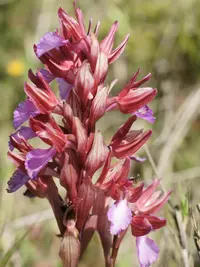
This terrestrial orchid flowers mainly from March to May across Mediterranean regions, producing dense spikes of pink to magenta flowers that stand out before many surrounding grasses reach full height.

Butterfly‑like floral lip

The large, patterned labellum (lip petal) is divided into lobes and marked with darker streaks and spots, giving each flower a butterfly‑like appearance that helps guide pollinators toward the nectar.

Variable color patterns

Populations show notable natural variation, from pale pink to deep purple flowers and from lightly to heavily marked lips, which has led botanists to describe several regional forms and subspecies.

Botan icon

Did you know?

This species often hybridizes naturally with other Anacamptis orchids where their ranges overlap, creating mixed populations with intermediate flower shapes and colors that can be challenging for botanists to identify in the field.

FAQs about Butterfly orchid

Lack of flowers often comes from insufficient winter chill, too much shade, or recent disturbance of the tubers. Avoid moving or dividing clumps frequently, and ensure a cool, relatively dry rest period after foliage dies back.

Grow Healthy Plants with Botan Care

Keep your plants happy and healthy with plant identification, disease detection, and easy care guidance.

Botan plant care app — identify plants on mobile

Explore More Plants